
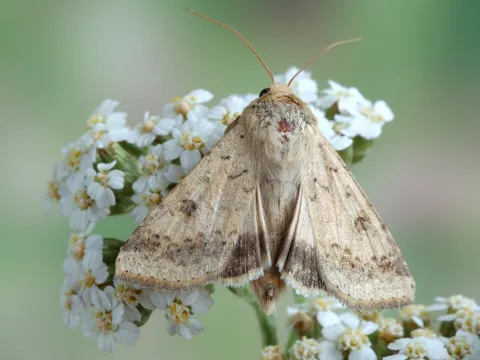
Cotton bollworm
Heliothis armigera
The cotton bollworm (Heliothis armigera) is a member of the Noctuidae family and is considered one of the most destructive agricultural pests worldwide.
What the section contains
Cotton bollworm
Adult moths are characterized by a wingspan of 30-40 mm, with colors ranging from yellowish-brown to olive-green, featuring dark patterns on their forewings.
The larvae go through five instars; their color is highly variable, ranging from light green to dark brown or black, usually with distinct longitudinal stripes.
Pupation occurs in the soil at a depth of 5-15 cm, where the insect enters a diapause state to survive unfavorable winter temperatures.
Female moths are prolific, laying hundreds of eggs singly on leaves, buds, and flowers, leading to rapid population explosions in suitable climates.
As a polyphagous species, it attacks a wide variety of crops, including cotton, maize, tomatoes, pulses, and sunflowers, causing significant economic losses.
Young larvae primarily consume leaves, but as they grow, they shift their diet to reproductive parts such as buds, flowers, and developing fruits.
By boring into fruits and pods, the larvae not only consume the produce but also create entry points for secondary bacterial and fungal pathogens.
In maize, the larvae feed on the silk and penetrate the cob, feeding directly on the developing kernels, which destroys the crop quality.
The ability of the larvae to feed internally makes them particularly difficult to control once they have bored into the host plant tissue.
Adult emergence typically begins in early spring as temperatures rise, allowing the first generation to establish on host weeds or early-planted crops.
The number of generations per year depends on the geographic location and can range from two in temperate zones to multiple in tropical regions.
Hot and humid weather conditions are ideal for the rapid development of the life cycle, often reducing the duration between generations to a month.
Late-season generations often pose the greatest threat to harvest quality, especially in slow-maturing crops that provide a consistent food source.
Monitoring seasonal patterns is essential for predicting peak flight periods and timing interventions to intercept the pest before it causes damage.
The presence of small, creamy-white, dome-shaped eggs on the upper surface of leaves or near the flowers is an early warning sign of infestation.
Accumulation of larval frass (excrement) on leaves or on the ground beneath the plants is a clear indicator of active feeding by the larvae.
Visual identification of boring holes in fruits, pods, or maize cobs confirms that the pest has successfully penetrated the plant organ.
Buds and flowers may appear withered or may drop prematurely due to the larvae feeding on the base or internal parts of the organs.
- Larvae found feeding on foliage or hiding within flowers and fruits during early morning or evening.
- Adult moths captured in pheromone-baited traps placed throughout the field.
- Skeletonized leaves caused by early-instar larvae feeding.
Integrated Pest Management (IPM) is crucial, relying heavily on pheromone traps to monitor population spikes and trigger timely spray operations.
Cultural practices, such as deep plowing after harvest, effectively expose pupae in the soil to predators and adverse weather conditions, reducing winter survival.
Biological control agents, such as parasitoid wasps and Bacillus thuringiensis, are effective if applied during the early larval stages.
Chemical control should target the vulnerable larvae before they enter the fruiting structures, using selective insecticides to minimize impact on beneficial insects.
Crop rotation and removing alternative host weeds from field margins help break the pest's life cycle and reduce the local population pressure.