
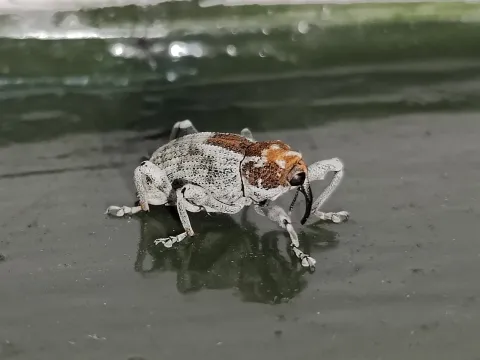
Weevil of the genus Eucryptorrhynchus
Eucryptorrhynchus
Adults of the Eucryptorrhynchus genus are weevils characterized by an elongated rostrum typical of the Curculionidae family. Their bodies are usually dark-colored, which serves as excellent camouflage against tree bark.
What the section contains
Weevil of the genus Eucryptorrhynchus
This genus belongs to the order Coleoptera and the family Curculionidae. They are known for being highly specialized insects that rely on specific woody host plants throughout their development.
The adult weevils typically measure between 8 and 15 mm in length. Their cuticle is often covered with scales or setae, forming cryptic patterns that blend in with the environment.
The larvae are apodous (legless) and have a creamy white, fleshy body with a distinct, sclerotized brown head capsule adapted for boring into woody tissue.
Identification of specific species within this genus often requires specialized taxonomic knowledge and microscopic examination of internal morphological features.
These weevils are significant pests of broad-leaved trees, particularly species within the Populus (poplar) and Salix (willow) genera. They are frequently reported as causing severe damage in plantations and urban landscapes.
The primary damage is caused by the larvae, which bore galleries into the inner bark, cambium, and sometimes deep into the heartwood, disrupting the tree's nutrient transport system.
Adult feeding on buds, young shoots, and bark leads to stunted growth, deformation, and loss of vigor, making the trees more susceptible to secondary stressors.
In addition to direct damage, their tunneling provides entry points for wood-decay fungi and other pathogens, which significantly reduces the structural integrity of the tree.
Severe infestations can lead to limb dieback, decline of the entire canopy, and eventually the death of the tree, especially in younger or drought-stressed plants.
Adult emergence typically begins in the spring, triggered by rising temperatures. During this period, the adults engage in maturation feeding on buds and twigs.
The mating and oviposition phase occurs during late spring and early summer, where females select specific bark areas to deposit their eggs.
Larval development takes place throughout the summer months, during which they tunnel continuously, creating complex gallery networks within the host tree.
Overwintering usually occurs as larvae within the woody host, although some adults may survive the winter in leaf litter or crevices in the bark near the base of the tree.
Depending on the climatic zone and the specific species, the life cycle may take one or two years to complete, impacting the frequency of outbreaks.
The most prominent sign of an infestation is the presence of small, round exit holes on the surface of the bark, indicating where adult weevils have emerged.
Frass (boring dust) accumulating at the base of the trunk or caught in bark crevices is a clear indicator of active larval feeding occurring beneath the surface.
Canopy dieback, wilting of individual branches, or yellowing leaves can often point to vascular disruption caused by tunneling larvae in the lower trunk or main branches.
Observing patches of dead or discolored bark that are slightly depressed can reveal the location of larval galleries underneath.
Early-stage infestations are often difficult to detect, but the presence of bark lesions and slow crown growth are critical indicators that warrant further inspection.
Sanitation is the most critical management strategy; removing and destroying infested wood promptly helps reduce the local population of the pest.
Maintaining high horticultural standards, such as proper watering and fertilizing, helps trees produce natural defenses and increases their tolerance to pest attacks.
Chemical control involving systemic insecticides can be applied during the adult activity window to target the pests before they lay eggs or during their supplementary feeding.
Monitoring using pheromone traps or visual inspections allows foresters and gardeners to time treatments effectively and manage the pest density proactively.
- Regular tree health inspections and monitoring.
- Removal of heavily infested and dying trees.
- Systemic insecticide treatments applied to the trunk or soil.
- Biological control through natural enemies like birds and parasitic wasps.