
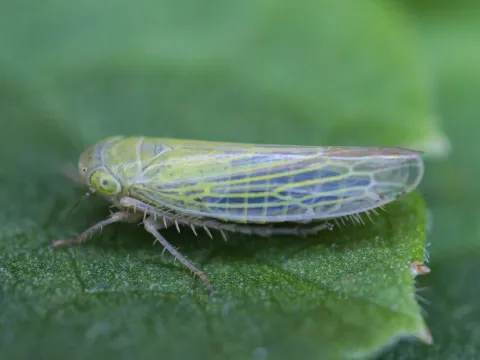
Yellow-striped leafhopper
Elymana sulphurella
The yellow-striped leafhopper (scientific name: Elymana sulphurella) belongs to the Cicadellidae family. It is a small insect characterized by its distinct yellowish-green color, which helps it blend perfectly into grass and cereal leaves.
What the section contains
Yellow-striped leafhopper
Adult insects measure approximately 4-6 mm in length. They possess a slender body and powerful hind legs, allowing them to perform rapid, jumping movements when disturbed, which is a key identifying behavior.
Nymphs are smaller versions of the adults but lack developed wings. They are highly active and remain on the host plant throughout their development stages, constantly feeding on sap.
This species is widely distributed across temperate regions of Europe and Asia. They prefer humid habitats and are commonly found in meadows, pastures, and grassy field margins.
The species exhibits high adaptability to temperature fluctuations, allowing it to survive in various environments and maintain stable populations throughout the year.
Both adults and nymphs cause damage by feeding on the cell sap of various herbaceous plants. Their primary hosts include wheat, barley, oats, and various forage grasses.
Beyond direct mechanical damage from piercing and sucking tissues, the leafhopper is a significant vector for various plant pathogens, including viruses and phytoplasmas, which are often more destructive than the feeding itself.
Infested plants typically show stunted growth, leaf yellowing, and deformation. In severe cases, the foliage may wilt and dry out prematurely due to the loss of essential plant nutrients.
Crop yields can be significantly reduced due to the combined stress of nutrient deficiency and viral disease transmission, leading to economic losses for farmers.
Field margins and areas adjacent to uncultivated land are particularly vulnerable, as these provide safe harbors for the insects before they migrate into the main crop.
Activity begins in late spring, as temperatures rise consistently above 10-12 degrees Celsius. Adults emerge from their overwintering sites to seek out fresh vegetation.
The peak period of activity occurs during the summer months, specifically June and July. During this time, the population density reaches its maximum, leading to the highest potential for crop damage.
This species can produce multiple generations per season, depending on the climatic zone. Successive generations often overlap, meaning that all life stages can be found in a field simultaneously.
As autumn approaches, adult activity gradually declines. The insects move toward the base of plants or find refuge in perennial weeds to prepare for the winter period of dormancy.
Effective management requires monitoring from early spring, as early-season infestations can significantly dictate the severity of damage later in the harvest period.
The first visual symptoms of an infestation include chlorotic spotting on leaves, which often progresses into yellowing or striped patterns. Growth retardation is also a common observation.
On closer inspection, one may find the insects themselves on the underside of leaves. When the plant is shaken or approached, the insects will jump suddenly, revealing their presence.
Plants may also show the presence of honeydew, a sticky substance secreted by the leafhoppers. This often leads to the growth of sooty mold, which impairs photosynthesis.
Viral disease symptoms, such as leaf curling, mosaic patterns, or severe stunting (often called "dwarfism"), serve as secondary indicators of leafhopper activity.
Farmers should use yellow sticky traps to detect the arrival of the pest, as this method provides a reliable early warning system for population surges.
The primary control measure is the systematic management of weeds in and around fields. Eliminating alternative hosts effectively reduces the local breeding population.
Implementing proper crop rotation and adjusting planting dates can help avoid the periods of peak leafhopper activity, thereby protecting the most vulnerable developmental stages of the crop.
Chemical control involving systemic or contact insecticides should be applied when populations exceed the economic threshold. Timing the application to the peak migration period is critical.
Border treatments, which involve spraying only the field edges, can be an effective way to minimize pesticide use while still preventing the insects from colonizing the entire crop area.
Promoting natural enemies, such as parasitic wasps and predatory bugs, is a key component of an integrated pest management (IPM) strategy to maintain long-term balance in the field.