
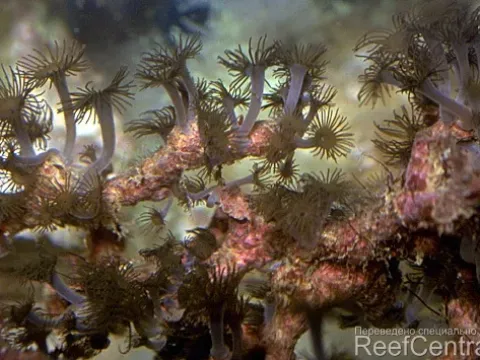
Zoanthids
Zoanthus
Zoanthids (Zoanthus) are colonial cnidarians belonging to the order Zoantharia. In marine management, they are often classified as pests due to their invasive nature and potential to overtake confined ecological systems.
What the section contains
Zoanthids
They typically appear as small, flower-like polyps connected by a mat of tissue called a stolon. This physical connectivity allows them to form dense, resilient colonies that spread rapidly across available surfaces.
While they come in a vast array of colors, from dull browns to brilliant fluorescent hues, their morphology remains consistent: a central oral disc surrounded by two rows of tentacles.
A critical biological fact is their ability to produce palytoxin, a potent biotoxin. This makes handling them a serious health hazard, requiring strictly controlled protective measures.
Systematically, they are highly adaptable organisms that occupy a middle ground between solitary polyps and reef-building corals, favoring high-nutrient environments where they outcompete other species.
The primary damage caused by zoanthids is the suppression of other desirable marine species. They physically encroach upon corals and other invertebrates, effectively smothering them.
They utilize chemical warfare by releasing toxins into the water column. This allelopathic behavior inhibits the growth and regeneration of competing corals, leading to systemic degradation.
In large-scale or industrial marine systems, zoanthid colonies can colonize vital infrastructure, including intake pipes and filtration media, which restricts water flow and lowers system efficiency.
They are detrimental to the balance of controlled marine environments. By dominating the substrate, they reduce the biodiversity and overall health of the ecosystem being managed.
Their resilience makes them difficult to eradicate once established. They thrive in neglected areas, turning small infestations into comprehensive biological invasions if not addressed promptly.
In managed marine environments, zoanthids do not have a seasonal cycle. Their activity is governed entirely by environmental variables such as light intensity, water flow, and nutrient availability.
Rapid expansion can occur at any time of the year if nitrogenous waste levels remain high. Maintaining stable water parameters is the primary method of preventing population surges.
Infestation events are most commonly linked to the introduction of new biological material. Quarantine periods are the only effective temporal barrier to preventing their entry into a clean system.
These organisms are capable of entering dormant phases under poor conditions, only to emerge and aggressively colonize when parameters improve, making them unpredictable pests.
Because they are perennial and grow continuously, they represent a constant, year-round concern for agronomists and marine biologists tasked with maintaining pure coral cultures.
The initial sign of infestation is the emergence of small, isolated polyps on previously clean surfaces. These early stages are often overlooked but lead to rapid colony formation.
Stunted growth or tissue recession in neighboring coral colonies provides clear evidence of chemical or physical encroachment by zoanthids.
The appearance of encrusting mats of tissue on rocks or equipment is a definitive sign that the colony has established a strong foothold and is beginning its invasive phase.
Changes in the behavior of surrounding organisms, such as retracting polyps or loss of color, often signify stress caused by the toxins excreted by neighboring zoanthid mats.
Visibility of connecting stolons indicates that the colony is actively exploring and claiming new territory, which is a critical signal for immediate intervention.
Mechanical removal is the most common control method, but it must be done with extreme caution. The use of safety gear is non-negotiable to prevent accidental contact with toxins.
Targeted application of concentrated hydrogen peroxide or specialized commercial remedies can kill zoanthid colonies. This must be performed precisely to ensure adjacent non-target species remain safe.
Biological controls are often ineffective or risky, as natural predators are frequently just as invasive as the zoanthids themselves, making them unsuitable for managed systems.
Rigorous quarantine and decontamination protocols for all new biological imports are the most effective prophylactic measures to keep systems free of this pest.
When an infestation becomes unmanageable, the physical removal of the infested substrate, such as a piece of live rock, is the most reliable strategy to restore system balance.