
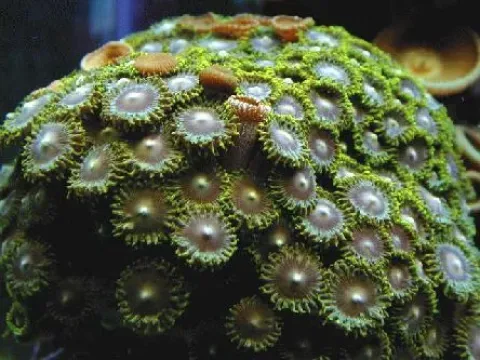
Zoanthus sociatus
Zoanthus sociatus
Zoanthus sociatus belongs to the order Zoantharia within the family Zoanthidae. These are colonial marine organisms consisting of polyps connected by a common base known as a stolon.
What the section contains
Zoanthus sociatus
Externally, they appear as dense clusters of small, cylindrical structures topped with two rows of tentacles. The coloration of the colonies ranges from gray-green to vibrant brown.
A key structural feature is the ability of these polyps to incorporate sand grains and detritus into their tissues, providing them with additional rigidity and a unique texture.
They reproduce actively via budding, forming carpet-like mats on the substrate. Under controlled environments, their growth can be extremely aggressive, making them competitors for other species.
It is crucial to remember that this species contains a highly toxic substance, palytoxin, which poses significant risks to marine life and humans if safety protocols are ignored.
Zoanthus sociatus poses a threat in marine aquaculture systems where sensitive corals and other sessile invertebrates are cultivated.
The primary damage is caused by allelopathy—a chemical interaction where the polyps release substances that inhibit the growth and health of neighboring corals.
Rapid colony expansion leads to the physical displacement of beneficial hydrobionts from the available space. They effectively smother other organisms through their mere presence.
In commercial or hobbyist marine farms, the uncontrolled propagation of this species can lead to the loss of valuable, collector-grade coral species.
Furthermore, the accumulation of palytoxin in the system necessitates special safety measures during tank maintenance, as the toxin can become airborne or dissolve into the water column.
A sign of infestation is the rapid appearance of small polyps on rocks or decorations, which quickly merge into a singular, interconnected network.
Noticeable growth retardation or tissue necrosis in neighboring corals located in close proximity to the zoanthid colony signals a toxic influence.
The appearance of cloudy patches around the colony indicates an intensive release of metabolites and defensive toxins into the surrounding environment.
Changes in aquarium lighting sometimes trigger the colony to spread even more aggressively in search of optimal conditions.
Upon physical injury to the colony, a specific "retraction" of polyps can be observed, often accompanied by the release of a slimy secretion.
Mechanical removal is the primary control method, though it requires the use of skin, eye, and respiratory protection due to the toxicity of palytoxin.
Utilizing a directed water jet or specialized scrapers allows for the separation of the colonies from the substrate, after which they must be carefully extracted from the system.
Chemical control methods are limited, as any potent substances used can be lethal to the remaining microflora of the marine tank.
Biological control involves introducing specialized species of fish or mollusks known to consume zoanthids, though their efficacy varies greatly depending on the environment.
- Use of gloves and goggles during maintenance.
- Isolation of infested rocks in quarantine tanks.
- Regular water filtration using activated carbon to neutralize toxins.