
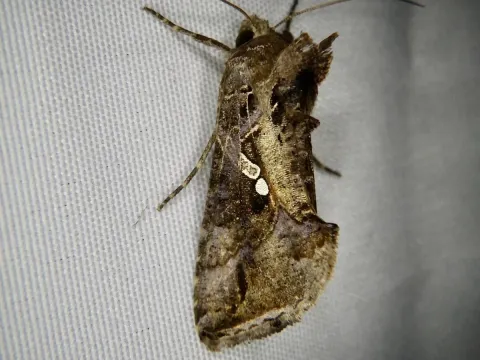
Ctenoplusia agnata
Ctenoplusia agnata
Ctenoplusia agnata belongs to the order Lepidoptera and the family Noctuidae. The adult moth has a wingspan of approximately 35–40 mm. Its forewings exhibit a grayish-brown coloration with a characteristic metallic sheen.
What the section contains
Ctenoplusia agnata
A distinctive feature of this species is the presence of a spot in the center of the forewings that resembles the Greek letter "gamma" (γ) or a metallic drop, which serves as a key identification mark.
The hindwings are generally lighter, with a grayish-brown shade and a darker band along the outer edge. This species is known for its high mobility and nocturnal activity pattern.
The larvae (caterpillars) possess a body structure typical for noctuid moths, with colors ranging from pale green to deep green, marked by longitudinal light-colored stripes along the sides.
Pupae are usually dark and are housed within loose, silken cocoons attached to the underside of leaves or hidden within the top layer of the soil during the transformation stage.
This pest is a polyphage, meaning it can feed on a wide variety of plant species. The most frequent victims of its larval activity include plants from the Solanaceae, Fabaceae, and Asteraceae families.
In agricultural settings, significant damage occurs in tomato, potato, soybean, sunflower, and various cabbage plantations. Additionally, it has been recorded feeding on weeds, which act as reservoirs.
Early-instar caterpillars feed primarily on the underside of leaves, leaving the upper epidermis intact, which results in the appearance of translucent "windows" on the foliage.
Older larvae consume the leaf tissue more aggressively, creating irregular holes. During periods of massive outbreaks, they may completely skeletonize leaves, leaving only the primary veins.
Beyond leaf consumption, if green biomass is limited, the caterpillars can attack generative organs, including buds, flowers, and young fruit, leading to substantial yield reductions.
The development cycle of Ctenoplusia agnata is closely tied to climatic conditions. The flight of the first generation of moths typically begins in late spring or early summer as temperatures rise.
Females lay eggs primarily on the underside of the leaves of host plants, either individually or in small clusters. Embryonic development, under optimal conditions, takes about 5 to 10 days.
Larval development spans approximately 3 to 4 weeks depending on the temperature. In warmer climates, the species can complete 2 to 3 generations per season, increasing its destructive potential.
Overwintering in temperate regions usually occurs at the pupal stage within the soil or plant debris, although severe frosts can significantly reduce the overwintering population.
Peak activity generally coincides with the phase of rapid vegetative growth of agricultural crops, necessitating heightened field monitoring during these critical periods.
The first sign of infestation is the emergence of characteristic "windows" on leaves, where the internal tissue is consumed while the thin outer skin remains, eventually drying and tearing.
When inspecting plants, focus on the underside of leaves, where both eggs and early-instar larvae, which often congregate in small groups, can be found.
The presence of frass (caterpillar excrement) in the form of small, dark, granular pellets on leaves or beneath the plants is a reliable indicator of an active larval population.
Damaged areas on plants often become entry points for secondary infections, such as fungal or bacterial rots, which may progress more rapidly than the physical damage caused by the larvae.
During evening and night hours, adult moths may be attracted to artificial lights, which serves as a practical monitoring technique for early detection of the pest's presence.
Effective management begins with agrotechnical practices, such as deep autumn plowing, which disturbs overwintering pupae and significantly reduces the following season's population.
Consistent weed control within and around field borders removes alternative food sources and pupation sites, thereby limiting the pest's ability to propagate.
Biological control methods, such as utilizing formulations based on Bacillus thuringiensis, are highly effective against young larvae while remaining safe for beneficial insects.
Chemical control with insecticides is recommended when economic thresholds are exceeded. It is advisable to use selective products from the organophosphate or pyrethroid classes.
- Implementing crop rotation cycles.
- Utilizing pheromone traps for population monitoring.
- Encouraging natural enemies (such as Trichogramma).
- Regular visual crop inspection.
- Timely application of targeted insecticides.