
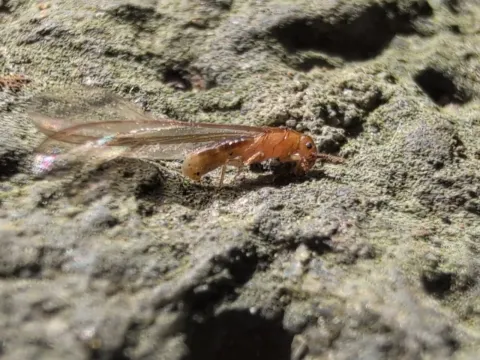
Cryptotermes piceatus
Cryptotermes piceatus
Cryptotermes piceatus is a species of drywood termite belonging to the family Kalotermitidae. Unlike subterranean termites, this species does not require access to soil moisture and lives entirely within dry wood structures.
What the section contains
Cryptotermes piceatus
The adults are characterized by their dark brown to black coloration, which helps differentiate them from other termite species. Soldiers possess a unique, highly sclerotized head designed to block the galleries and prevent intruders from entering the colony.
The life cycle begins with swarmers, known as alates, that fly out to mate and establish new colonies. Once a mate is found, they shed their wings and bore into a piece of wood to start a new lifecycle.
Colonies of Cryptotermes piceatus tend to be relatively small but can persist for many years. Their slow growth rate is one of the reasons why infestations often go undetected for a significant duration.
These termites rely on symbiotic protozoa within their hindgut to digest the cellulose found in timber, allowing them to thrive in wood that has extremely low moisture content.
The primary damage caused by this pest is the internal excavation of dry wood. This includes structural beams, flooring, door frames, furniture, and other wooden elements within a building.
Because they live inside the wood, they create a network of galleries while leaving the outer shell of the wood intact. This makes it difficult for building owners to realize the extent of the damage until it is severe.
In addition to homes, they pose a significant threat to wooden artifacts and heirloom furniture. The structural integrity of a building can be compromised if the termites destroy load-bearing wooden members.
Over time, the cumulative effect of their feeding can lead to the structural failure of wooden panels or decorative elements. The wood may eventually sag, collapse, or show signs of surface cracking.
The presence of Cryptotermes piceatus is often associated with stable, low-humidity environments, making them particularly adapted to living in finished buildings where wood is kept dry.
The most reliable sign of an infestation is the presence of frass. These are small, hard, six-sided fecal pellets that termites push out of tiny 'kick-out' holes in the wood surface.
Kick-out holes are small openings, often the size of a pinhead, that the termites clear out to dispose of their waste. These are usually found near areas where the termites are actively feeding.
Finding discarded wings on window sills or floors is a strong indicator of a recent swarming event, which implies that a mature colony is present somewhere in the immediate vicinity.
Surface blisters or depressions in wood are signs that the termites have consumed so much of the internal wood that the outer layer is starting to weaken or collapse under pressure.
If you suspect an infestation, gently tapping the wood can sometimes reveal a hollow sound, indicating that the internal structure has been replaced by termite galleries.
Prevention is key, and it involves ensuring that all lumber used in construction is pre-treated with wood preservatives. Regular monitoring for signs of frass is essential for early detection.
Local treatment options include injecting specialized insecticides directly into the galleries to target the termite colony where they live. This requires expert identification of the gallery network.
For more widespread infestations, whole-structure fumigation is the most effective solution. This process uses gas to penetrate all wood materials, ensuring total elimination of the colony.
Removing and replacing severely infested wooden members is often necessary to restore the structural safety of the affected building components.
- Regular structural inspections.
- Use of termite-resistant treated timber.
- Installing screens to block winged termites.
- Professional fumigation for large colonies.
- Sealing cracks and crevices in woodwork.