
Straw itch mite
Pyemotes dryas
Description
How to identify
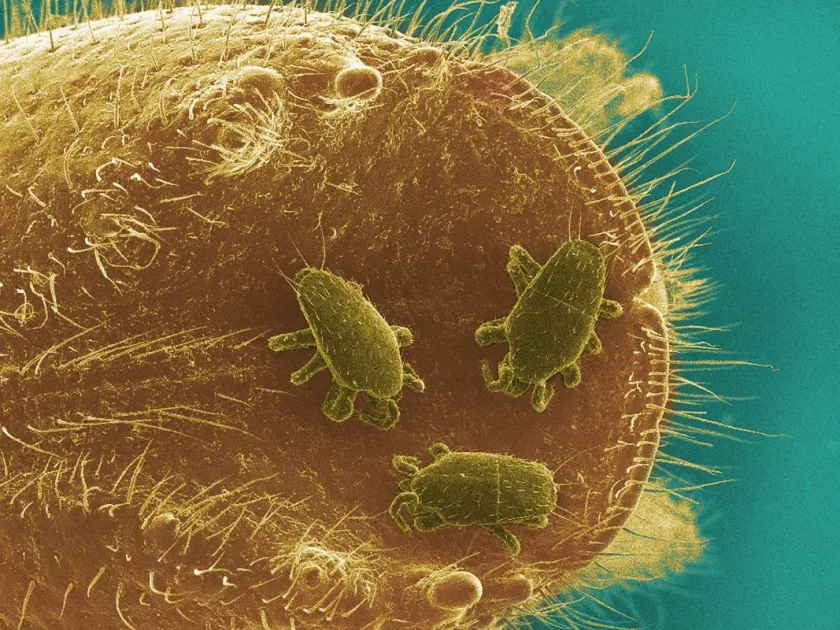
The straw itch mite (Pyemotes dryas) belongs to the Pyemotidae family within the Trombidiformes order. The adult female is distinct due to its physogastry: after mating, its abdomen swells significantly to a round, bloated shape.
Due to their microscopic size, these mites are nearly impossible to detect with the naked eye on tree bark. They exhibit viviparous reproduction, where offspring develop inside the female, allowing for rapid population growth under ideal conditions.
These mites are ectoparasites that primarily feed on the larvae of wood-boring insects. While they act as biological control agents for these pests, their presence can become a nuisance to the broader environment.
They possess a specialized, powerful mouthpart used to inject a paralytic toxin into their prey. This neurotoxic secretion is highly irritating and can trigger severe allergic dermatitis in humans who come into contact with infested wood.
The life cycle of the straw itch mite is strictly dependent on the availability of its insect hosts. When host populations are high, the mite population thrives and can migrate to exposed areas of the bark.
What it damages
This species is not a primary phytophagous pest; it does not consume plant tissues directly. However, it causes indirect damage by thriving in the galleries created by wood-boring beetles, particularly in oak forests.
The mites primarily infest the larvae of beetles that weaken trees. By interfering with the insect community, they play a complex role in the ecosystem, though they are often seen as an indicator of pre-existing pest issues.
In cases of high infestation, the mites can leave the wood tunnels and disperse onto the tree surface. This poses a significant health risk to foresters, gardeners, and anyone handling firewood or lumber from infested trees.
The economic damage is often tied to the management of affected timber and the costs associated with treating skin reactions in people who have been exposed during forestry operations.
Ultimately, the damage caused by the straw itch mite is characterized by the risks it presents to human health and its role as a parasite in already stressed woody plant populations.
Signs of infestation
The primary sign of the mite's presence is the existence of galleries and exit holes caused by wood-boring beetles, such as Cerambycidae. An infestation in an oak forest is a strong indicator of suitable host availability.
While the mites themselves are too small to see, the decline of trees or the presence of exit holes in bark can suggest a high probability of mite colonization. Laboratory analysis of bark samples is necessary for confirmation.
A major indicator for humans is the sudden appearance of itchy, red welts on the skin after being near wood piles or working in suspected areas. This reaction is often the first symptom reported by affected individuals.
Seasonal activity typically peaks in the spring and summer, coinciding with the development phases of the host beetle larvae and rising temperatures.
Dead wood, fallen branches, and timber stockpiles left in the sun serve as primary breeding sites, and their presence is a clear sign of potential risk.
Control measures
The most effective management strategy is the sanitation of infested forest areas. This involves removing and properly disposing of infested wood to disrupt the life cycle of the host insects.
Regular forest monitoring is essential to detect early stages of wood-boring beetle infestations, which prevents the secondary buildup of straw itch mite populations.
Chemical control specifically targeting the mite is generally inefficient because they are protected inside wood galleries. Efforts should be focused on controlling the primary wood-boring pests.
Personal protective equipment, such as long sleeves and gloves, is strongly recommended for those working with timber in areas where this mite is prevalent to prevent dermatological reactions.
- Conducting regular forest pathology surveys.
- Prompt removal and destruction of infested firewood.
- Minimizing storage of untreated logs near residential areas.
Taxonomy
- Latin name
- Pyemotes dryas
- Order
- Mites
- Family
- Pyemotidae
- EPPO code
- PYEMDR
Discussion
No discussions yet — be the first.