
Straw itch mite
Pyemotes herfsi
Description
How to identify
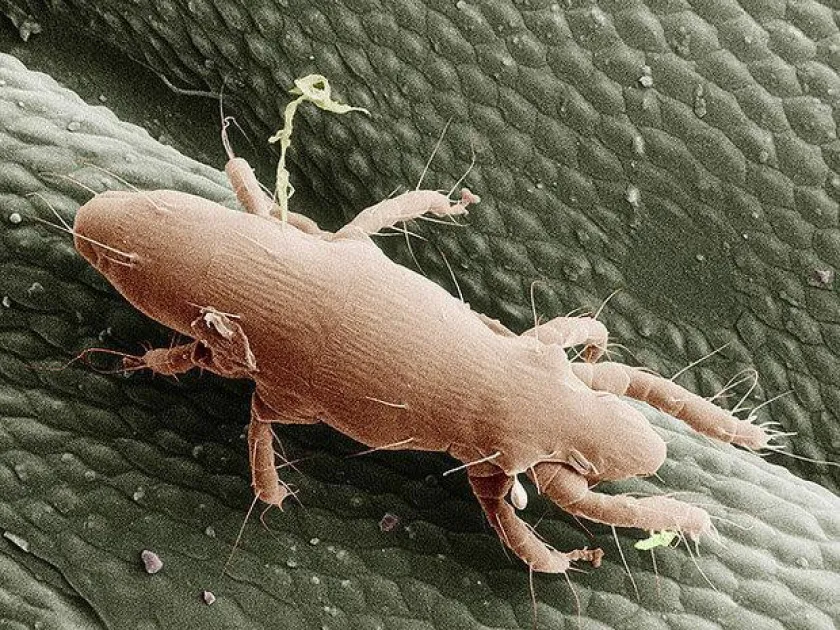
The straw itch mite (Pyemotes herfsi) belongs to the order Trombidiformes and the family Pyemotidae. It is a microscopic parasite, recognizable in the female stage by its significantly swollen abdomen filled with developing eggs.
Adult males are much smaller than females and do not feed; their primary function is to locate and mate with unfertilized females to ensure population growth.
The life cycle of this mite is exceptionally short, allowing for the rapid expansion of populations within infested grain facilities under favorable environmental conditions.
These mites are ectoparasites that attach to insect hosts, injecting a potent venom that paralyzes the prey before the mite begins feeding on the insect's hemolymph.
Besides agricultural damage, the straw itch mite poses a health risk to humans, as its bites induce intense skin irritation, rashes, and dermatitis.
What it damages
The mite primarily affects various stored grains, pulses, and oilseeds, often becoming a major pest in granaries and industrial storage facilities.
In the field, it is frequently found associated with various stored-product insects, such as grain beetles or weevils, which serve as its primary food source.
While the mite may kill other grain-infesting insects, it rapidly exceeds the damage caused by the initial pests, as its population explodes and spreads throughout the storage.
The mites contaminate grain supplies with their feces and exuviae, rendering the stored products unfit for transport or further industrial processing.
Heavily infested grain loses its market value and becomes hazardous to handle, requiring strict safety measures and often total decontamination.
When it appears
The straw itch mite thrives in indoor storage conditions where the temperature ranges from 20 to 30 degrees Celsius and humidity remains elevated.
During the warmer months, the mites can be dispersed over large distances by flying insects that serve as their carriers.
They survive the winter by hiding in wall crevices, floor cracks, and residues of grain, waiting for conditions to improve for resumed activity.
Humidity levels in grain exceeding 13-14% are critical factors that stimulate the explosive reproductive potential of this mite species throughout the year.
In unfavorable conditions, the mites enter a state of reduced metabolism but remain alive, ready to emerge as soon as the environment stabilizes.
Signs of infestation
The first sign of an infestation is often a sudden outbreak of skin rashes and intense itching among personnel handling the stored grain or hay.
Visual identification involves noticing dust-like particles on the grain surface which, under magnification, reveal active, moving populations of mites.
A sudden decline in other grain-infesting insect populations can serve as an indirect indicator that a parasitic mite infestation is underway.
Infested grain often develops a characteristic musty, unpleasant odor that signals decay and the presence of high densities of parasites.
In severe cases, a fine grayish or white film may be visible on the surface of grain bags, equipment, or walls, indicating a massive mite presence.
Control measures
Strict warehouse sanitation is the primary line of defense, including the thorough cleaning of all dust, debris, and spilled grain from previous seasons.
Maintaining low humidity in stored grain is essential, as keeping moisture content below 12% significantly hinders the mite's ability to reproduce.
Fumigation of grain stocks using approved chemicals (such as phosphine-based products) is the most effective method for killing mites deep within the grain mass.
Regular preventive treatment of empty storage structures using contact insecticides helps prevent the initial settlement of the pest at the start of the season.
- Regular monitoring of stored grain for mite presence.
- Proper ventilation to control moisture levels.
- Thorough cleaning of harvesting and transport equipment.
Taxonomy
- Latin name
- Pyemotes herfsi
- Order
- Mites
- Family
- Pyemotidae
- EPPO code
- PYEMHE
Discussion
No discussions yet — be the first.