
Zeugodacus
Zeugodacus
Description
How to identify
Zeugodacus is a genus of insects belonging to the family Tephritidae (fruit flies) within the order Diptera. The most infamous member of this group is the melon fly (Zeugodacus cucurbitae).
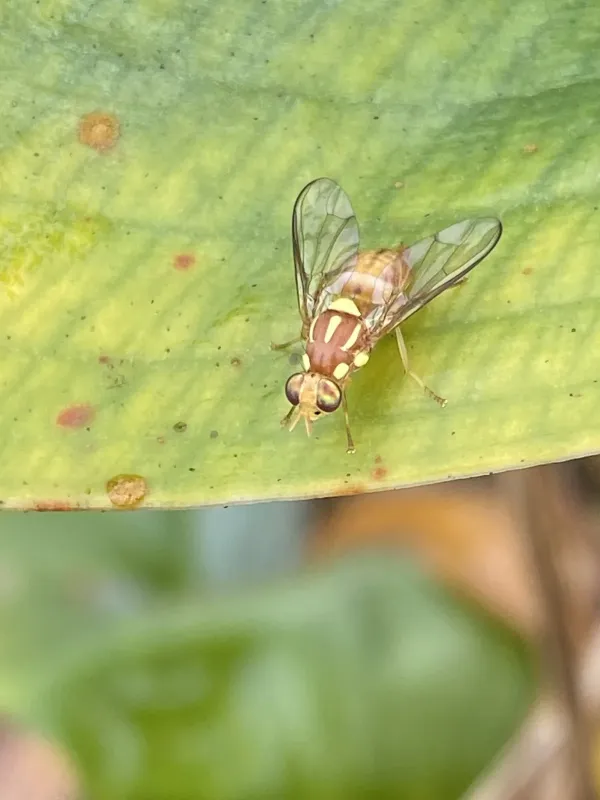
Adult flies are relatively small, often displaying a striking resemblance to wasps or bees in both color and body shape, a phenomenon known as Batesian mimicry.
Their bodies are typically marked with distinct yellow and brown bands. Their transparent wings are characterized by darkened patterns or apical spots, which are diagnostic features for identification.
The female is equipped with a sharp, elongated ovipositor, a specialized organ used to puncture the skin of fruits and insert eggs deep into the nutritious flesh.
Larvae are cream-colored, legless maggots that grow up to 10 mm in length. Their development is entirely endophytic, meaning they live exclusively within the tissues of the host fruit.
What it damages
These flies are highly polyphagous pests, demonstrating a strong preference for Cucurbitaceae species, including cucumbers, melons, pumpkins, squashes, and bitter gourds.
Beyond cucurbits, they have been observed attacking tomatoes, eggplants, beans, and occasionally various stone fruits, making them a major threat to agricultural stability.
The primary damage is caused by larvae feeding inside the fruit. As they tunnel through the pulp, they destroy the internal structure and trigger rapid tissue degradation.
Feeding larvae facilitate secondary infections by bacteria and fungi, causing the fruit to rot prematurely, deform, and become completely unmarketable.
In uncontrolled environments, infestation levels can reach total crop loss, as the internal development protects the larvae from most external environmental stressors and chemical sprays.
When it appears
The life cycle of Zeugodacus is heavily influenced by ambient temperature and humidity levels, with warm, tropical conditions accelerating their life processes significantly.
In favorable climates, the pest can complete its entire life cycle in as little as 3–4 weeks, allowing for multiple overlapping generations within a single growing season.
Overwintering strategies vary; in colder regions, the pupal stage often remains dormant in the soil, while in milder areas, adults may survive in protected microhabitats.
Activity typically spikes during the flowering and fruit-setting phases of host plants, as females actively seek fresh, soft tissues for oviposition.
The population density usually peaks in mid-summer, as the combination of abundant host availability and optimal heat creates a perfect breeding ground for rapid multiplication.
Signs of infestation
The earliest symptom of an infestation is the appearance of small, pin-prick punctures on the surface of young fruits, sometimes accompanied by clear fluid exudation.
Over time, these puncture sites may darken as the tissue surrounding them begins to bruise or necrotize due to the localized mechanical damage.
The fruit may develop noticeable lumps, bumps, or irregular deformities while still growing, which is a classic indicator that maggots are present inside the tissue.
Internally, the flesh begins to liquefy and emit a foul odor, symptomatic of advanced decay caused by larval tunneling and secondary bacterial contamination.
In infested plots, one may observe mature larvae emerging from the fruit to drop into the soil for pupation, or find empty pupal cases in the earth beneath the canopy.
Control measures
Management strategies rely heavily on male annihilation techniques using pheromone-laced traps, which effectively reduce the fertilization rate of the female population.
Strict sanitation practices are crucial; all infested, dropped, or rotten fruit must be collected daily and destroyed via burning or deep burial to kill developing larvae.
Chemical control involving systemic insecticides may be applied, though it is most effective when used as part of a targeted monitoring program before heavy oviposition occurs.
Physical protection, such as bagging individual fruits with fabric or paper sleeves immediately after pollination, provides a 100% effective barrier against egg-laying adults.
- Utilizing biological control agents, such as parasitoid wasps (e.g., Fopius arisanus).
- Implementing crop rotation to disrupt the host cycle.
- Regular monitoring with attractant-baited traps to gauge population density.
Taxonomy
- Latin name
- Zeugodacus
- Order
- Diptera (flies)
- Family
- Tephritidae
- EPPO code
- ZEUDSP
Discussion
No discussions yet — be the first.