

Pest · Coleoptera (beetles) · affects Winter wheat, Fodder beet, Winter barley
Especially harmful
Austrian beetle
Anisoplia austriaca
Description
How to identify
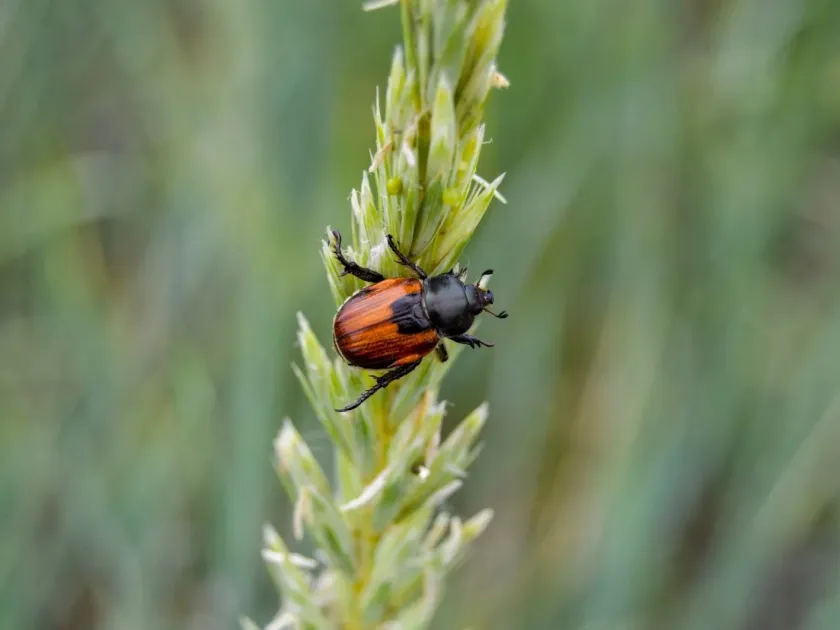
The Austrian beetle (Anisoplia austriaca) is a member of the Scarabaeidae family, known for causing significant damage to cereal crops across many agricultural regions.
Adult beetles are approximately 12–16 mm long, featuring metallic-green or dark elytra with distinct dark markings that help identify the species.
The larvae, commonly known as white grubs, have a C-shaped body, a brownish head, and three pairs of legs, living underground and feeding on plant roots.
These insects are highly active during warm sunny days, when they aggregate on cereal spikes to feed on the developing grain.
Morphologically, they are robust beetles with strong mandibles designed to crush and consume the soft grain of wheat, barley, and other grasses.
What it damages
Adult beetles primarily damage cereal crops such as wheat, barley, and rye by feeding on the grain during the milk and dough stages, leading to severe yield loss.
The larvae develop in the soil for two years, causing extensive damage to the root systems of a wide range of crops, including fodder beet and soybean.
Other economically important crops susceptible to larval feeding include rapeseed, cabbage, watermelons, melons, and flax, which may suffer from root destruction.
The damage caused by larvae is particularly dangerous as it often goes unnoticed until the plants begin to yellow or die due to water and nutrient deficiency.
During heavy infestations, the combined impact of adult feeding on grain and larval feeding on roots can lead to catastrophic losses in total harvest output.
When it appears
The beetle follows a two-year life cycle, which dictates the long-term planning of crop rotation to mitigate the population density in affected fields.
Larvae remain in the soil throughout their development, surviving two winters and becoming increasingly destructive as they grow larger in their second year.
Adults emerge from the soil in June, coinciding with the flowering and grain-filling period of cereal crops, which is the peak time for damage.
The mass flight of adults typically lasts about a month, during which they feed, mate, and lay their eggs in loose, cultivated, or weed-covered soil.
By the end of summer, the eggs hatch into young larvae, which immediately begin feeding on organic matter and small roots before retreating deeper for winter.
Signs of infestation
The most visible sign of infestation in grain fields is the presence of empty or partially eaten spikes, often referred to as "white heads" in the crop.
Large numbers of beetles can be observed directly on the stems of wheat or barley during the day, particularly during calm and sunny weather conditions.
If larval infestation is present, crop patches may show signs of stunting, wilting, or yellowing, and the plants can be pulled out of the soil very easily.
- Empty or damaged spikes in wheat and barley fields.
- Visible presence of beetles on crop ears during the summer months.
- Wilting and stunted growth of root crops like beets or flax.
Field surveys involving soil sampling are essential to detect the presence of larvae before planting sensitive crops in the following season.
Control measures
Deep autumn plowing is the most effective cultural method to expose larvae and pupae to mechanical damage and natural predators, significantly reducing their numbers.
Strategic crop rotation is crucial, avoiding the planting of cereals in fields with high larvae populations identified during the previous season.
Chemical control involving systemic or contact insecticides is recommended during the peak flight of adults to prevent damage to the developing ears of grain.
Seed treatment with insecticidal products can provide essential protection against soil-dwelling larvae, safeguarding the crop during its early development stage.
Integrated pest management, combining monitoring with localized applications, ensures that chemical use is minimized while protecting the yield effectively.
In brief
20
Damages crops
Content graph
Damages crops · 20
Content graph
Connections · Austrian beetle
Most often together:
Marketplace
Products · 20


Karatel Es
Nanjing No.1 Pesticide Factory of Red Sun Group Co., Ltd.
Insecticides
0
0
·
2.6K
3 offers
4.98 €per 1 l
Buy


Ruby
Sharda Worldwide Exports Pvt Ltd, Sharda World
Insecticides
0
1
·
2.1K
2 offers
10.6 €per 1 l
Buy

Puska
Три Дельта Компані Інтернешнл, Гонконг, Китай.
Insecticides
1
0
·
1.9K
1 offer
7.73 €per 1 l
Buy


Graphis
Три Дельта Компані Інтернешнл, Гонконг, Китай.
Insecticides
0
3
·
756
3 offers
26.5 €per 1 l
Buy

Raut
Три Дельта Компані Інтернешнл, Гонконг, Китай.
Insecticides
0
0
·
753
2 offers
0.89 €per 1 l
Buy


Credo
Три Дельта Компані Інтернешнл, Гонконг, Китай.
Insecticides
0
0
·
620
1 offer
57.42 €per 1 l
Buy

Biology
Taxonomy
- Latin name
- Anisoplia austriaca
- Order
- Coleoptera (beetles)
- Family
- Scarabaeidae
- EPPO code
- ANISAU
Community
Discussion
No discussions yet — be the first.