
Xanthaciura insecta
Xanthaciura insecta
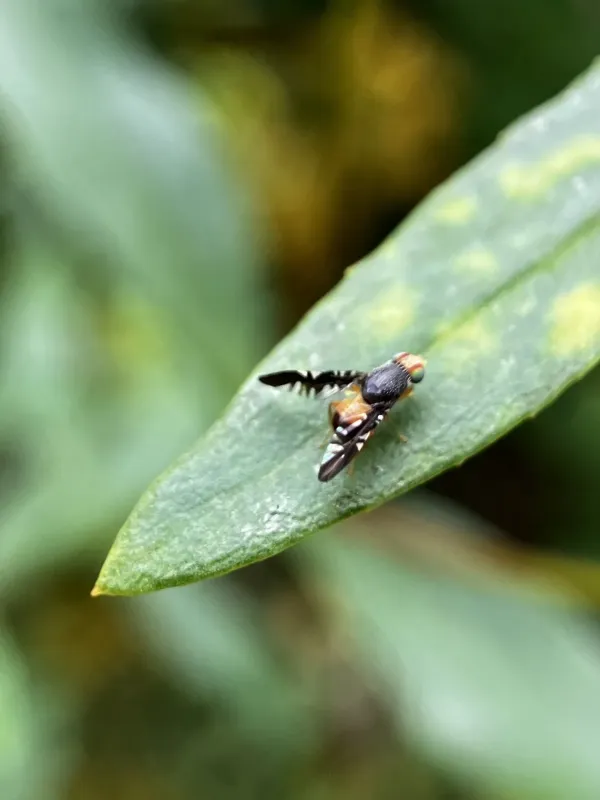
Description
How to identify
Xanthaciura insecta is a species belonging to the Tephritidae family, commonly known as fruit flies. These insects are characterized by their intricate wing patterns and small body size.
The adult fly typically exhibits a yellowish-brown coloration. Its wing venation is complex, creating distinctive markings that allow for species-level differentiation.
The larvae are cylindrical, legless maggots, often creamy-white in color, specifically adapted for development within the tissues of their host plants.
The lifecycle follows a complete metamorphosis: egg, larva, pupa, and adult. Development speed depends heavily on ambient temperature and host plant quality.
Identification in the field is facilitated by yellow sticky traps, which attract adults, or by visual inspection of flower buds for puncture marks.
What it damages
This pest primarily attacks plants within the Asteraceae family. It is a significant concern for various ornamental and wild flowering species.
The larvae feed on the internal reproductive organs of the flower heads. This feeding activity leads to the destruction of floral tissues and developing seeds.
Damage often manifests as stunted growth of the flower head, browning of petals, and premature decay of the bud due to secondary bacterial or fungal infections.
In high densities, the pest can severely impact both the aesthetic value of ornamental plants and the seed yield of host crops.
The presence of larvae inside the flower head effectively renders the plant unmarketable, causing direct economic losses for growers.
Signs of infestation
The earliest signs of infestation include small, subtle puncture marks on the bracts or closed buds, where the female has deposited eggs.
Visible deformation of the flower head is a hallmark of infestation. Flowers may fail to open properly or display asymmetrical development.
Upon opening a damaged flower, one may observe larvae amidst the floral parts, often accompanied by dark frass (excrement).
Premature wilting or localized necrosis within the center of the flower head indicates feeding activity by the larval stages.
The active presence of small flies fluttering near potential host plants on sunny days is a reliable indicator for farmers to begin monitoring.
Control measures
Cultural control practices, such as the prompt removal and destruction of infested flower heads, are essential to break the pest's reproductive cycle.
The deployment of yellow sticky traps helps in monitoring adult population density and provides a method for trapping the flies.
Chemical control involving systemic insecticides is effective when applied during the peak flight of adults to prevent them from laying eggs.
Biological control methods, such as the use of parasitoid wasps that target larvae, are being explored as sustainable alternatives in integrated pest management.
Maintaining weed-free borders around fields prevents the buildup of populations on wild Asteraceae hosts, limiting the spread to commercial crops.
Taxonomy
- Latin name
- Xanthaciura insecta
- Order
- Diptera (flies)
- Family
- Tephritidae
- EPPO code
- XANRIN
Discussion
No discussions yet — be the first.