
Amorpha moth
Walshia amorphella
Description
How to identify
The Amorpha moth (scientific name Walshia amorphella) belongs to the Cosmopterigidae family. This insect is primarily recognized for its unique association with the false indigo-bush (Amorpha fruticosa).
Adult moths are small, nocturnal creatures. They are rarely seen during the day, as their coloration allows them to blend in perfectly with the bark of their host shrubs.
The larvae, or caterpillars, are the damaging stage. They possess a pale, elongated body and strong mandibles designed for boring into woody tissues, creating characteristic living structures.
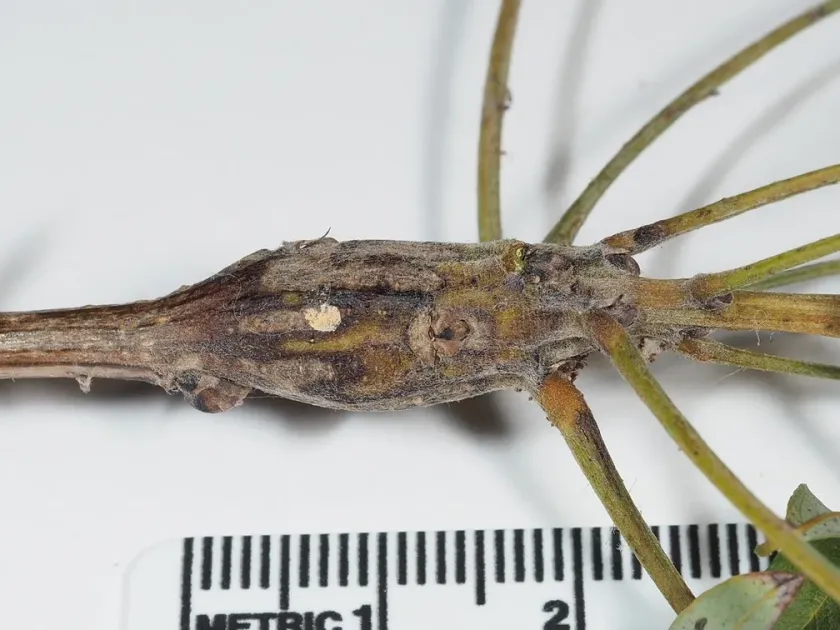
The moth's biology is intrinsically linked to the formation of galls. The larvae stimulate the plant to grow abnormal tissues, creating a safe and nutrient-rich environment for their development.
Due to its high host specificity, the Amorpha moth is generally found only in landscapes where its specific host plant is grown for ornamental or ecological purposes.
What it damages
Amorpha fruticosa is the primary host plant for this pest. The moth causes significant damage to the twigs and stems, which are crucial for the shrub's structural integrity.
As the larvae bore into the stems, they disrupt the vascular system, preventing the flow of water and essential nutrients, which often leads to the chlorosis of leaves on the affected branch.
Structural damage is a common consequence of larval activity. The weakened stems often snap under the pressure of wind or snow, leading to a ragged and unsightly appearance of the shrub.
The formation of galls diverts the plant's energy resources, causing physiological stress. This reduces the shrub's ability to resist other environmental stressors or diseases.
In severe infestations, the cumulative damage can lead to the death of major branches or, in vulnerable cases, the entire plant, significantly reducing its ornamental value.
When it appears
The species typically overwinters as a larva inside the galls found on the branches of the host shrub, remaining protected from harsh winter temperatures.
With the arrival of spring, larvae complete their development within the woody tunnels. They pupate in place, safely ensconced within the plant's tissue.
Adult moths emerge in early summer. After mating, the females deposit eggs onto the bark of young shoots, ensuring the next generation has immediate access to food.
Throughout the summer months, newly hatched larvae tunnel into the host tissue, feeding and creating the characteristic galls that will serve as their winter home.
Visual symptoms become most obvious towards the end of the growing season when the galls reach their full size and the foliage on infested branches begins to fade.
Signs of infestation
The most distinctive sign of a Walshia amorphella infestation is the presence of swellings or galls on the shoots, which can range from small bumps to large, woody nodules.
One can identify the exit points of the adult moths as small, circular holes on the surface of these galls, confirming that the larvae successfully completed their cycle.
If you observe premature wilting or yellowing of leaves on specific branches, it often indicates internal damage caused by the larvae feeding inside the stem.
Finding broken twigs that exhibit signs of internal excavation and wood shavings around the area is a classic indicator of the moth's presence.
In the dormant season, when the bushes are bare, the galls are clearly visible, making it an excellent time to inspect and evaluate the severity of the infestation.
Control measures
Sanitary pruning is the most effective management strategy. Branches containing galls should be removed and disposed of properly to prevent the emergence of the next generation of moths.
All infested plant material must be burned or buried deep to ensure that larvae inside the wood do not survive and complete their pupation cycle.
Systemic insecticides can be applied during the early summer when larvae are newly hatched and trying to penetrate the bark, as they are most vulnerable at this stage.
Promoting overall plant health and vigor helps the shrub recover more effectively from minor damage and improves its natural resistance to potential infestations.
- Regular monitoring of Amorpha plants for gall development.
- Pruning and destroying all infested wood before the moth emergence.
- Applying systemic treatments at the start of the summer if necessary.
- Ensuring proper plant spacing to allow for easier inspection.
Taxonomy
- Latin name
- Walshia amorphella
- Order
- Lepidoptera (butterflies)
- Family
- Tineidae
- EPPO code
- WALSAM
Discussion
No discussions yet — be the first.