

Pest · Coleoptera (beetles) · affects Winter wheat, Fodder beet, Apple
Especially harmful
Beet root weevil
Curculionidae
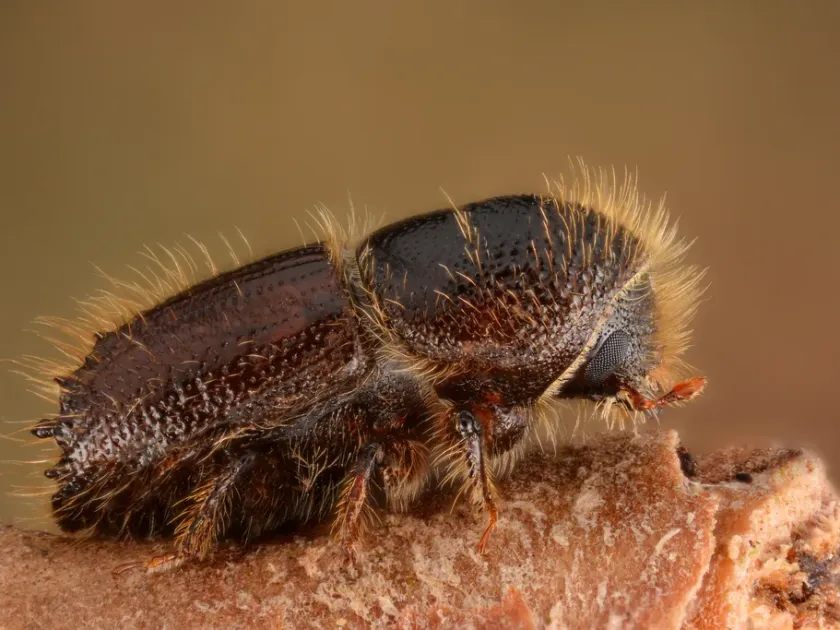
Description
How to identify
The beet root weevil (lat. Bothynoderes punctiventris) belongs to the Curculionidae family, order Coleoptera. Adult beetles are 12–16 mm long, with a dense, gray-brown body covered in fine hairs.
The rostrum (snout) is short, wide, and robust, serving as a key diagnostic feature for this species. Larvae are legless, C-shaped, creamy-white in color, and can reach up to 30 mm in length, possessing a well-defined head capsule.
These insects overwinter primarily as adults within the soil at depths of up to 50 cm. They emerge in the spring when soil temperatures reach 10–12°C to begin their feeding and reproductive cycles.
The species completes one generation per year. After mating, females deposit their eggs in the upper soil layers near the base of host plants, where larval development subsequently takes place.
As a significant pest, the beet root weevil exhibits high adaptation capabilities, allowing it to survive various environmental stressors and maintain population density in sugar beet-growing regions.
What it damages
The primary hosts of this pest include sugar beets, fodder beets, and garden beets. Adult beetles cause major damage by consuming the cotyledons and terminal buds of young seedlings, often leading to total crop failure.
Larvae are considered the most destructive stage, as they feed on the roots of plants. They bore into the root system, stunting growth and creating entry points for secondary infections like rot.
Beyond beets, the pest has been documented damaging crops such as winter barley, winter wheat, garden cabbage, and apple trees, acting as a flexible feeder when primary food sources are limited.
The economic impact of the beet root weevil is significant, often necessitating field reseeding if infestation levels are high. Reduced crop stands directly lead to lower yields at harvest.
Infested roots lose weight and sugar content, rendering them less suitable for industrial processing and affecting the overall quality of the agricultural product.
When it appears
Adult activity commences in early spring as temperatures rise. The most critical period for crops is when seedlings emerge, as the beetles are highly hungry after emerging from overwintering sites.
Spring migration of adults from overwintering areas usually coincides with the beginning of the planting season, making newly emerged seedlings particularly vulnerable to attack.
During the summer months, the pest focuses on the soil-dwelling phase. Larvae actively feed on roots throughout the growing season, completing their development before the arrival of autumn.
As temperatures drop in late autumn, the new generation of adults retreats into the soil to undergo winter diapause. They remain inactive deep underground until the following spring.
Environmental factors, particularly soil moisture and temperature fluctuations, dictate the speed of development and the survival rate of the larval population during the critical growth months.
Signs of infestation
The first visible signs of infestation are the characteristic semi-circular or irregular notches along the leaf margins of young seedlings caused by adult feeding.
Sudden yellowing and wilting of plants on sunny days, despite adequate soil moisture, indicate that larvae are feeding on the root system and disrupting water uptake.
Field inspection involves digging around the base of plants to locate larvae or identifying boreholes in the roots. These signs confirm the presence and severity of the underground infestation.
Thinning crop stands and the formation of empty patches in the field are indicators of an established population that has likely caused significant early-season damage.
- Adult weevils found on leaves in the early morning.
- Irregular feeding patterns on cotyledons.
- Wilted plants with damaged taproots.
Control measures
Effective management starts with rigorous crop rotation, ensuring that beets are not planted in the same field for at least 3–4 years. Spatial isolation from previous-year beet fields is also essential.
Cultural practices, including deep autumn plowing and thorough soil preparation, help disrupt the life cycle of the weevil by exposing overwintering adults to adverse conditions.
Chemical control is required when the infestation exceeds the economic threshold (typically 0.2–0.5 adults per square meter during seedling emergence). Systemic and contact insecticides are commonly used.
Treating seeds with systemic insecticides before planting serves as a highly effective preventive measure, protecting the vulnerable early growth stages from immediate damage by adult weevils.
Regular monitoring using pheromone traps or field counts allows growers to make data-driven decisions regarding pesticide application, ensuring efficient resource use and reduced environmental impact.
In brief
5
Damages crops
Content graph
Damages crops · 5
Content graph
Connections · Beet root weevil
Most often together:
Marketplace
Products · 12


Sharpei
ЗАТ Фірма Август, Росія.,селище Вурнари,
Insecticides
0
0
·
2.5K
1 offer
712.13 €per pack
Buy


Raut
Три Дельта Компані Інтернешнл, Гонконг, Китай.
Insecticides
0
0
·
753
2 offers
0.89 €per 1 l
Buy
Biology
Taxonomy
- Latin name
- Curculionidae
- Order
- Coleoptera (beetles)
- Family
- Curculionidae
- EPPO code
- 1CURCF
Community
Discussion
No discussions yet — be the first.