
Grape root borer
Vitacea polistiformis
Description
How to identify
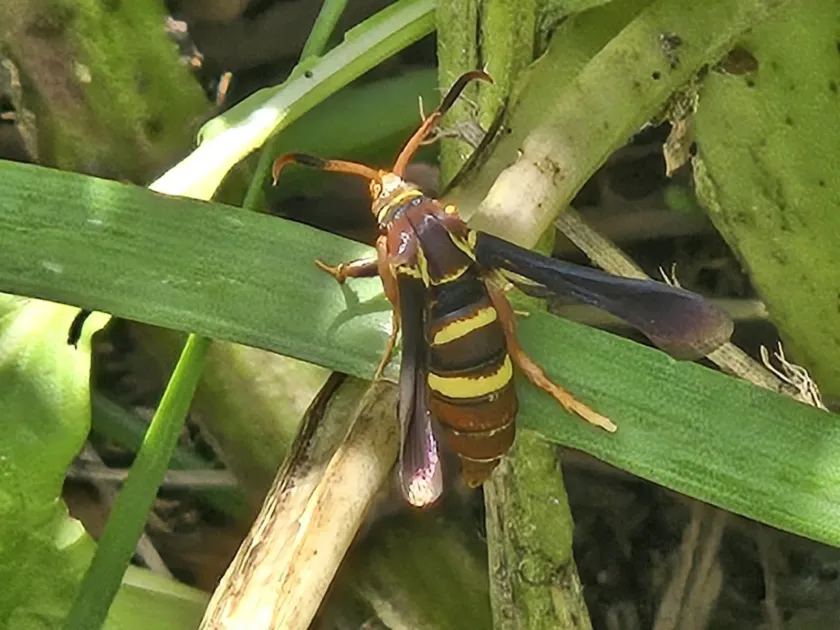
The grape root borer (Vitacea polistiformis) is a clearwing moth belonging to the Sesiidae family. Its appearance is a classic example of Batesian mimicry, as it closely resembles a paper wasp to deter predators.
Adult moths have a wingspan of 30–40 mm. Their wings are largely transparent, and their abdomen features distinct yellow or orange bands, mimicking the appearance of stinging Hymenoptera.
The larvae are creamy white with a brown head capsule and can grow up to 40 mm in length. They spend nearly their entire two-year life cycle boring into the root system and the lower trunk of grapevines.
Pupation occurs within the galleries formed by the larvae in the soil or the base of the trunk. Before adult emergence, the pupa uses its specialized structures to break through the bark.
Adults emerge during the summer months. Because they are active during the day and resemble wasps, their presence often goes unnoticed by growers until significant damage has occurred.
What it damages
This pest is a major threat to commercial viticulture, feeding primarily on the roots and the subterranean portion of the grapevine trunk. It affects both cultivated Vitis species and some wild varieties.
Larvae consume the inner bark and the woody tissue of the roots. This disruption of the vascular system prevents the movement of water and nutrients from the soil to the leaves and fruits.
Plants infested with grape root borer exhibit symptoms of severe physiological stress, including stunted shoot growth, chlorotic leaves, and a general decline in overall plant vigor.
Structural integrity is significantly compromised. Heavy larval feeding can hollow out the root crown, making the vine highly susceptible to snapping under stress or during high wind events.
Yield loss is significant, as the vine struggles to maintain fruit development. Severe infestations can eventually lead to the complete death of the vine, requiring expensive replanting of the vineyard block.
Signs of infestation
The most visible sign is the presence of empty pupal cases protruding from the soil or the lower trunk, indicating that adults have emerged and the cycle is continuing.
Growers should look for piles of frass, which resemble sawdust, at the base of the vine. This material is expelled by larvae as they bore deeper into the woody tissue.
Vines that appear weak, stunted, or show signs of premature leaf senescence compared to healthy adjacent plants are prime candidates for inspection for borer activity.
Careful excavation around the root crown may reveal tunneling and larval galleries. These galleries provide direct evidence of the extent of the infestation within the structural parts of the vine.
During dry spells, infested vines show symptoms of water stress much earlier than healthy ones because their impaired root systems cannot supply enough moisture to the canopy.
Control measures
Integrated Pest Management (IPM) is essential. Monitoring with pheromone traps is the most reliable method for detecting adult flight activity and timing protective interventions.
Chemical control is challenging due to the concealed nature of the larvae. Applications of residual insecticides to the soil surface around the base of the vine can target neonate larvae before they penetrate the wood.
Cultural practices, such as maintaining healthy vine vigor through proper irrigation and fertilization, can help plants tolerate low-level infestations and recover more effectively.
In highly infested vineyards, removing and destroying heavily damaged vines is recommended to reduce the overall population pressure within the block.
Weed control around the base of the trunk is helpful, as it eliminates hiding spots and makes it easier to spot signs of larval activity, such as sawdust piles or empty pupal cases.
Taxonomy
- Latin name
- Vitacea polistiformis
- Order
- Lepidoptera (butterflies)
- Family
- Sesiidae
- EPPO code
- PARHPO
Discussion
No discussions yet — be the first.