

Pest · Lepidoptera (butterflies) · affects Grapevine, Apple, Winter wheat
Especially harmful
European vine moth
Sparganothis pilleriana
Description
How to identify
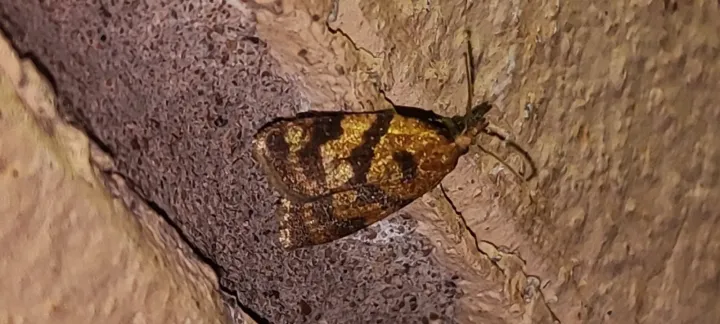
The European vine moth (Sparganothis pilleriana) belongs to the order Lepidoptera, family Tortricidae. The adult moth has a wingspan of approximately 25 mm and is characterized by its straw-yellow forewings with distinct brown transverse bands.
The larvae, or caterpillars, grow up to 25 mm in length. They typically feature a brownish head and a body that ranges from greyish-green to dirty yellow, covered with dark, prominent tubercles or warts.
The life cycle encompasses four stages: egg, larva, pupa, and imago. In most climatic zones, the pest completes one generation per year, which dictates the timing of management interventions.
The larvae overwinter in the second or third instar phase, sheltered within tough, silken cocoons hidden under the loose bark of grapevines or deep within crevices of woody plant parts.
As a highly polyphagous insect, the European vine moth is capable of surviving on various hosts, making it a persistent and challenging pest for commercial and private growers alike.
What it damages
While grapevines are the primary host, the moth exhibits a wide dietary range and can cause significant economic losses across several agricultural and horticultural crops.
The pest is known to affect a variety of plants, including:
- Apple (Malus domestica)
- Plum (Prunus domestica)
- Cucumber (Cucumis sativus)
- Tomato (Solanum lycopersicum)
- Potato (Solanum tuberosum)
- Winter oilseed rape
- Winter wheat
- Common hop
On fruit-bearing trees, the larvae damage both leaves and young ovaries, which often leads to fruit deformity, reduced quality, and premature drop of the harvest.
In vegetable crops such as tomatoes and cucumbers, leaf tissue consumption slows down photosynthesis, causing stunted growth and reducing the overall yield potential.
Cereal and industrial crops face the highest risk during the early spring, when larvae feed on the growing points, effectively killing the apical meristem and destroying the shoots.
Signs of infestation
Early signs of infestation appear in spring as larvae emerge and begin feeding on newly developing buds, which often fail to open properly and eventually dry out.
A hallmark of this pest is the creation of tightly rolled leaves, fastened together with silk threads. These nests provide a safe environment for larvae to feed on the leaf tissue.
When grape inflorescences are attacked, the larvae bind the flower clusters with silk, causing them to wither and fall before fertilization, leading to substantial crop loss.
In mid-season, the presence of the pest is indicated by skeletal-looking leaves with large holes, accompanied by dark frass deposits trapped within the silk-bound nests.
Late-season damage often involves direct feeding on ripening fruits or berries, which serves as a site for secondary infections such as gray mold or other fungal pathogens.
Control measures
Cultural control is essential and involves removing loose bark from grapevine stems during the dormant season to destroy overwintering sites, followed by the burning of debris.
Integrated pest management relies on pheromone traps to monitor adult moth activity. This data allows growers to apply insecticides precisely when larvae are most vulnerable.
Biological control methods, particularly the use of Bacillus thuringiensis, are highly effective against early-instar larvae and are safer for beneficial insects and pollinators.
Chemical control should be implemented during the peak larval emergence period using systemic or stomach-acting insecticides to ensure the most effective population reduction.
Maintaining clean fields by eliminating nearby weeds is a critical component of pest control, as these areas often serve as reservoirs that re-infest the main crops each season.
In brief
9
Damages crops
Content graph
Damages crops · 9
Content graph
Connections · European vine moth
Most often together:
Marketplace
Products · 17


Nuprid 200
Нуфарм Австралія Лтд. , Австралія (місце виробництва: Чілі
Insecticides
0
0
·
1.9K
7 offers
26.52 €per 1 l
Buy

Puska
Три Дельта Компані Інтернешнл, Гонконг, Китай.
Insecticides
1
0
·
1.9K
1 offer
7.76 €per 1 l
Buy


Cezar c.e., Insecticide (Bifenthrin, 100 g/l)
F. Macteshim Chemical Works, LLC
Insecticides
0
0
·
58
6 offers
69.5 €per 1 l
Buy


Opercot z.p., (lambda-cyhalotrin, 50 g/kg)
Санрайз Кемікалз Ко. Лтд., Шанхай, Китай
Insecticides
0
0
·
56
2 offers
8.55 €per 1 l
Buy


Biology
Taxonomy
- Latin name
- Sparganothis pilleriana
- Order
- Lepidoptera (butterflies)
- Family
- Tortricidae
- EPPO code
- SPARPI
Community
Discussion
No discussions yet — be the first.