
Horned treehopper
Vidalia cornuta
Description
How to identify
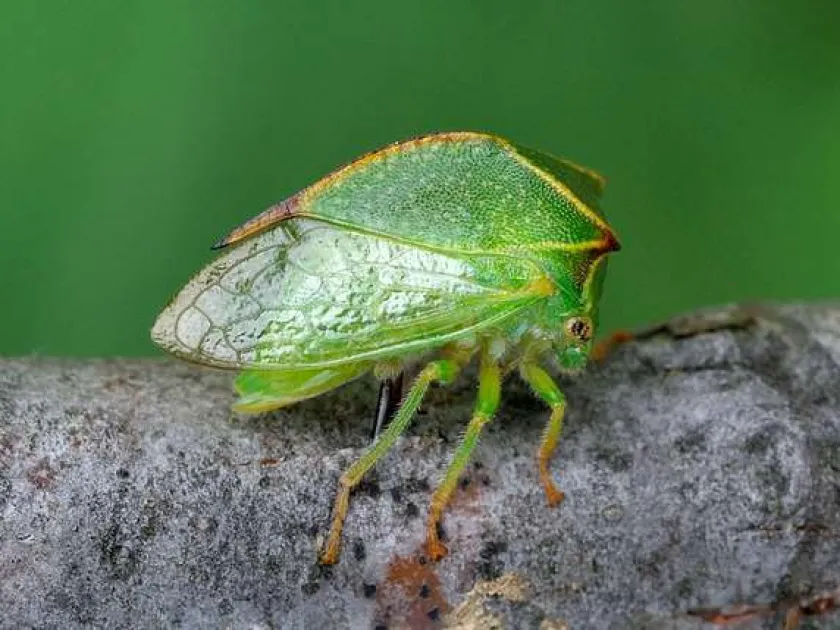
The horned treehopper (Vidalia cornuta) is a member of the Membracidae family, commonly known as treehoppers. These insects are easily recognized by their unique pronotum, which extends backward into horn-like structures.
These insects generally have a brown or greyish coloration, providing excellent camouflage against the bark of trees and shrubs. Adult specimens typically reach lengths of 6 to 10 millimeters.
The nymphs of this species look quite different from the adults. They are often flattened and feature numerous spines and outgrowths on their bodies, which help them remain camouflaged while feeding.
Females are equipped with a sharp, sword-like ovipositor used to slit the bark of young twigs to lay eggs. This specific biological adaptation is what causes the primary damage to plants.
Horned treehoppers are diurnal and highly mobile. They possess strong legs adapted for jumping, allowing them to escape quickly when disturbed or threatened by predators or during inspection.
What it damages
The horned treehopper primarily targets various woody plants, including deciduous trees and several species of shrubs. Young trees and seedlings are particularly vulnerable to their activity.
The main injury occurs during the egg-laying process. The female makes deep incisions in the bark, which disrupt the vascular system and weaken the structural integrity of young shoots.
These bark incisions create entry points for opportunistic fungal and bacterial pathogens. Often, this leads to cankers, bark necrosis, or the dieback of entire terminal shoots.
Affected shoots often show signs of wilting, curvature, or yellowing leaves. The reduced vitality of the plant makes it more susceptible to environmental stressors like drought or cold winters.
In nurseries, high populations of these pests can cause significant stunting in seedling growth, resulting in stunted development and poor ornamental quality for nursery stock.
When it appears
The life cycle of the horned treehopper is highly seasonal, with overwintering occurring exclusively at the egg stage. Eggs are safely tucked inside the bark of host plants through the winter.
Nymphs emerge in the spring, coinciding with the period of active sap flow and bud break. This is when they start feeding on the tender tissues of the host plant.
Development from nymph to adult typically takes several weeks. Adult insects usually emerge by mid-summer, which is when their activity in the canopy becomes most noticeable.
The mating and egg-laying phase occurs in late summer and early autumn. During this time, females actively seek out suitable young twigs to deposit their eggs before the onset of winter.
The species usually completes one generation per year in temperate climates. However, in warmer regions, the life cycle may be slightly accelerated, though rarely exceeds two generations annually.
Signs of infestation
The most distinctive sign of infestation is the presence of scarring or longitudinal slits on the bark of younger twigs. These are the oviposition scars left by the females.
Curled, wilted, or dying tips of branches are strong indicators that the vascular tissue has been compromised by the egg-laying process, leading to localized dieback.
The presence of spiky-looking nymphs on the undersides of leaves or in the crotches of branches is a definitive sign that a reproductive population is present on the plant.
Gummosis or sap exudation from the bark wounds is a frequent secondary symptom as the tree attempts to heal the damage caused by the insects.
Observing groups of adult treehoppers on tree trunks during warm, sunny periods is a clear indication of a significant pest presence requiring attention.
Control measures
The most effective cultural practice is the sanitary pruning of infested shoots. Removing twigs containing egg masses significantly reduces the population for the following season.
Systemic insecticides can be used to control nymphs during the spring. Applications should be timed to coincide with the period of egg hatch to ensure maximum efficacy.
Maintaining tree health through proper irrigation and balanced fertilization helps plants recover more quickly from physical wounds and boosts their overall resistance to pests.
Promoting natural biological control is beneficial. Encouraging predators like birds, spiders, and predatory insects can help keep treehopper populations at manageable levels.
- Regular inspection of young shoots for bark scars.
- Sanitary pruning and destruction of infested branch material.
- Application of approved systemic insecticides when necessary.
- Integrated pest management to protect beneficial predatory species.
Taxonomy
- Latin name
- Vidalia cornuta
- Order
- Diptera (flies)
- Family
- Tephritidae
- EPPO code
- VIDACO
Discussion
No discussions yet — be the first.