
Pine clearwing moth
Vespamima pini
Description
How to identify
The Pine clearwing moth, known by the scientific name Vespamima pini, is a member of the Sesiidae family. Its appearance is a classic example of Batesian mimicry, as it closely resembles a wasp.
Adult moths have a wingspan ranging from 20 to 30 mm. Their wings are largely transparent, with distinctive dark margins that distinguish them from other lepidopterans.
The body exhibits yellow or orange bands across the abdomen, mimicking the appearance of stinging Hymenoptera. This camouflage helps the moth avoid many avian predators.
Larvae are typically cylindrical with a white or yellowish body and a dark, sclerotized head capsule. They spend their entire developmental period concealed beneath the bark.
The life cycle of the species is adapted to survive on various coniferous tree species, with development occurring primarily within the conductive tissues of the stem.
What it damages
Larvae feed primarily on the phloem and cambium layers of pine trees. This localized feeding disrupts the transport of nutrients, weakening the structural integrity of the tree.
Young trees and saplings are most vulnerable, as deep feeding galleries can easily girdle the stem. This often results in the mortality of the host plant.
The damaged area serves as an entry point for secondary infections, including fungal pathogens and wood-boring beetles, which further accelerate the decline of the tree.
Heavy infestations reduce the overall aesthetic value of ornamental pines and can cause significant economic losses in silviculture and nursery operations.
Trees stressed by drought or environmental factors are more susceptible to larval colonization, making it essential to monitor the health status of plantations.
When it appears
Adult flight activity typically occurs during late spring and throughout the summer months. The timing of emergence is highly dependent on ambient temperature and regional climate.
Females are selective about oviposition sites, preferring to lay eggs near bark fissures, wounds, or existing damage. Proper site selection is crucial for larval survival.
The larvae overwinter within their tunnels under the bark, which provides protection from extreme winter weather. This allows the species to persist in various environmental conditions.
Pupation occurs within the galleries, and prior to adult emergence, the pupa partially emerges from the exit hole. This is a characteristic feature of the Sesiidae family.
Understanding the phenology of the moth is critical for determining the window of opportunity for effective pesticide application and monitoring.
Signs of infestation
Visible resin flow, or pitch bleeding, on the trunk or root collar is often the first indicator of larval presence. This is the tree's natural defense mechanism against boring insects.
Accumulations of frass—a mixture of larval excrement and wood particles—near the base of the trunk or at the entrance of galleries are clear diagnostic symptoms.
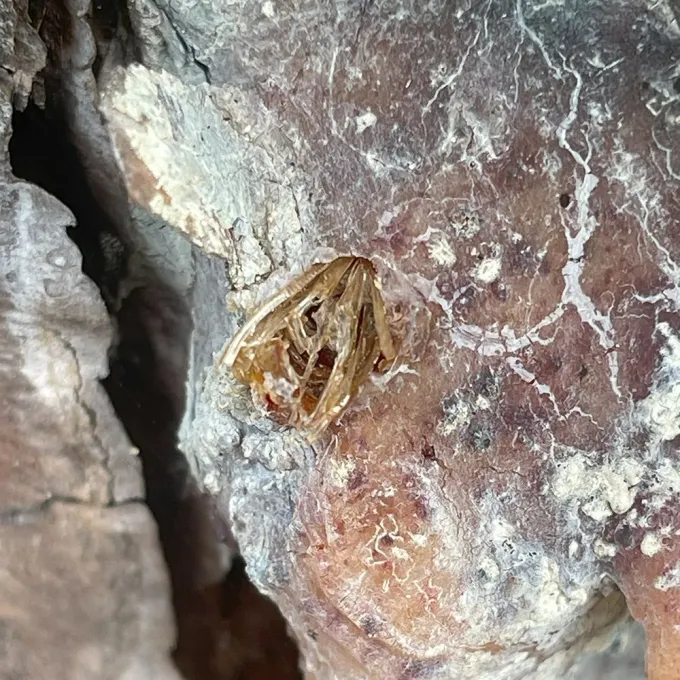
The presence of empty pupal exuviae protruding from exit holes on the bark indicates that adults have successfully emerged from the tree.
Foliar symptoms include chlorosis, needle browning, and premature needle drop, which reflect the impairment of the tree's vascular system due to larval feeding.
The use of pheromone-baited traps is the most reliable method for detecting adult presence and identifying the onset of the flight period for management purposes.
Control measures
Integrated Pest Management (IPM) strategies for Vespamima pini focus on promoting tree vigor. Healthy trees are better able to withstand and recover from larval boring.
Good silvicultural practices, such as the removal and disposal of heavily infested trees, are essential to reduce the local population density of the moth.
Chemical control involving systemic or contact insecticides applied to the bark during the adult flight period can be effective in preventing successful oviposition.
Biological control options, including the use of entomopathogenic nematodes or natural predators, are being explored as sustainable alternatives to conventional chemicals.
- Monitoring adult flight with pheromone traps.
- Preventing bark wounds during forestry and gardening operations.
- Sanitation logging of heavily affected or dying saplings.
- Application of protective wound dressings on mechanical injuries.
Taxonomy
- Latin name
- Vespamima pini
- Order
- Lepidoptera (butterflies)
- Family
- Sesiidae
- EPPO code
- VESMPI
Discussion
No discussions yet — be the first.