
Maple bladder-gall mite
Vasates quadripedes
Description
How to identify
The maple bladder-gall mite, scientifically known as Vasates quadripedes, is a tiny member of the Eriophyidae family. These mites are microscopic, worm-like, and appear whitish or yellowish under magnification.
Unlike most mites that have four pairs of legs, this species belongs to the four-legged mite group. They are so small, measuring approximately 0.2 mm, that they remain invisible to the naked eye.
They are obligate parasites that depend entirely on their host plants. Their life cycle is synchronized with the spring bud break of specific maple species, primarily the silver and sugar maples.
Adult females overwinter in the bark crevices and bud scales. As soon as the temperatures rise, they emerge to infest the emerging new foliage, where they begin to feed and lay eggs.
Multiple generations are produced throughout the growing season. This rapid development allows the mite population to increase significantly if conditions remain favorable throughout the summer.
What it damages
The primary hosts for Vasates quadripedes are maple trees. They are highly host-specific, meaning they do not migrate to other types of trees or shrubs in the landscape.
The feeding activity of these mites triggers a physiological response in the leaf tissue, causing abnormal cell growth which manifests as galls. This is a defensive reaction or a consequence of the mite's salivary enzymes.
While the aesthetic damage can be severe, the impact on the tree's overall long-term health is typically minimal unless the tree is already stressed or the infestation is repeated annually over many years.
Heavy infestations can lead to premature leaf drop or yellowing, which may slightly reduce the tree's energy reserves for the following season if the stress persists.
In ornamental urban settings, the presence of galls is considered a major nuisance because it ruins the visual quality of the trees in parks, residential areas, and manicured gardens.
Signs of infestation
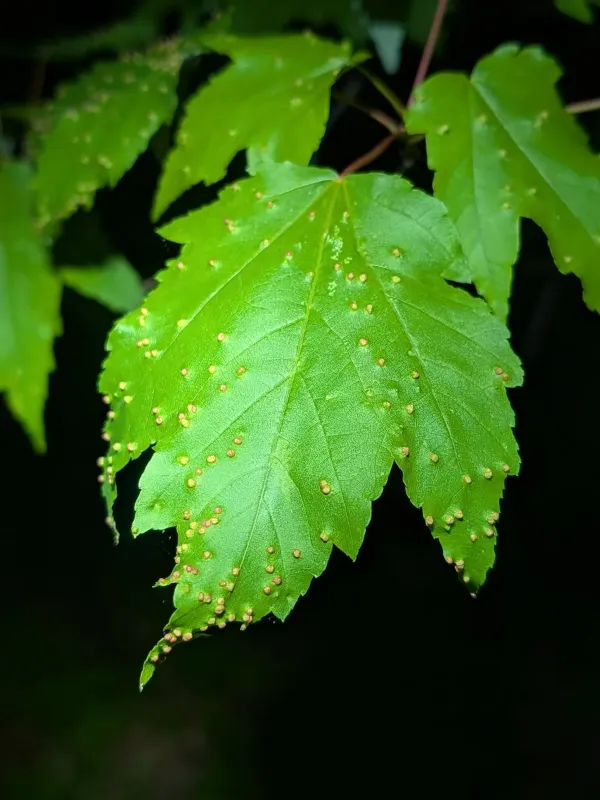
The most distinctive sign of a mite infestation is the appearance of small, spherical, or finger-like galls on the upper surface of the leaves during the early spring.
Initially, these galls appear light green, blending in with the leaf color. As the season progresses, they turn vivid red, purple, or even black, making them highly conspicuous.
The galls can cover the entire leaf surface, causing it to become twisted, curled, or stunted. A single leaf may host hundreds of these individual gall structures.
If the underside of the leaf is inspected, one can usually find a small opening or pore associated with each gall. This is where the mite colonies reside and move within the protected environment of the gall.
Severe infestations might show signs of general leaf browning or necrosis late in the summer, which is a symptom of the exhaustion of the plant tissue due to intensive feeding.
Control measures
Controlling the maple bladder-gall mite is difficult because the pests are sheltered inside the galls, where they are protected from most contact insecticides and environmental stressors.
Effective management requires applying a dormant oil or a suitable miticide exactly at the moment when the buds begin to swell but before the leaves fully unfurl.
Cultural practices, such as pruning and disposing of heavily infested branches, can help reduce the local population, although this is usually not enough to eradicate the pest completely.
Maintaining tree vigor through proper watering and mulching is essential, as healthy trees are better equipped to tolerate the minor physiological stress caused by the mites.
Chemical intervention is often unnecessary for large, mature trees unless the infestation is critically damaging the tree's health or if the aesthetic loss is unacceptable for the specific landscape goals.
Taxonomy
- Latin name
- Vasates quadripedes
- Order
- Mites
- Family
- Eriophyidae
- EPPO code
- VASAQU
Discussion
No discussions yet — be the first.