
Maple bladder-gall mite
Vasates aceriscrumena
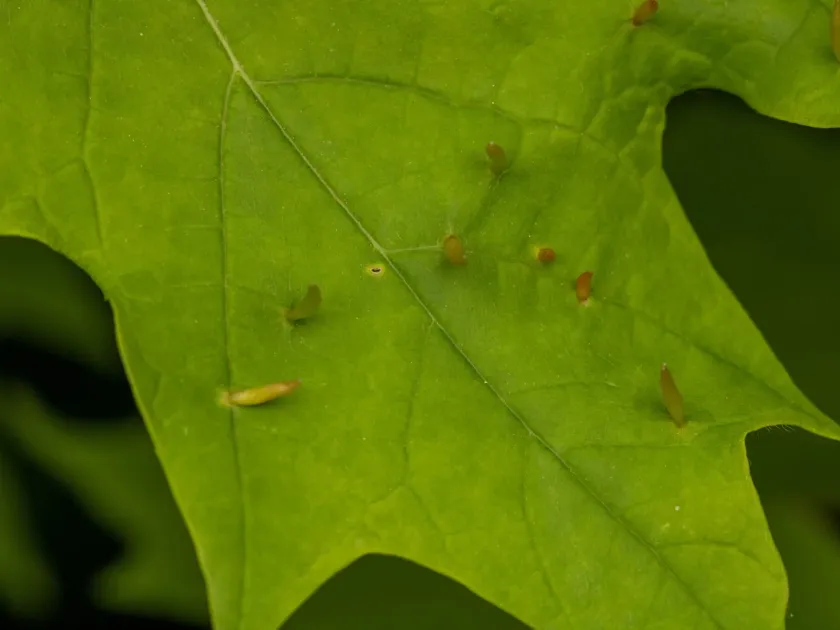
Description
How to identify
The maple bladder-gall mite (Vasates aceriscrumena) is a microscopic pest belonging to the order Acariformes and the family Eriophyidae. These mites are extremely small, with an elongated, worm-like body measuring approximately 0.2 mm in length.
Due to their size, they are impossible to see without professional magnification equipment. They are classified as "four-legged" mites because they only have two pairs of legs, which is a characteristic feature of this specific family of plant-parasitic arthropods.
What it damages
This mite primarily attacks various species of maple trees, particularly silver maple (Acer saccharinum) and sugar maple. The pest is highly host-specific, rarely affecting other woody plants in the landscape.
The damage is mostly cosmetic. The feeding process induces the formation of galls, which are abnormal growths on the leaf tissue. While unsightly, these galls rarely cause serious long-term damage or the death of a well-established mature maple tree.
When it appears
The life cycle begins in early spring. Adult, fertilized females overwinter in protected areas of the tree, specifically under bark crevices or beneath bud scales. As soon as the buds begin to open, the mites migrate to the newly developing leaves.
The peak activity period occurs in spring and early summer. Several overlapping generations can occur during a single season. As the leaves mature, the mites stop producing new galls, and eventually, the adults move back to their wintering sites in late summer and autumn.
Signs of infestation
The most distinctive symptom is the appearance of small, elongated, bladder-like galls on the upper surface of the leaves. These galls often start as green and later turn to shades of bright red or pink, making them quite striking.
Eventually, the galls harden and turn brown or black as the tissue dies. In cases of severe infestation, the leaves may become twisted, curled, or stunted, which significantly reduces the aesthetic quality of the tree's canopy.
Control measures
Effective management is challenging because once the mites are inside the galls, they are protected from topical treatments. Therefore, timing is the most critical factor for success.
- Apply dormant oil or specific acaricides in early spring just as buds are beginning to swell.
- Systemic acaricides can be effective if applied during the early migration phase of the mites onto new foliage.
- Remove and dispose of fallen leaves in the autumn to reduce the population of overwintering mites.
- Focus on overall tree health, including proper fertilization and watering, to help the tree tolerate the infestation better.
Taxonomy
- Latin name
- Vasates aceriscrumena
- Order
- Mites
- Family
- Eriophyidae
- EPPO code
- VASAAC
Discussion
No discussions yet — be the first.