
Tomato russet mite
Vasates
Description
How to identify
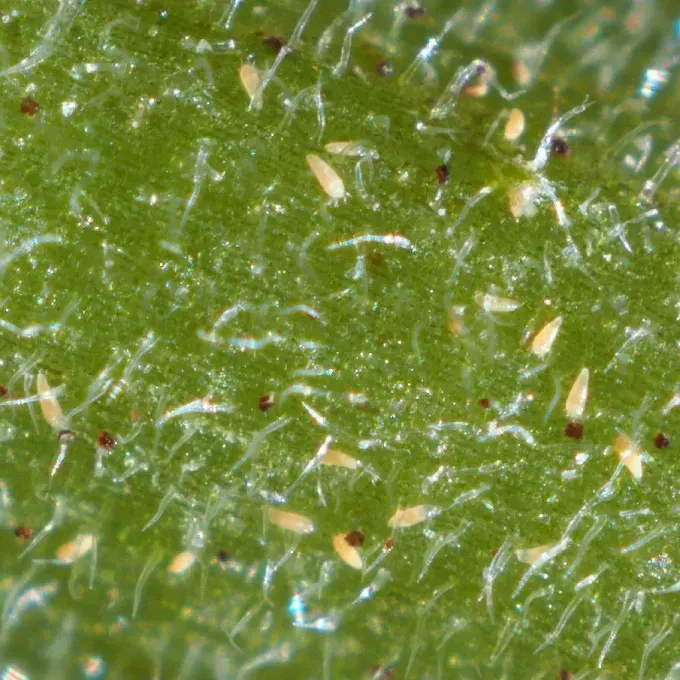
The tomato russet mite, scientifically known as Aculops lycopersici (formerly associated with the genus Vasates), is a microscopic pest belonging to the Eriophyidae family. Measuring only 0.2 mm, it is invisible to the naked eye.
Unlike common spider mites, this pest does not produce silk webbing. Its body is wedge-shaped and yellowish-white, perfectly adapted to hiding within the grooves and hairs of host plants.
The life cycle is incredibly rapid; under favorable conditions of 25–27 °C, the mite completes its development from egg to adult in just 5 to 7 days, leading to massive population explosions in greenhouses.
These mites overwinter in soil debris or on wild solanaceous weeds. In the spring, they migrate to new crops, spreading rapidly via wind currents and human activity, such as handling plants or contaminated tools.
The population consists mostly of females that lay eggs directly on the leaves and stems. The rapid turnover of generations makes it one of the most challenging pests to manage in professional tomato cultivation.
What it damages
The primary hosts are solanaceous crops, including tomatoes, peppers, potatoes, and eggplants. The mite feeds by piercing and sucking cell contents, leading to cellular dehydration and plant tissue death.
Signs of infestation
The first telltale sign is a characteristic bronze or metallic sheen appearing on the lower stems of the plant. The epidermal cells die, causing the surface to become corky and rough to the touch.
As the infestation progresses, leaves become curled, yellowish, and eventually necrotic. The mites move upwards, systematically killing the foliage until the entire plant is severely stunted.
Fruits are also affected, developing a grayish, cracked, or leathery texture. Flowers may drop prematurely, drastically reducing the yield and quality of the final harvest.
Control measures
Sanitation is the first line of defense. All crop residues must be removed and burned at the end of the season to eliminate overwintering sites, and weeds around the greenhouse must be strictly controlled.
Biological control can be implemented using predatory mites like Amblyseius species, which feed on the russet mite. However, this requires consistent monitoring to ensure predatory populations are sufficient.
Chemical control necessitates the use of effective acaricides. Since the mites multiply quickly, growers should perform repeat applications at short intervals to break the life cycle and prevent resistance buildup.
Taxonomy
- Latin name
- Vasates
- Order
- Mites
- Family
- Eriophyidae
- EPPO code
- VASASP
Discussion
No discussions yet — be the first.