
Vanduzeea
Vanduzeea
Description
How to identify
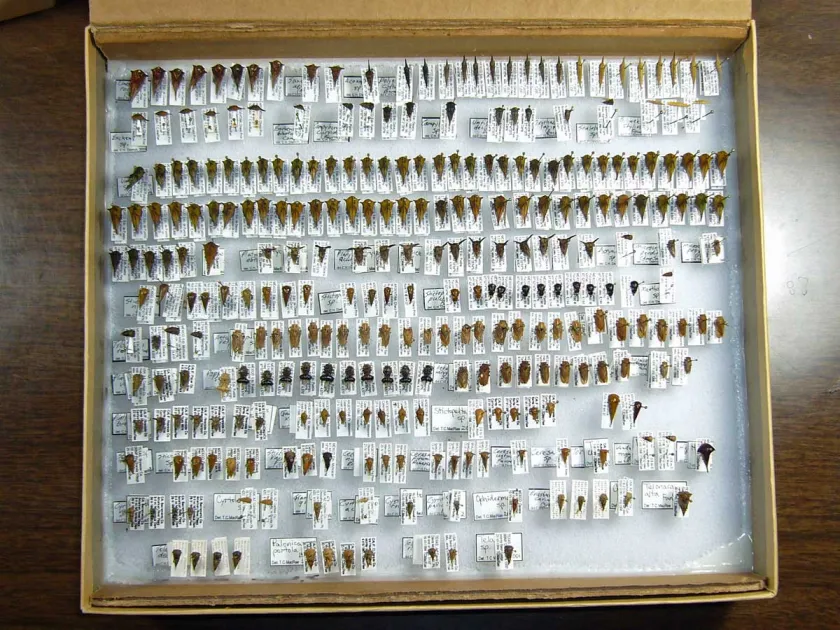
Vanduzeea is a genus of insects belonging to the treehopper family (Membracidae). They are distinguished by their pronotum, which often extends into ornate, thorn-like shapes that help them blend into the stems of host plants.
These insects are typically 5–10 mm long and possess a robust exoskeleton. Their coloration, ranging from brown to black, serves as effective camouflage against tree bark or green foliage.
Unlike adults, the nymphs are less mobile and lack the characteristic helmet-like structure. They are often found in clusters, covered in protective wax secretions that deter potential predators.
A hallmark of the Vanduzeea biology is their mutualistic relationship with ants. The ants protect the nymphs from predators in exchange for honeydew, a sugary substance secreted by the treehoppers during feeding.
Gardeners can often locate these pests by observing increased ant activity along the stems, as the ants actively tend to the treehopper colonies.
What it damages
Vanduzeea treehoppers are sap-sucking pests that feed on the phloem of a variety of plants, including legumes and various woody ornamentals or fruit-bearing shrubs.
The feeding process involves puncturing plant tissue, which causes localized wilting, stunted growth, and potential curling of young leaves and shoots.
Continuous feeding by a large colony significantly drains the plant's resources, leading to reduced vigor and making the plant more susceptible to environmental stressors.
The accumulation of honeydew on the plant surface encourages the growth of sooty mold, a black fungal layer that blocks sunlight and interferes with the plant's vital photosynthesis.
Furthermore, the puncture wounds created by the mouthparts act as entry points for secondary bacterial and fungal infections, which can result in long-term damage to the plant structure.
When it appears
The life cycle of Vanduzeea is highly dependent on seasonal temperature variations. Overwintering occurs in the egg stage, typically hidden within bark crevices or buds.
In spring, as temperatures rise, the nymphs emerge and begin their feeding cycle on the fresh, tender growth of host plants. This is the most vulnerable stage for the plants.
Summer marks the peak of their activity, with multiple overlapping generations causing population surges if left unchecked by natural predators or human intervention.
Autumn triggers a shift in behavior where the focus transitions to egg-laying for the next generation, often concentrating on perennial woody stems.
Regular monitoring is essential from late spring through the end of summer to catch early infestations before they reach levels that cause visible economic or ornamental damage.
Control measures
Effective management of Vanduzeea involves disrupting their mutualistic bond with ants, as ants provide the necessary protection that allows the pest population to thrive.
Physical control measures, such as pruning and disposing of heavily infested branches, are highly effective in small-scale gardens to reduce the immediate population load.
Chemical intervention with systemic insecticides is recommended for severe infestations, as these products are absorbed by the plant and ingested by the insects during feeding.
Encouraging the presence of natural enemies, such as lady beetles, lacewings, and parasitic wasps, can provide a sustainable way to keep treehopper populations at manageable levels.
- Pruning infested shoots and stems.
- Controlling ant populations on host plants.
- Applying systemic insecticides when thresholds are exceeded.
- Preserving habitat for predatory insects and beneficial fauna.
Taxonomy
- Latin name
- Vanduzeea
- Order
- Hemiptera (bugs, aphids, leafhoppers)
- Family
- Membracidae
- EPPO code
- VANDSP
Discussion
No discussions yet — be the first.