
Aconophora laminata
Aconophora laminata
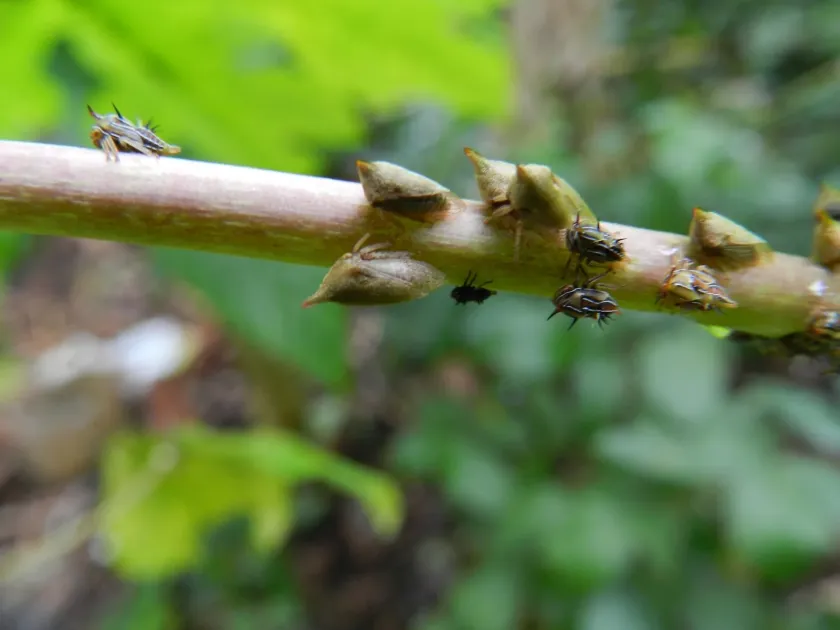
Description
How to identify
Aconophora laminata is a species of treehopper belonging to the family Membracidae within the order Hemiptera. These insects are easily identified by the distinct pronotal process, a dorsal extension that resembles a horn or a crest, which is highly developed in this species.
Adults generally measure between 8 and 10 millimeters in length. Their coloration is usually brownish or mottled, providing excellent camouflage against tree bark, where they often mimic thorns or irregularities on the stems of their host plants.
The nymphs go through several developmental stages on the host plant. Unlike the adults, nymphs lack the large, hardened pronotal crest and often aggregate in large groups on stems, where they are protected by their behavior and physical resemblance to plant tissues.
These insects possess strong hind legs for jumping, which they use to escape potential threats. They feed using a specialized piercing-sucking mouthpart, which allows them to penetrate the plant epidermis to reach the phloem vessels.
The life cycle of Aconophora laminata is heavily dependent on the presence of suitable woody plants. They are primarily found in temperate and tropical environments where their host plants provide food and shelter throughout the year.
What it damages
Aconophora laminata primarily infests broad-leaved trees and various shrubs. They are considered pests of concern for nurseries and decorative plantations, as they can quickly spread across young trees, causing significant stress to the host.
Damage is caused by both adults and nymphs extracting large volumes of plant sap. This continuous feeding depletes the tree's energy reserves, leading to stunted growth, reduced vigor, and in extreme cases, the death of young branches.
The physical act of feeding causes localized tissue damage. The punctures made by the mouthparts can lead to the development of necrotic lesions on the stems, which potentially disrupts the vascular system and makes the plant susceptible to secondary infections.
The secretion of honeydew is a significant indirect effect of these insects. This sugary substance coats the leaves and stems, serving as a medium for the growth of sooty mold, which blocks sunlight and interferes with the plant’s photosynthetic capacity.
Furthermore, these treehoppers are known to be vectors for various phytopathogens. By moving between plants, they can facilitate the transmission of plant diseases, turning a localized infestation into a broader health issue for the orchard or landscape.
Signs of infestation
The most reliable sign of an infestation is the presence of clusters of insects sitting along the stems of young shoots. Their camouflage makes them look like part of the plant, but careful observation reveals their rhythmic feeding behavior.
A noticeable presence of ants on the branches often points to the existence of Aconophora colonies. Ants are attracted to the honeydew produced by the treehoppers and will actively defend these colonies against predators, making the ant activity a diagnostic indicator.
Wilting, curling, and yellowing of leaves on the upper shoots are common symptoms. As the insects suck the sap, the youngest parts of the plant often show signs of desiccation or deformation due to the loss of nutrients.
The accumulation of a dark, powdery sooty mold on the surface of the plant indicates a long-term infestation that has produced enough honeydew to support fungal growth.
- Clusters of treehoppers on young green stems.
- Visible ant activity on infested branches.
- Sticky residue or dark sooty mold on foliage.
- Curled, deformed, or yellowing young shoots.
Control measures
Pruning is one of the most effective mechanical methods for managing small or early-stage infestations. By removing the infested shoots and disposing of them away from the area, the population size can be drastically reduced.
For larger infestations, chemical control using systemic insecticides is highly recommended. These products are taken up by the plant tissue and provide a long-lasting effect against sap-sucking insects like Aconophora laminata.
Integrated Pest Management (IPM) practices emphasize the importance of healthy tree maintenance. Providing proper irrigation and fertilization ensures that trees can better recover from feeding damage and are less stressed, which reduces their attractiveness to pests.
Monitoring programs are essential in high-value plantations. By checking for the presence of ants and inspecting the terminal buds during the growing season, growers can detect population spikes before they cause major economic damage.
Promoting a balanced ecosystem by protecting natural predators, such as lady beetles, lacewings, and parasitic wasps, can help keep treehopper populations at manageable levels without the need for intensive chemical applications.
Taxonomy
- Latin name
- Aconophora laminata
- Order
- Hemiptera (bugs, aphids, leafhoppers)
- Family
- Membracidae
- EPPO code
- ACOOLA
Discussion
No discussions yet — be the first.