
Aconophora pugionata
Aconophora pugionata
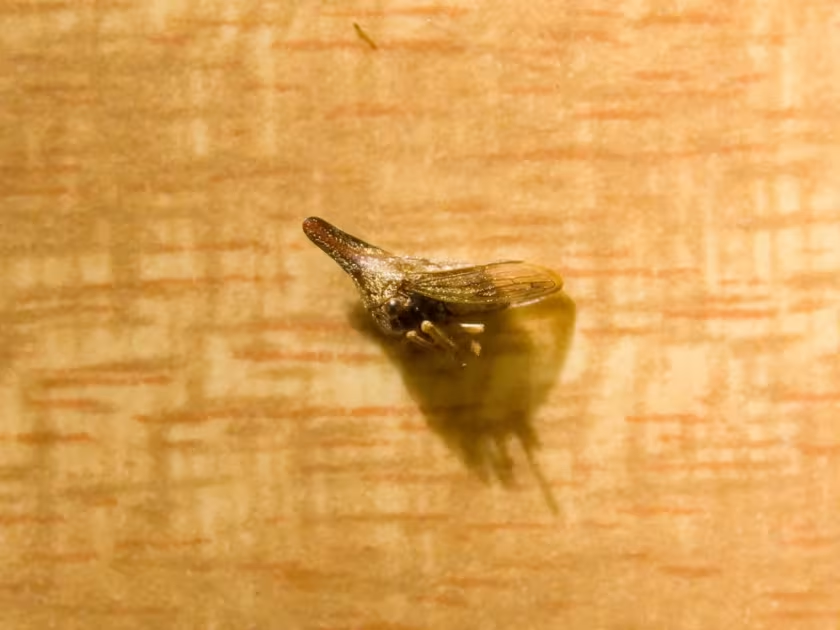
Description
How to identify
Aconophora pugionata belongs to the treehopper family (Membracidae), within the order Hemiptera. These insects are distinguished by their unusual pronotal shape, which often mimics a thorn or crest, helping them camouflage effectively on the bark or stems of host plants.
Adult specimens possess a characteristic dorsal thoracic extension that resembles a dagger or blade, which is reflected in the specific epithet pugionata. They are typically only a few millimeters in size, with coloration varying from light brown to dark tones that blend perfectly with woody surfaces.
Treehopper nymphs differ significantly from adults: they lack the developed pronotal projection, have soft bodies, and often develop in groups. Detecting them requires careful inspection of the underside of leaves and young shoots during the spring and summer months.
For accurate identification, agronomists use entomological nets and visual inspections of vegetative organs. It is essential not to confuse this species with other members of the Membracidae family, as their geographical distribution and dietary preferences can vary considerably.
These insects have a specialized piercing-sucking mouthpart that allows them to feed efficiently on plant sap. The specific structure of their thoracic region makes them excellent jumpers, which complicates mechanical control methods.
What it damages
This pest prefers to feed on the sap of a wide range of woody plants and shrubs. Host plants include various ornamental trees as well as certain fruit-bearing species found in tropical and subtropical regions.
The primary damage is caused by the disruption of the plant's vascular system. While feeding, treehoppers inject saliva into the host tissues, which can lead to the blockage of vascular bundles and interfere with the normal metabolic processes in young shoots.
During mass outbreaks, plant growth inhibition, leaf curling, and premature leaf drop are commonly observed. Young saplings are particularly sensitive to Aconophora impact, as their tender tissues are easily pierced by the insect's proboscis.
Beyond direct mechanical damage, treehoppers can serve as indirect vectors for viral and fungal diseases. Sooty mold often develops on the honeydew secreted by these insects, which blocks sunlight and hinders photosynthesis in the foliage.
The severity of the damage depends directly on the population density per unit area. In agroecosystems without proper monitoring, Aconophora colonies can spread rapidly, exhausting the reserves of perennial plantings.
When it appears
The life cycle of Aconophora pugionata is closely linked to the seasonal rhythms of its host plants. The primary activity of the pest coincides with the period of active sap flow and vegetation, which begins with the onset of consistent warm weather.
Females typically lay eggs directly into plant tissues, selecting young, succulent shoots or leaf petioles. The duration of embryonic development depends on environmental temperatures, making population dynamics unstable during cooler seasons.
Nymphs emerge in the spring and pass through several developmental stages, feeding actively throughout the summer. During this time, they are most noticeable due to the secretion of honeydew, which attracts ants that often attend the treehopper colonies.
Adults can be observed on plants throughout the warm months. Under unfavorable conditions, such as drought or sudden drops in temperature, the insects may enter a dormant or cryptic state, hiding in bark crevices.
Monitoring pest density should begin in early spring, before bud break, to prevent mass egg-laying on cultivated plants. Timely detection of the first generation is key to successfully suppressing the population.
Signs of infestation
The first sign of Aconophora presence is the appearance of a sticky residue on the leaf surface, known as honeydew. This is a clear, viscous liquid excreted by the insects as they process plant sap.
The second significant symptom is the development of a black sooty mold on areas where pests congregate. The mold fungus feeds on the honeydew, obstructing light and manifesting visually as "dirty" or blackened foliage.
Local deformations and twisting can be observed on young shoots. The plant reacts to tissue punctures, leading to uneven growth and the formation of specific swellings at the feeding sites.
The presence of ants on tree branches often indicates an active treehopper colony. Ants "farm" the pests to collect their sweet secretions, protecting them from predators, which complicates natural biological control of Aconophora.
Leaf drop or wilting of shoot tips during the peak of summer is a late sign of significant infestation. By this time, the plant is already exhausted and requires immediate intervention from an agronomist.
Control measures
Control of Aconophora requires an integrated approach. First and foremost, it is necessary to perform thorough pruning and disposal of affected shoots, which may contain egg clutches or nymphs.
The use of contact and systemic insecticides is effective during the early stages of colony development. Systemic products are generally preferred, as they are absorbed into the plant sap and act on the pest directly during feeding.
Biological control methods include the attraction of natural enemies such as entomophagous insects, predatory bugs, and lady beetles. Maintaining biodiversity around the site helps suppress pest populations without heavy reliance on chemicals.
Ant control is essential, as ants facilitate the spread of treehoppers. Applying sticky bands to tree trunks prevents ant access to the canopy, leaving the pests vulnerable to natural predators.
Adherence to good agricultural practices is a vital element: regular fertilization and proper watering enhance plant resistance to pest attacks. A strong, healthy plant can tolerate damage caused by treehoppers much more effectively.
Taxonomy
- Latin name
- Aconophora pugionata
- Order
- Hemiptera (bugs, aphids, leafhoppers)
- Family
- Membracidae
- EPPO code
- ACOOPU
Discussion
No discussions yet — be the first.