
Crimson-speckled moth
Utetheisa pulchella
Description
How to identify
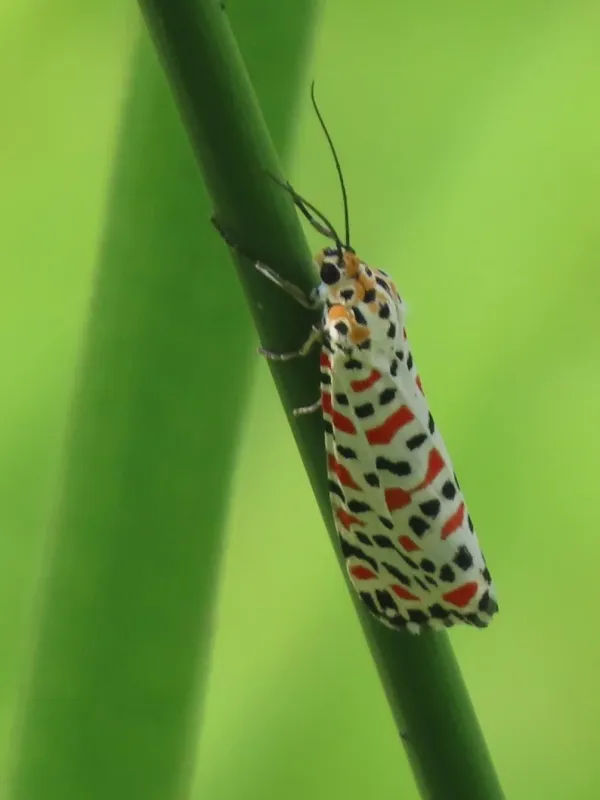
The Crimson-speckled moth (Utetheisa pulchella) is a moth of the family Erebidae, known for its distinct and colorful appearance during the adult stage.
Adult moths have a wingspan of 30–45 mm, with forewings featuring a white or cream base adorned with numerous red and black spots, which serve as their primary identification feature.
The hindwings are predominantly white with an irregular dark brown or black margin, making the species relatively easy to identify in the field.
The larvae, or caterpillars, are dark with orange transverse bands and white dots, covered in dense tufts of hair, which serve as a defense mechanism against some predators.
Pupation occurs within a silken cocoon, typically constructed among plant debris or hidden in soil crevices, which protects the pupa until emergence.
What it damages
As a polyphagous species, the Crimson-speckled moth feeds on a wide range of plants, showing a particular preference for species within the Fabaceae and Boraginaceae families.
It poses a significant threat to various legume crops, including soybeans, chickpeas, and alfalfa, as larvae consume the leaf tissue and sometimes the reproductive parts.
Heavy infestations can lead to significant defoliation, which hampers the plant's photosynthetic capability and can result in severe yield losses if not managed promptly.
Beyond cultivated crops, the moth utilizes wild hosts such as heliotrope, which can act as a bridge for the pest to move into agricultural fields during the growing season.
The damage is most severe in the larval stage, where high population densities can quickly reduce young seedlings to just the main stems and leaf veins.
When it appears
The lifecycle of the Crimson-speckled moth is highly dependent on ambient temperature, as it is a migratory species that thrives in warm climates.
Adult activity usually begins in the spring, once temperatures are sufficiently high to support flight and successful mating among the emerged populations.
The duration from egg to adult can take approximately one month during warm periods, allowing for multiple overlapping generations within a single growing season.
The peak abundance of larvae typically occurs during mid-to-late summer, coinciding with the rapid growth phase of many agricultural crops.
In temperate regions, the moth may struggle to survive the winter, but it can persist in sheltered areas or migrate to warmer latitudes to continue its cycle.
Signs of infestation
Visual identification of infestation often starts with irregular feeding patterns on leaves, where caterpillars have eaten holes or entire sections of the lamina.
The presence of frass (larval excrement) on the ground or within the foliage is a key indicator that a population of caterpillars is actively feeding nearby.
Caterpillars can often be found hiding on the underside of leaves or within spun silk shelters during the hottest parts of the day to avoid desiccation.
Light traps are highly effective tools for detecting adult moths in the field, as they are strongly attracted to artificial light sources at night.
Small, greyish or brownish cocoons attached to stems or fallen leaves confirm that the larvae have successfully completed their feeding stage and are undergoing metamorphosis.
Control measures
Effective management begins with strict weed control, as removing alternate hosts like heliotrope reduces the potential for population outbreaks on crops.
Deep tillage after the harvest is a standard agronomic practice that helps to disrupt the life cycle by destroying pupae hidden in the upper soil layers.
Chemical control should be implemented based on scouting data, focusing on applying insecticides when larvae are in the early instars to maximize efficacy.
Biological control options, such as the application of Bacillus thuringiensis or the preservation of natural predators, provide eco-friendly alternatives to broad-spectrum pesticides.
- Monitor adult flight patterns using pheromone-based or light traps.
- Rotate crops to minimize the build-up of larval populations in specific fields.
- Use integrated pest management (IPM) to balance chemical and cultural tactics.
Taxonomy
- Latin name
- Utetheisa pulchella
- Order
- Lepidoptera (butterflies)
- Family
- Erebidae
- EPPO code
- UTETPU
Discussion
No discussions yet — be the first.