
Mauritanian knapweed fly
Urophora mauritanica
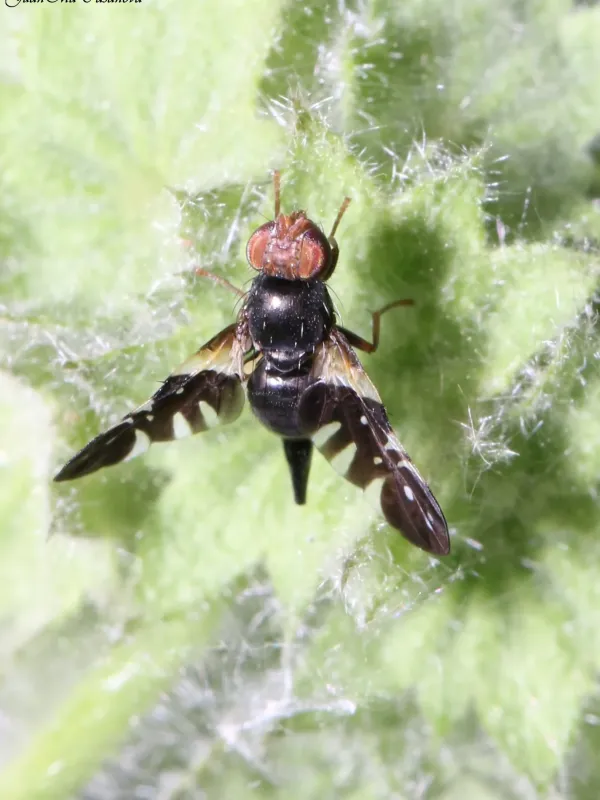
Description
How to identify
The Mauritanian knapweed fly (lat. Urophora mauritanica) belongs to the Tephritidae family, order Diptera. These flies are characterized by their small size and distinctive intricate dark patterns on their wings, resembling a mesh or network.
Adult flies possess slender bodies and prominent compound eyes, which are essential for navigating and locating suitable host plants for oviposition.
The larvae are typically legless, cream-colored, and cylindrical in shape, equipped with mouth hooks specialized for feeding on internal plant tissues within flower heads.
Identification often relies on the specific wing venation patterns and the morphology of the male genitalia, as many species within the Urophora genus share similar external characteristics.
These flies are highly host-specific, having evolved to interact closely with the reproductive structures of plants within the Asteraceae family.
What it damages
The primary hosts for the larvae of this species are plants from the Centaurea genus, commonly known as knapweeds, which are members of the Asteraceae family.
The pest invades the flower heads, where larval feeding induces the plant to create a gall — a pathological growth that protects the larva while providing a constant food source.
By consuming the developing seeds and floral tissues, the larvae significantly reduce the reproductive output of the host plant.
In many regions, this fly is viewed as a beneficial biocontrol agent rather than a pest, as it helps suppress the spread of invasive knapweed species.
The severity of the damage depends on the infestation density and the overall health of the plant population at the site.
When it appears
The life cycle of the Mauritanian knapweed fly is perfectly synchronized with the flowering period of its host plants.
Adult flies emerge in late spring or early summer, coinciding with the development of the first flower buds of the host plants.
After mating, females use their ovipositors to insert eggs directly into the developing flower heads, ensuring a secure environment for their offspring.
Larvae feed and develop throughout the summer months within the gall, systematically destroying the seeds and tissues inside the flower head.
Overwintering occurs in either the larval or pupal stage inside the dried galls, often remaining attached to the plant stem or falling to the soil surface.
Signs of infestation
The most visible sign of infestation is the presence of deformed or pathologically swollen flower heads that fail to open correctly.
Dissecting an affected flower head will reveal the presence of white larvae encased within the hard, woody tissue of the gall.
A lack of viable seeds in the mature flower heads of knapweed is a strong indicator of larval activity and successful pest colonization.
Adult flies can be observed during the blooming season, resting on flower heads or actively seeking sites for egg-laying.
Small, circular exit holes found on the surface of dried flower heads indicate that the adult flies have successfully emerged after completing their development.
Control measures
In agricultural settings, direct control measures are rarely necessary, as this fly primarily targets non-crop weeds rather than vital economic crops.
Deep plowing of the fields during the off-season is an effective mechanical method to bury and destroy the overwintering pupae and larvae.
Mowing or removing weeds before the seeds mature is a highly effective way to interrupt the pest's life cycle and reduce its population in subsequent seasons.
Chemical control is generally avoided to prevent collateral damage to beneficial insects, including bees and other pollinators present in the field.
- Implementing crop rotation schedules.
- Removing wild Centaurea species from field borders.
- Proper sanitation by clearing and destroying infested plant debris.
Taxonomy
- Latin name
- Urophora mauritanica
- Order
- Diptera (flies)
- Family
- Tephritidae
- EPPO code
- URORMA
Discussion
No discussions yet — be the first.