
Thorn bug
Umbonia crassicornis
Description
How to identify
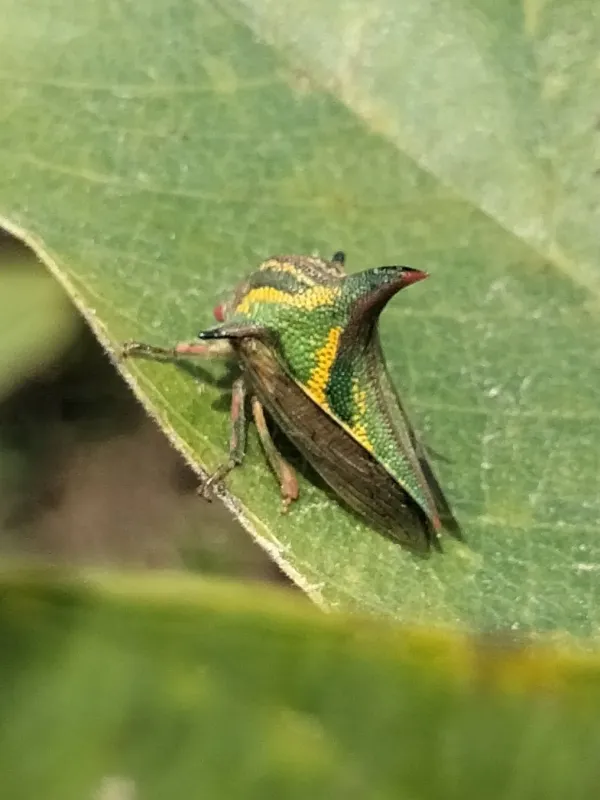
The Thorn bug (Umbonia crassicornis) belongs to the family Membracidae, the treehoppers. It is easily identified by the large, thorn-like dorsal horn on its pronotum, which gives the insect its common name.
Adults exhibit vibrant colors, typically ranging from bright green and yellow to red with dark longitudinal stripes. They measure about 10–12 millimeters in length and are highly conspicuous when perched on plant stems.
Nymphs differ significantly from adults, lacking the developed dorsal horn. They are often covered in small spines or filaments, which provide camouflage against the bark of the host plant.
This species is notable for maternal care, a rare behavior in insects. Females guard their egg clutches, which are laid in bark incisions, and remain in close proximity to the nymphs during their early development stages.
Adults possess the ability to jump rapidly when threatened, which makes mechanical removal or manual capture quite challenging in nursery or garden settings.
What it damages
The Thorn bug is a specialized sap-sucking pest that prefers woody shrubs and trees. It shows a strong preference for plants within the Fabaceae (legume) family.
Key host plants include Calliandra, Albizia, various species of acacia, citrus trees, and hibiscus, making them particularly destructive in ornamental gardens and urban landscapes.
These pests aggregate on young stems and leaf petioles, where they pierce plant tissues with their mouthparts to feed on the nutrient-rich phloem sap.
Large infestations can result in the extraction of significant amounts of plant nutrients, leading to reduced photosynthetic capacity and stunted overall plant development.
Beyond direct feeding, the constant wounding of the plant creates entry points for secondary pathogens, such as fungal infections and various bark cankers.
When it appears
Thorn bug activity is highly dependent on local climate conditions and the growth cycles of their host plants. In tropical and subtropical regions, they can reproduce year-round.
In temperate zones, population peaks occur during spring and summer months, coinciding with the flush of new shoot growth that provides essential nutrition for developing nymphs.
The life cycle encompasses an egg stage, five nymphal instars, and the adult stage. The duration of a single generation can range from several weeks to months based on prevailing temperatures.
Plants become most susceptible to massive colonization during periods of fluctuating moisture, where environmental stress diminishes the host's natural defensive response to pests.
Adult dispersal primarily occurs during warmer weather, as insects actively relocate to adjacent plants to mate and search for fresh food sources.
Signs of infestation
The initial sign of infestation is the appearance of distinct scars on stems where females have inserted their eggs. These areas often appear as small swellings or deformities on the bark.
The presence of large colonies leads to visible distortion and bending of young stems, caused by the continuous draining of sap and damage to growing tissues.
Sticky honeydew secretions left behind by nymphs serve as a medium for sooty mold growth, which manifests as a black, powdery coating on leaves and branches.
Heavy infestations lead to premature leaf drop, dieback of branch tips, and general growth retardation, which significantly compromises the visual quality of ornamental plants.
- Adults with characteristic dorsal horns visible on stems.
- Clustered nymphs resembling spiny bark protrusions.
- Black sooty mold growth on infested stems and leaves.
- Distortion and curling of new plant growth.
Control measures
Effective management begins with the pruning and disposal of heavily infested branches that harbor egg clutches or dense nymphal colonies.
For smaller ornamental gardens, regular inspection combined with mechanical removal using a high-pressure water spray can dislodge and control active nymphal populations.
In cases of severe infestation, systemic insecticides are recommended, as they are translocated through plant tissues and affect the sap-sucking insects during feeding.
Timing is critical: applications should coincide with the period of egg hatching, as young nymphs are more susceptible to insecticides before they develop thicker protective cuticles.
Environmentally friendly options include horticultural oils or insecticidal soaps, which are effective against nymphs while posing a lower risk to beneficial garden insects.
Taxonomy
- Latin name
- Umbonia crassicornis
- Order
- Hemiptera (bugs, aphids, leafhoppers)
- Family
- Membracidae
- EPPO code
- UMBOCR
Discussion
No discussions yet — be the first.