
Vinegar eel
Turbatrix aceti
Description
How to identify
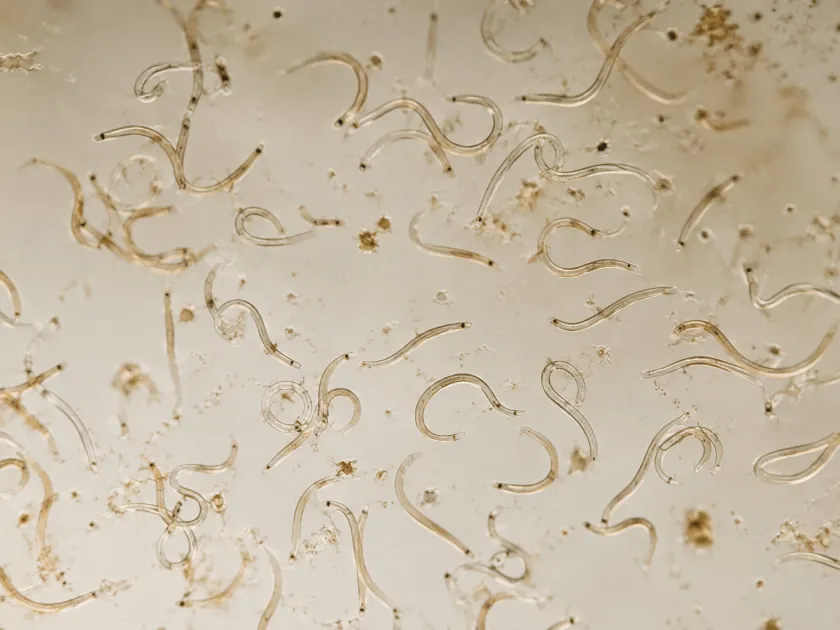
The vinegar eel (Turbatrix aceti) belongs to the phylum Nematoda, order Rhabditida, and family Panagrolaimidae. It is a free-living microscopic worm.
Adults typically measure between 1 to 2 millimeters in length and are commonly found in acidic environments such as fermenting vinegar or decaying fruit.
These organisms reproduce rapidly through viviparity, meaning they give birth to live young, which allows their populations to expand quickly.
They feed primarily on the yeast and acetic acid bacteria that grow in the fermentation media, making them common in poorly managed vats.
Their body structure is thin and translucent, enabling them to move through viscous liquids with undulating, snake-like swimming motions.
What it damages
The vinegar eel is considered a significant pest in the food and beverage industry, particularly in the production of natural vinegars and wines.
Infestation compromises product quality, making it unacceptable for commercial sale due to sanitary regulations regarding live organisms in food.
While not a direct agricultural plant parasite, they can thrive in agricultural by-products and waste, potentially spreading if sanitation is poor.
The economic impact is high because an infested batch often requires complete destruction and extensive decontamination of all affected machinery.
They can contaminate production lines, leading to long-term issues if the source of the infestation is not completely eradicated from the facility.
Signs of infestation
A key indicator of infestation is the appearance of turbidity or a visible film on the surface of the vinegar, which may ripple due to nematode activity.
Using a magnifying glass or microscope, you can detect the presence of the worms by their continuous, rapid swimming behavior in the liquid.
Affected products may exhibit an off-smell or a change in clarity caused by the presence of large clusters of the nematodes and their by-products.
Slime buildup on the inner walls of storage tanks or piping systems often indicates the presence of established nematode colonies.
Monitoring for these signs during the maturation or storage phase is critical to preventing large-scale product loss in food processing plants.
Control measures
Control of vinegar eels relies heavily on maintaining rigorous hygienic standards and strict process control within the production facility.
Heat treatment, specifically pasteurization, is the most effective way to eliminate these nematodes, as they cannot survive temperatures above 50°C.
Frequent and thorough cleaning of tanks, valves, and pipelines with industrial disinfectants is essential to prevent re-colonization.
Ensuring that all storage containers are properly sealed prevents the introduction of the nematodes from external sources like fruit flies or airborne particles.
Regular laboratory screening of samples from different stages of production ensures early detection and immediate action against potential infestations.
Taxonomy
- Latin name
- Turbatrix aceti
- Order
- Nematodes
- Family
- Panagrolaimidae
- EPPO code
- TURBAC
Discussion
No discussions yet — be the first.