
Picture-winged fly
Trupanea wheeleri
Description
How to identify
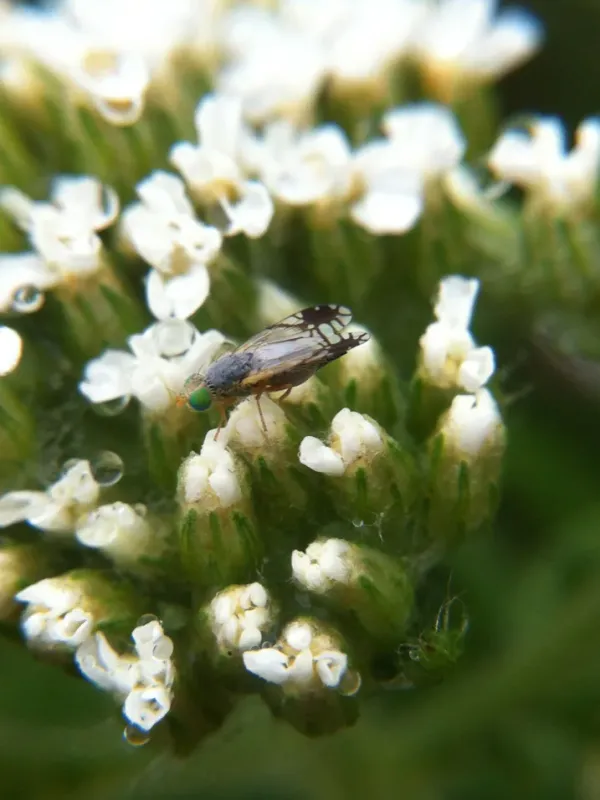
The Trupanea wheeleri is a species of fruit fly belonging to the family Tephritidae. Adult flies are characterized by their intricate wing patterns, featuring dark spots and bands that serve as a form of camouflage against the host plant's flowers.
These flies have relatively small bodies, with a specialized ovipositor in females designed to pierce the thick tissues of floral buds to lay eggs. Their head features prominent compound eyes, which are essential for navigating and locating suitable host plants.
The larval stage is spent entirely inside the plant tissues, often hidden within the floral receptacle. The larvae are apodous (legless) and possess mouthparts specifically adapted for consuming plant juices and internal tissues of the flower head.
Accurate identification of this species is complex due to the morphological similarity between various Trupanea species. Identification often requires expert examination of the wing venation patterns and the male or female genitalia structures.
As a highly specialized herbivore, this pest depends entirely on the reproductive structures of Asteraceae plants for its survival and development.
What it damages
Trupanea wheeleri larvae target plants within the Asteraceae family. They are primarily seed predators, consuming developing seeds and parts of the floral receptacle, which results in direct yield losses.
Infestation leads to reduced seed quality and quantity. For seed producers, this damage is economically significant as it directly affects the marketability and germination rate of the harvested seeds.
The feeding activity of the larvae creates entry points for various pathogens, leading to secondary infections. Fungal and bacterial colonizers often thrive in the damaged tissues, accelerating the decay of the entire floral head.
In intensive cultivation, the impact of this fly can be devastating if not controlled. By damaging the embryo within the developing seed, the larvae effectively destroy the future plant's potential viability.
The severity of damage correlates with the fly population density during the bud development stage. High infestations can lead to substantial reductions in total harvestable seeds.
When it appears
The life cycle of Trupanea wheeleri is tightly synchronized with the phenology of its host plants. The first generation of adults emerges at the onset of bud formation, allowing them to deposit eggs in optimal conditions.
Overwintering usually occurs in the pupal stage, buried in the soil or protected within dried floral remnants. This strategy allows the insect to survive harsh winter temperatures until environmental conditions become favorable.
Adult emergence in spring is triggered by rising temperatures and photoperiod shifts. Depending on the local climate and host availability, several generations can develop within a single growing season.
The peak of damage occurs during the flowering period when larvae are most active in consuming the internal structures of the flower. Once mature, the larvae pupate in situ or drop into the soil.
Climatic factors, such as temperature and humidity, significantly influence the population dynamics. Warm and extended summers provide the perfect conditions for multiple generations, exacerbating the infestation pressure.
Signs of infestation
Early signs of infestation include tiny punctures on the involucral bracts, which are created by the female's ovipositor. These marks are often accompanied by localized tissue discoloration.
Visually, affected flower heads may appear stunted or malformed. Growth is frequently arrested, and petals may drop prematurely, leading to an overall withered or unhealthy appearance of the flower head.
Upon dissecting the flower head, one can usually find cream-colored larvae feeding within the seed zone. Their presence is often marked by the destruction of developing seeds.
The accumulation of larval frass (excrement) inside the flower head is a common indicator. This waste material creates a dark, damp, and decaying environment that invites further opportunistic mold infections.
Field observation of adult flies resting on flower heads during early morning or evening hours is a strong indicator that egg-laying is occurring or about to occur.
Control measures
Effective management begins with strict agrotechnical measures, such as the systematic removal and destruction of wild Asteraceae weeds that act as reservoir hosts for the flies.
Post-harvest deep plowing of the soil is a critical step in reducing the population. By burying the pupae at depth, many individuals fail to emerge in the following season.
For high-value or ornamental crops, the use of protective netting can physically prevent females from accessing the buds, successfully eliminating the risk of larval infestation.
Chemical control via systemic insecticides may be necessary in areas with high infestation rates. Applications must be timed precisely during the early bud formation phase, before flowers fully open.
- Deploy yellow sticky traps for monitoring adult flight and determining treatment timing.
- Promptly rogue and incinerate infested flower heads to prevent larval migration and further spread.
- Maintain spatial isolation between commercial Asteraceae crops and wild habitats.
Taxonomy
- Latin name
- Trupanea wheeleri
- Order
- Diptera (flies)
- Family
- Tephritidae
- EPPO code
- TRUPWH
Discussion
No discussions yet — be the first.