
Trupanea bisetosa
Trupanea bisetosa
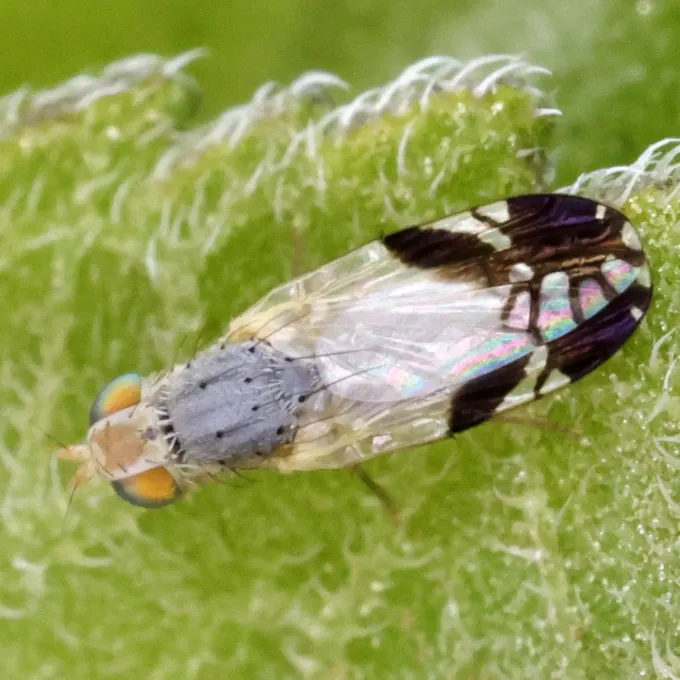
Description
How to identify
Trupanea bisetosa is a member of the Tephritidae family, commonly known as fruit flies or picture-winged flies, within the order Diptera.
Adult flies are small, characterized by a distinct, mottled wing pattern which is typical for this family. The species name reflects the presence of specific bristles on the body.
The body coloration is usually brownish or yellowish, with a length of only a few millimeters. The head is round with well-developed compound eyes.
The life cycle follows a holometabolous development: egg, larva, pupa, and adult. Pupation typically occurs within the plant tissue or in the soil, depending on environmental conditions.
This species is a specialist pest, primarily targeting specific botanical families. Identification usually involves examining inflorescences during the budding and flowering stages.
What it damages
The primary hosts for Trupanea bisetosa larvae are plants belonging to the Asteraceae family, commonly referred to as the daisy or sunflower family.
The larvae feed within the flower heads (capitula), making the pest particularly dangerous for seed production, industrial crops, and ornamental plants.
By consuming the developing seeds and ovaries, the larvae cause significant losses in yield and reduced seed viability. This can render the harvest unsuitable for commercial use.
Infested flower heads often show signs of deformation and premature wilting due to internal tissue consumption by the feeding larvae.
Severe infestations can lead to a total loss of seed quality, necessitating strict monitoring and management on seed-production fields.
Signs of infestation
The most reliable sign of an infestation is the presence of small entry holes in the base or sides of the flower heads. Opening a capitulum will reveal larvae or their frass.
Visually, affected flower heads often appear underdeveloped or shriveled compared to healthy ones. Petals may wither or turn brown before their expected lifespan.
Increased activity of adult flies around plants during the flowering period is a clear indicator of potential egg-laying activity.
Dissecting a flower head often reveals damaged, necrotic seeds that have turned brown or disintegrated. Sometimes, secondary fungal infections occur in the damaged tissue.
Field scouting should focus on patches where flowering seems uneven or where seeds are shedding prematurely, as these are strong indicators of larval presence inside the receptacle.
Control measures
Cultural control is the first line of defense, which involves removing Asteraceae weeds near the fields that serve as reservoirs for the population.
Crop rotation helps interrupt the life cycle, as the pest is highly dependent on specific host plants. Deep plowing after harvest can destroy pupae overwintering in the soil.
During the peak flight of adults, contact-action insecticides are effective. It is critical to apply these treatments before the flies have a chance to lay eggs into the buds.
Biological control involves the use of natural enemies or parasitoids that target the larvae. Pheromone or yellow sticky traps are excellent for monitoring adult flight times.
- Regular inspection and culling of infested plant material.
- Monitoring population density using yellow sticky traps.
- Application of pyrethroid-based insecticides during the pre-flowering stage.
Taxonomy
- Latin name
- Trupanea bisetosa
- Order
- Diptera (flies)
- Family
- Tephritidae
- EPPO code
- TRUPBI
Discussion
No discussions yet — be the first.