
Booklouse
Trogium
Description
How to identify
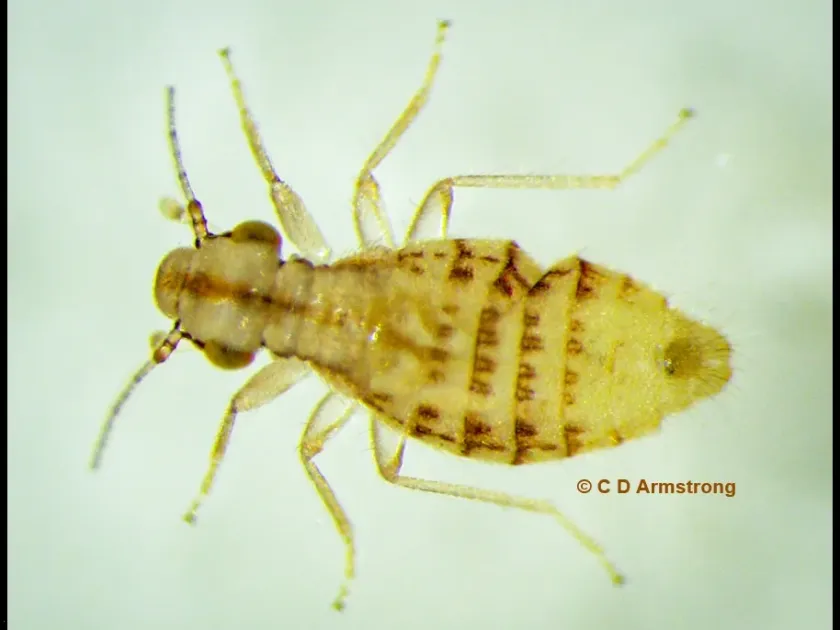
The booklouse (Trogium pulsatorium) belongs to the order Psocoptera, commonly known as barklice or booklice, within the family Trogiidae. It is a tiny, wingless insect measuring approximately 1 to 2 mm in length.
The insect possesses a soft, pale-colored body ranging from yellowish to white. They have long, filiform antennae and chewing mouthparts specialized for grazing on microscopic fungi.
These pests reproduce via parthenogenesis, allowing a single individual to initiate an entire population in a new location. They are highly dependent on environmental moisture to survive.
Adult booklice are known for their ability to produce rhythmic clicking sounds by striking their abdomens against surfaces, which has historically led to superstitions regarding their association with death.
Their life cycle consists of egg, nymph, and adult stages. Because they are highly sensitive to desiccation, they are most active in humid, undisturbed environments with poor ventilation.
What it damages
In agriculture, the booklouse acts as a secondary pest that thrives in stored grain, seeds, and dried plant samples. They primarily consume microscopic molds that grow on organic substrates.
While they do not usually destroy the internal structure of healthy, dry seeds, their presence is a clear indicator that the stored material has become too moist and is beginning to decay.
The infestation can damage seed germination potential by consuming the protective coating of the seed or the germ itself if it has been softened by fungal growth.
Large populations contribute to the contamination of stored commodities with their excrement, cast-off exuviae, and bodies, rendering the grain unsuitable for commercial processing.
Furthermore, they play a role in spreading mold spores throughout a grain pile, effectively accelerating the spoilage of the entire stored batch.
Signs of infestation
Identifying an infestation can be challenging due to their minuscule size. They are often mistaken for moving dust particles until observed under magnification.
A primary indicator of their presence is the appearance of small, scurrying insects on the surface of grain bags, shelves, or wall surfaces in storage rooms with high humidity.
A musty or earthy odor in a storage facility is a classic sign of the fungal activity required to support a booklouse colony, signaling an urgent need for inspection.
In damaged seed batches, microscopic feeding marks on the surface of the seed coats or the presence of fine, powdery dust indicate significant pest activity.
In very quiet rooms, the distinct clicking noise made by adults can serve as an audible warning that the pest population has reached a significant level of density.
Control measures
The most effective strategy for managing booklice is the strict control of humidity. Keeping relative humidity below 50% creates an environment where they cannot survive or reproduce.
Good housekeeping practices, such as removing dust, debris, and spilled grain, are essential to eliminate food sources for both the molds and the insects.
Proper aeration of stored products prevents the development of the moisture pockets that booklice require. Regular monitoring of grain temperature and moisture levels is crucial.
If chemical control is necessary, apply registered insecticides as directed, focusing on cracks, crevices, and storage surfaces where the insects congregate during the day.
- Maintain storage humidity below 50%.
- Ensure adequate ventilation in storage rooms.
- Clean up all spilled grain and organic dust immediately.
- Inspect new inventory to prevent introducing the pest.
Taxonomy
- Latin name
- Trogium
- Family
- Trogiidae
- EPPO code
- TROUSP
Discussion
No discussions yet — be the first.