
Booklouse
Lepinotus inquilinus
Description
How to identify
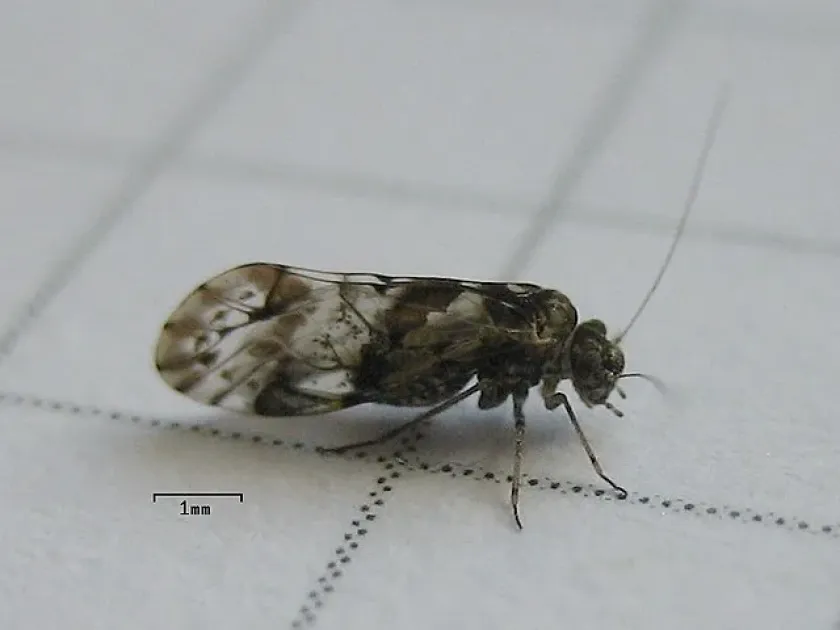
The booklouse (Lepinotus inquilinus) is a small insect belonging to the order Psocoptera and the family Trogiidae. These insects are typically 1–2 mm long, soft-bodied, and range from pale yellow to light brown in color.
They possess a chewing mouthpart and long, thread-like antennae consisting of multiple segments, which helps distinguish them from other small store insects.
They are wingless and rely on crawling as their primary mode of movement. Their physiological survival is strictly dependent on high relative humidity levels.
The life cycle involves an egg stage, several nymphal instars, and the adult stage. The transition from egg to adult is influenced by environmental temperature and moisture.
Under favorable conditions (20–25°C and high humidity), the entire life cycle can be completed in about one month, leading to rapid population expansion.
What it damages
The booklouse primarily feeds on microscopic mold and fungi that grow on damp organic materials, including stored grain, flour, books, and insect collections.
While they do not usually consume the bulk of the product, their presence indicates fungal growth, which is a major concern for food quality and safety.
Direct damage to stored grains includes the consumption of the germ, which negatively affects the nutritional value and germination potential of seeds.
Product contamination via excrement, cast skins, and fungal spores makes the affected goods aesthetically and hygienically unacceptable for distribution.
In large-scale storage, they often act as a precursor to more severe pest infestations by preparing the substrate with fungal growth.
Signs of infestation
The presence of tiny, rapidly moving insects on shelves, bags, or near damp wall corners is the most obvious sign of an infestation.
A dusty appearance on product surfaces, caused by the accumulation of insect frass and shed skins, indicates established populations.
A musty or moldy odor emanating from the storage area is a frequent secondary sign that the environmental conditions favor both mold and booklice.
Physical evidence of feeding may appear as fine, irregular scrapings on paper surfaces, book bindings, or cardboard packaging where moisture has accumulated.
Regular monitoring using glue traps can detect the early stages of infestation before populations reach critical levels.
Control measures
The most effective strategy is the rigorous control of humidity levels. Keeping warehouse air relative humidity below 60% prevents mold growth, effectively starving the pest.
Sanitation is critical; all spillages, dust, and debris must be removed regularly to eliminate potential food sources and nesting sites.
Proper building maintenance, such as fixing leaks and improving ventilation, prevents local moisture buildup that booklice thrive upon.
In cases of severe infestation, professional fumigation or the application of approved contact insecticides may be necessary to eliminate established colonies.
Proper inspection of incoming goods and the use of dry, clean storage containers significantly reduce the risk of introducing booklice into the facility.
Taxonomy
- Latin name
- Lepinotus inquilinus
- Family
- Trogiidae
- EPPO code
- LEPNIN
Discussion
No discussions yet — be the first.