
Trirhithrum meladiscum
Trirhithrum meladiscum
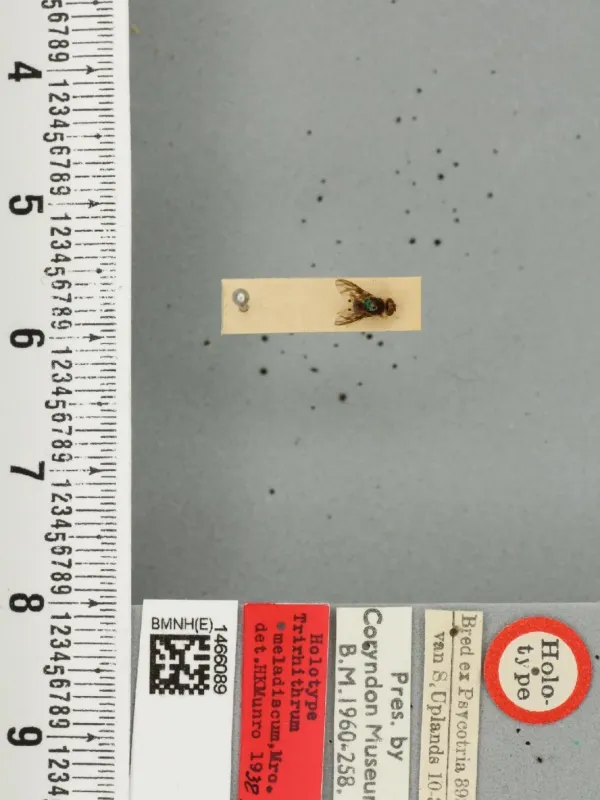
Description
How to identify
Trirhithrum meladiscum is a species of fruit fly belonging to the family Tephritidae, order Diptera. This species is part of a complex of fruit flies that are morphologically similar, often requiring detailed examination for accurate identification.
Adult flies exhibit distinct wing patterns typical of tephritids, which serve as a camouflage against the plant surface. Distinguishing this species from its congeners often requires microscopic inspection of specific morphological features.
The larvae are typically maggot-like, devoid of head and limbs, specialized for life inside the fruit tissue. This cryptic nature makes them difficult to spot until significant internal damage has already occurred.
The adults are highly mobile, capable of flying over long distances to seek out suitable host plants for oviposition. Their life cycle is synchronized with the phenology of their preferred fruit crops.
As a pest endemic to the Afrotropical region, its presence is of significant quarantine concern, as it poses a risk to agricultural trade and the export of fresh fruit products.
What it damages
The larval stage causes the most significant damage by feeding on the pulp of host fruits. The host range is typically limited to specific fruit-bearing plants found within its native distribution range.
Damage occurs when larvae consume the internal flesh of the fruit, rendering it commercially unmarketable. Infestations are often detected too late to save the affected portion of the harvest.
Premature fruit drop is a common consequence of larval infestation, leading to substantial yield losses in orchards. Furthermore, oviposition punctures allow secondary pathogens like fungi and bacteria to enter.
Once the larvae settle inside the fruit, they create intricate tunnels that result in tissue decay and liquefaction of the pulp. The presence of larval excrement and secondary decay makes the fruit entirely unfit for consumption.
In regions where Trirhithrum meladiscum is established, the cumulative damage can lead to major economic impacts, necessitating intensive monitoring and preventive pest management practices.
When it appears
The activity of Trirhithrum meladiscum adults is heavily influenced by climatic factors, particularly ambient temperature and humidity levels, which dictate their seasonal movement.
Oviposition coincides with the fruit ripening period, as the female fly requires soft skin to pierce with her ovipositor. This biological dependency creates clear seasonal pulses of infestation.
In tropical environments, reproduction may occur throughout the year, but in areas with distinct dry and wet seasons, activity peaks correlate closely with the fruiting phenology of host trees.
Developmental rates for larvae and pupae are optimized by moderate temperatures, enabling multiple generations to occur within a single growing season if food sources are available.
The species survives adverse conditions by overwintering as puparia in the soil under host plants or within fallen, mummified fruits until favorable conditions trigger adult emergence.
Signs of infestation
The first external sign of infestation is often small, pin-prick punctures on the fruit surface, which may develop into soft, discolored spots as the tissue underneath decays.
Cutting open a suspected fruit usually reveals internal tunneling and liquefaction, accompanied by a foul smell resulting from the presence of larvae and secondary decomposition.
Unexplained premature fruit drop is a strong indicator of an internal pest infestation, suggesting that larvae are developing within the fallen crop.
Fеromone traps are the most effective way to detect adult populations early in the season, providing an early warning system before eggs are laid in developing fruit.
In advanced stages of the infestation, one might observe emergence holes on the fruit surface, left by the larvae that have exited to pupate in the soil.
Control measures
Rigorous phytosanitary measures, including the inspection of imported fruit, are essential to prevent the spread of Trirhithrum meladiscum to non-infested areas.
Sanitation practices, such as the prompt collection and destruction of fallen or infested fruit, are critical to interrupting the pest's life cycle and preventing further pupation.
Chemical control involving systemic or contact insecticides can target adult flies, though application must be carefully timed to minimize risks to non-target species and residue limits.
Biological control using specific natural enemies or parasitoids can play a role in suppressing population levels within stable ecosystems.
- Regular monitoring with pheromone traps.
- Immediate removal and disposal of infested fruit.
- Soil tilling to disturb puparia under host trees.
- Integrated pest management (IPM) using biopesticides.
Taxonomy
- Latin name
- Trirhithrum meladiscum
- Order
- Diptera (flies)
- Family
- Tephritidae
- EPPO code
- TRRUME
Discussion
No discussions yet — be the first.