
Coffee fruit fly
Trirhithrum coffeae
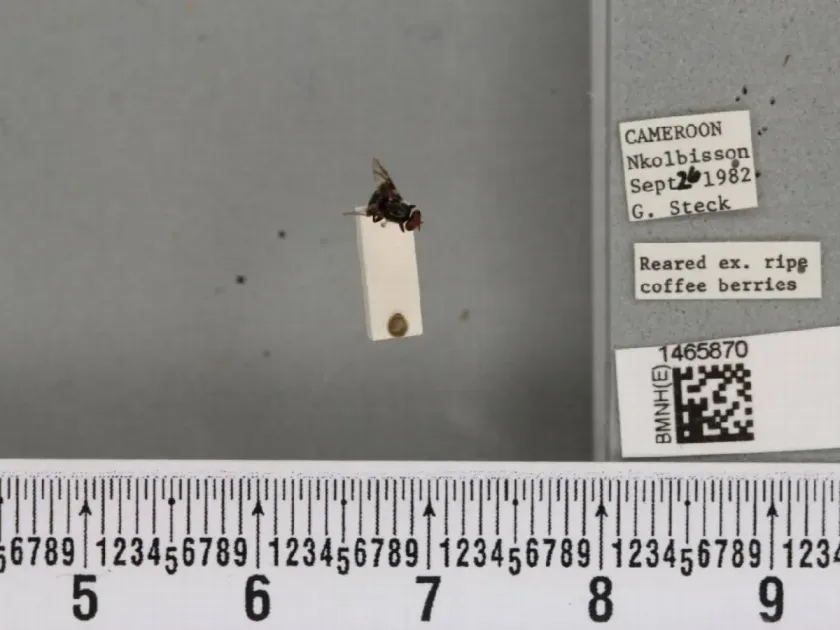
Description
How to identify
The Trirhithrum coffeae belongs to the Tephritidae family, order Diptera. These flies are recognized by their distinct wing patterns, which are a characteristic feature of this family of fruit flies.
Adult flies are small but agile, with well-developed vision adapted to locating host fruits. The females possess an ovipositor used to penetrate the outer layer of coffee berries.
Larvae develop internally, consuming the pulp of the coffee cherry. They are typically pale, legless, and remain hidden from view until the fruit is opened for inspection.
The life cycle is closely tied to environmental temperatures and humidity, which determine the rate of maturation from egg to adult and the number of generations per year.
This species is a specialized pest that has evolved in close association with coffee plants (genus Coffea), making it a significant challenge for professional coffee growers.
What it damages
The primary hosts are coffee species like Coffea arabica and Coffea canephora. The pest targets developing cherries, directly impacting the marketable yield.
Larval feeding causes the destruction of the fruit pulp and often leads to the degradation of the coffee beans themselves, rendering them unsuitable for high-quality processing.
The mechanical injury caused by the larvae often provides an entry point for secondary pathogens, such as fungi and bacteria, which cause the fruit to rot prematurely.
Heavy infestations result in significant yield losses due to the premature abscission of fruit, leading to smaller harvests and lower overall farm profitability.
The quality of the final product is severely compromised if the damage to the beans is extensive, as it affects the flavor and aroma profile essential for the coffee market.
Signs of infestation
The first signs of infestation are small, dark puncture marks on the skin of the cherries, where the female has inserted her ovipositor to deposit eggs.
Color changes are often visible, with infested fruits ripening irregularly. Cherries may exhibit premature browning or yellowing compared to healthy fruit on the same branch.
Upon opening a suspected cherry, one may find internal tunnels and the presence of larvae. The pulp may appear liquefied or decayed due to larval activity.
The accumulation of waste products inside the fruit is another clear sign of active infestation, often accompanied by a distinct odor associated with fruit decay.
Significant fruit drop under the trees, especially if the fallen cherries are premature or damaged, is a strong indicator of an active coffee fruit fly population.
Control measures
Field sanitation is the most effective cultural control. Collecting and destroying all fallen and infested fruit breaks the pest's cycle by removing the larvae from the soil.
Monitoring with pheromone or attractant traps allows growers to detect the arrival of adults and determine the precise timing for intervention, reducing unnecessary chemical use.
Chemical control involving approved insecticides can be used to target adult flies before they have the chance to oviposit in the ripening coffee cherries.
Biological control, including the release of specific parasitoid wasps or the use of entomopathogenic fungi, is gaining popularity as a sustainable management strategy.
Pruning and canopy management help maintain lower humidity levels within the plantation, making the environment less favorable for the survival and reproduction of the fly.
Taxonomy
- Latin name
- Trirhithrum coffeae
- Order
- Diptera (flies)
- Family
- Tephritidae
- EPPO code
- CERTCF
Discussion
No discussions yet — be the first.