
Silver-wedge fruit fly
Trirhithrum argenteocuneatum
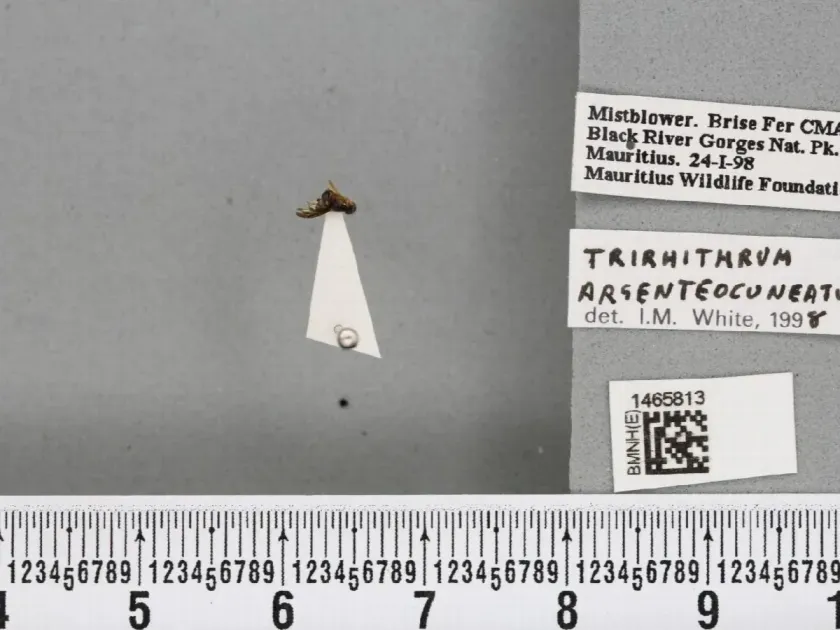
Description
How to identify
Trirhithrum argenteocuneatum is a species of the Tephritidae family, commonly known for the distinct silver-wedge shaped patterns on its wings. This coloration helps in identification.
Adult flies possess well-developed compound eyes and a dark, often metallic-looking body. Their morphology is highly adapted for survival and host-seeking within complex orchard environments.
The larvae are typically legless and maggot-shaped, adapted for burrowing deep into the fleshy tissues of host fruits, which serves as both their shelter and primary food source.
The life cycle begins with the female using her ovipositor to insert eggs beneath the skin of a healthy fruit, which is a critical phase for the start of the infestation.
Development proceeds through egg, three larval stages, pupation (usually in the soil or decaying fruit), and finally, the emergence of the adult insect.
What it damages
This pest targets a variety of tropical and subtropical fruits. It represents a significant threat to commercial orchards where host plants are grown in large quantities.
Host plants include coffee and various other fruits that are economically significant in the regions where the pest is established and thrives.
Larval feeding causes the fruit's interior to liquefy and rot rapidly. This damage often renders the entire fruit unmarketable and unsuitable for human consumption.
The economic impact can be severe, leading to high yield losses, especially if monitoring and mitigation measures are neglected during the critical ripening stages.
Besides larval damage, the entry points made by the female for egg-laying serve as vectors for opportunistic pathogens, including secondary fungal and bacterial rot infections.
When it appears
Adult activity is highly synchronized with the fruit ripening stages. In tropical climates, the fly can maintain continuous generations throughout the year if host fruits are available.
Peak emergence typically occurs during periods when fruits are becoming soft and sugar-rich, which are the optimal conditions for larval survival and development.
Warm temperatures (20–30°C) accelerate the insect's life cycle, allowing for multiple generations to occur within a short period, leading to explosive population growth.
The pupal stage is the primary overwintering or dormant phase, where the pest remains in the soil waiting for favorable weather and the availability of suitable hosts.
Monitoring for adult flies using traps is essential for planning effective control measures throughout the growing season.
Signs of infestation
The first sign of infestation is usually the presence of minute puncture marks on the fruit skin, often surrounded by a small area of discoloration or bruising.
Internal damage becomes evident as the larvae consume the fruit pulp, creating galleries. The tissue eventually loses its structural integrity and begins to ferment or rot.
Premature fruit drop is a common indicator of a severe infestation. This occurs as the fruit's physiology is disrupted by the feeding larvae and associated secondary infections.
- small puncture marks on the skin;
- premature fruit abscission and drop;
- soft and discolored areas on the fruit surface;
- presence of larvae within the fruit pulp;
- fermented or unpleasant odor emanating from the fruit.
Early visual diagnosis is critical for intervention, as the damage is often irreversible once the larvae have deeply penetrated the fruit tissues.
Control measures
Good agricultural practices are the first line of defense: regular collection and disposal of fallen fruit prevents the completion of the larval development cycle.
The use of traps baited with lures and attractants provides an effective way to monitor adult populations and apply insecticide treatments only when strictly necessary.
Biological control methods involve the release of parasitoids or the use of entomopathogenic fungi, which are natural enemies of fruit flies and help regulate populations.
Chemical control must be applied with caution, ensuring that selected insecticides are registered for the specific crop and that pre-harvest intervals are strictly respected.
Quarantine measures are vital to prevent the movement of Trirhithrum argenteocuneatum to uninfested regions, ensuring the protection of local biodiversity and fruit industries.
Taxonomy
- Latin name
- Trirhithrum argenteocuneatum
- Order
- Diptera (flies)
- Family
- Tephritidae
- EPPO code
- TRRUAR
Discussion
No discussions yet — be the first.