
Trichopria drosophilae
Trichopria drosophilae
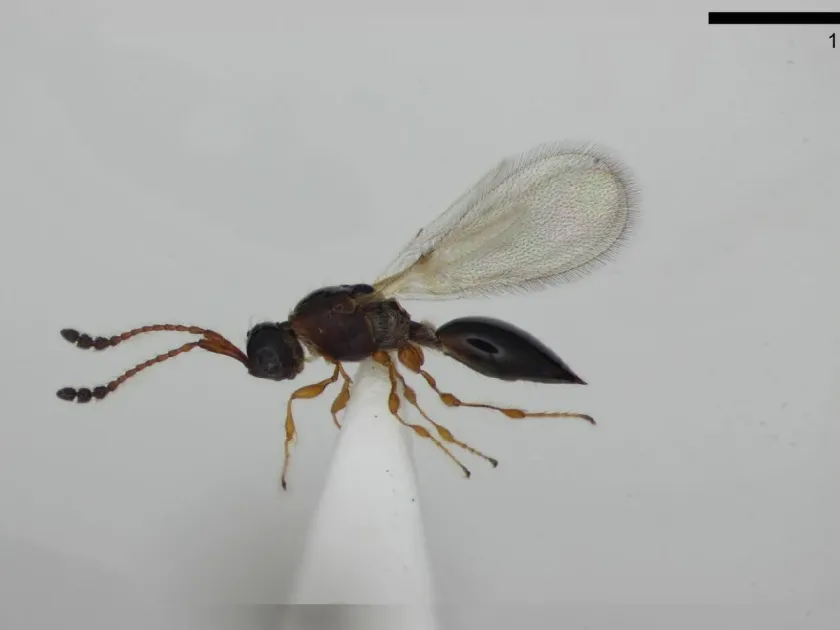
Description
How to identify
Trichopria drosophilae is a tiny Hymenopteran parasitoid belonging to the family Diapriidae. It is a highly specialized insect that targets larvae and pupae of various fruit fly species.
The adult wasp is small, typically measuring 1 to 2 millimeters in length. It possesses a dark-colored body and functional wings, allowing it to move across orchards and berry patches in search of host sites.
The life cycle involves finding the pupae of target flies and using a specialized ovipositor to pierce the outer shell and insert an egg directly into the host.
The development of the wasp occurs entirely within the host puparium. The larval stage feeds on the tissues of the fly, eventually consuming it and undergoing pupation within the shell.
Finally, the adult wasp emerges by chewing a small exit hole through the host's pupal case, marking the completion of its life cycle and the destruction of the pest.
What it damages
Trichopria drosophilae does not cause any damage to plants. On the contrary, it is considered a beneficial insect because it acts as an effective natural predator of the spotted-wing drosophila (Drosophila suzukii).
Drosophila suzukii is a significant agricultural pest that attacks thin-skinned fruits such as strawberries, raspberries, blackberries, blueberries, cherries, and grapes.
By parasitizing the larvae of these flies, Trichopria drosophilae interrupts their life cycle, preventing them from developing into adults and attacking further fruit crops.
Therefore, this wasp is an important ally for growers, serving as a biological agent that helps reduce the need for excessive chemical pesticide applications.
In the context of modern agronomy, protecting this parasitoid population is essential for maintaining the health of the agroecosystem and controlling fruit fly infestations.
When it appears
The activity of Trichopria drosophilae typically follows the seasonal abundance of its hosts, beginning in the spring and lasting through the end of autumn.
The wasps are most active during the period of fruit ripening, as this is when the density of target fly larvae is high enough to sustain a growing parasitoid population.
Warm temperatures generally accelerate the wasp's development cycle, allowing for several generations per season depending on the local climate and host availability.
Overwintering occurs at the pupal stage within the host puparia, which are often found in soil or decaying organic matter at the base of fruit plants.
In greenhouse environments with controlled temperatures and year-round host availability, Trichopria drosophilae can maintain continuous reproduction cycles.
Signs of infestation
The most reliable sign of Trichopria drosophilae presence is the appearance of small, perfectly circular exit holes on the puparia of target fruit flies.
These exit holes, usually measuring less than 1 millimeter, distinguish parasitized pupae from those that have been damaged or opened by other environmental factors.
Monitoring the emergence rates of Drosophila suzukii using specialized trapping methods can reveal the impact of parasitism; a lower emergence rate of the pest often points to effective biological control.
Laboratory dissection of collected field pupae is the most accurate method to confirm the parasitism rate and the presence of developing wasp larvae inside the host tissues.
Visual identification of adult wasps is challenging due to their small size, but they may occasionally be spotted on flowers or fruit clusters during peak daylight hours.
Control measures
The primary management strategy concerning Trichopria drosophilae is the preservation and support of its population through sustainable farming practices.
- Avoiding broad-spectrum insecticides that are toxic to beneficial parasitoids, especially during critical berry ripening phases.
- Implementing integrated pest management (IPM) programs that prioritize the use of selective, biorational pesticides.
- Sanitation measures, such as removing fallen fruit and decaying organic matter, which reduces both the pest habitat and potential overwintering sites for the wasp.
- Maintaining field margins and biodiversity strips to provide shelter and alternative food sources for adult wasps.
By integrating these practices, growers can leverage the natural predatory potential of Trichopria drosophilae to keep fruit fly damage below economic injury thresholds.
Taxonomy
- Latin name
- Trichopria drosophilae
- Order
- Hymenoptera
- Family
- Diapriidae
- EPPO code
- TRIRDR
Discussion
No discussions yet — be the first.