
Spilomicrus antennatus
Spilomicrus antennatus
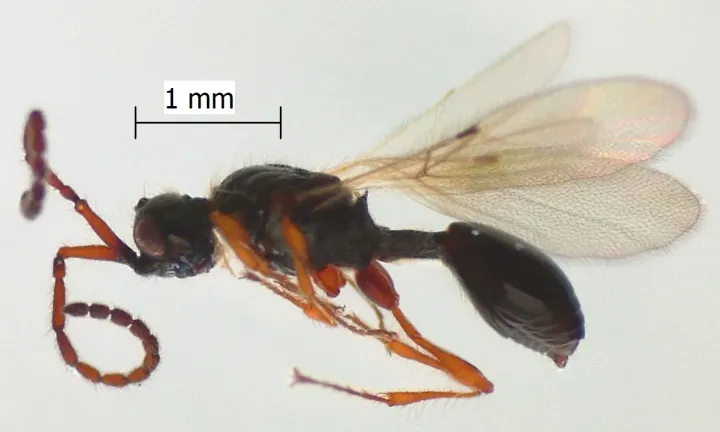
Description
How to identify
Spilomicrus antennatus is a species of parasitic wasp belonging to the family Diapriidae within the order Hymenoptera. These tiny insects are specialized parasitoids, primarily targeting the larvae of various fly species.
The morphology of this species is characterized by distinct antennal features, which are vital for identification among the diverse family of Diapriidae. Adults are small, dark-colored, and often inconspicuous in the field.
Females utilize specific chemical cues (kairomones) to locate the puparia of host flies hidden within soil or decomposing organic matter, where they subsequently deposit their eggs.
The life cycle encompasses a complete metamorphosis, including egg, larval, pupal, and adult stages, each adapted to survive within the protective confines of the host's environment.
Accurate identification usually requires specialized entomological expertise and microscopic examination of the male and female terminalia.
What it damages
While primarily recognized as a parasitoid, Spilomicrus antennatus can contribute to plant stress when its host populations (fly larvae) are abundant and physically damaging to crop root systems.
Plants affected include various vegetables and cereals, where the larvae of host flies feed on roots, causing wilting, stunted growth, and eventually plant mortality.
Secondary damage occurs when the feeding sites of the fly larvae act as entry points for phytopathogenic fungi and bacteria, leading to further root rot and vascular collapse.
In greenhouse settings, the presence of these wasps is an indicator of underlying pest pressure, necessitating an integrated approach to manage the entire host-parasite complex.
Economic impact is mainly linked to the cumulative stress placed on young seedlings during their most vulnerable developmental stages.
##season##The activity of Spilomicrus antennatus is highly dependent on soil temperature and humidity, usually peaking when host fly populations are most active during the spring and summer months.
In controlled environments like greenhouses, the population can remain active throughout the year, provided there is a continuous supply of host pupae and suitable soil conditions.
Overwintering typically occurs in the larval or pupal stage inside the puparium of the host fly, nestled within the top layer of the soil profile.
The emergence of adults is highly synchronized with the lifecycle of the host, ensuring that the wasps have immediate access to suitable targets for reproduction.
Multiple generations per year are possible in warmer regions, allowing the population to build up rapidly if environmental conditions remain stable.
Signs of infestation
The most reliable sign of activity is the presence of minute exit holes in fly puparia found within the rhizosphere of affected plants, indicating successful wasp development.
Adult wasps can be monitored using yellow sticky traps placed close to the soil surface or the base of the crop canopy.
Plants may exhibit signs of nutrient deficiency, such as yellowing leaves (chlorosis), despite adequate fertilization, reflecting root system disruption.
A sudden, unexplained decline in crop vigor in specific patches of the field often indicates a localized infestation of host flies and their associated parasitoids.
Visual inspection of the soil surface during irrigation cycles can sometimes reveal adult wasp activity, particularly in early morning hours.
Control measures
Integrated Pest Management (IPM) is essential for controlling this complex, starting with strict crop rotation to reduce the availability of host fly breeding sites.
Soil management practices, such as proper drainage and debris removal, are highly effective in limiting the habitat suitability for the fly larvae that the wasps rely on.
Biological control using entomopathogenic fungi, such as Beauveria bassiana or Metarhizium anisopliae, can help manage both the host and the parasitoid populations effectively.
Chemical intervention should be considered a last resort and must be targeted to avoid harming beneficial predators or pollinators within the ecosystem.
- Implementation of physical barriers like fine-mesh screening in greenhouses.
- Regular monitoring of soil health and fly activity.
- Sanitation practices that remove host-breeding organic matter.
Taxonomy
- Latin name
- Spilomicrus antennatus
- Order
- Hymenoptera
- Family
- Diapriidae
- EPPO code
- SPLCAN
Discussion
No discussions yet — be the first.