
Coptera
Coptera
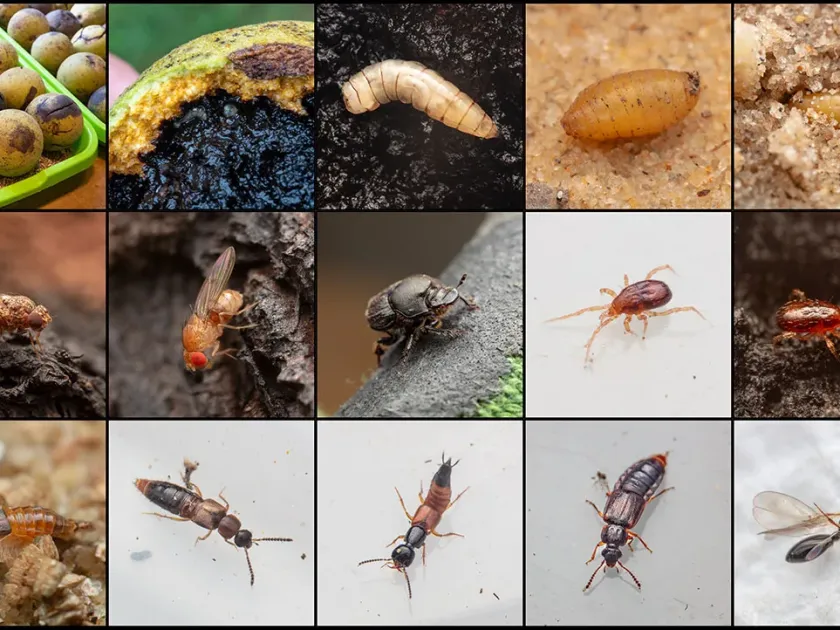
Description
How to identify
The genus Coptera belongs to the order Hymenoptera, family Diapriidae. These are tiny parasitic wasps that play a significant role in agricultural ecology.
Physically, the adults are small, dark-colored insects with wing and antenna structures characteristic of their family.
Their morphology is perfectly adapted for searching for hosts in complex environments, such as soil layers or decaying plant matter.
The life cycle is intimately linked to other insects, making them a focal point for studies on biocontrol within agroecosystems.
Taxonomically, they are closely related to other parasitic hymenopterans that influence the populations of harmful dipterans.
What it damages
While many species of Coptera act as entomophages, some are associated with insects that damage vegetables and field crops.
The primary impact is indirect, occurring when the presence of these insects disrupts the natural balance of pest population control.
In scenarios where the host population surges, the presence of these wasps may not be sufficient to prevent significant crop losses.
Crops associated with the presence of this genus include cereals and various industrial plants.
It is important to note that the genus Coptera does not cause direct physical damage to plant tissues through feeding.
When it appears
The peak activity period occurs during the second half of the growing season when environmental temperatures are optimal.
Adult emergence is frequently synchronized with the mass development of their hosts, which is critical for population survival.
There may be several generations per year, largely dependent on regional climatic conditions and the availability of hosts.
High soil moisture during spring promotes successful pupation and the subsequent emergence of adults.
Monitoring is typically conducted using yellow sticky traps or soil sampling techniques during the active growing phase.
Signs of infestation
Identifying the presence of these wasps in the field is difficult due to their extremely small physical size.
Evidence of their activity includes finding host puparia in the soil or crop debris with characteristic exit holes.
A disruption in natural control cycles often leads to visible outbreaks of pests that these wasps typically parasitize.
An indirect sign is a decline in crop health despite the presence of beneficial insects in the surrounding ecosystem.
Professional entomological soil analysis is required for precise diagnostic assessment.
Control measures
The primary control strategy involves preserving natural biodiversity on field margins to support beneficial insect populations.
Restricting the use of broad-spectrum insecticides helps reduce the negative impact on these natural parasitic populations.
Agricultural practices, such as deep autumn plowing, are effective in regulating insects that overwinter in the soil.
Prioritizing the use of biological control agents is recommended due to their selective effects on target species.
- Pest population monitoring
- Crop rotation management
- Optimal planting time selection
- Minimization of chemical applications
Taxonomy
- Latin name
- Coptera
- Order
- Hymenoptera
- Family
- Diapriidae
- EPPO code
- COPESP
Discussion
No discussions yet — be the first.