
White-spotted treehopper
Tricentrus albomaculatus
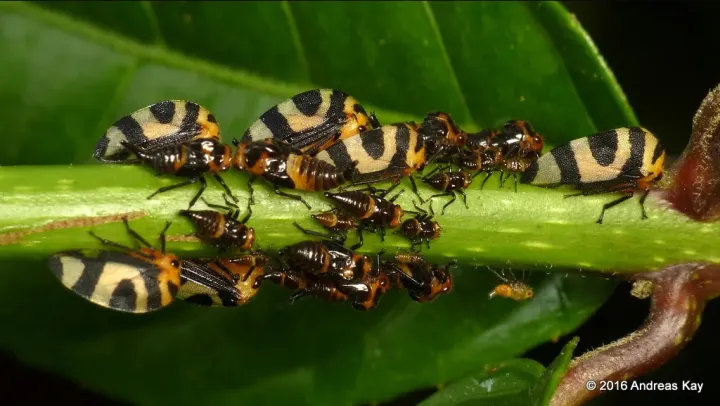
Description
How to identify
The White-spotted treehopper (Latin: Tricentrus albomaculatus) is a member of the Membracidae family, belonging to the order Hemiptera.
This insect is relatively small, with adults measuring approximately 5–7 mm in length, known for their unique and highly specialized morphology.
The pronotum is extended posteriorly into a horn-like structure that covers the abdomen, giving the insect a distinct hunched or "humped" appearance.
The general body coloration is typically dark brown, highlighted by characteristic white spots on the sides of the thorax, which justifies its common name.
Nymphs differ significantly from adults, as they lack the prominent pronotal horn and are usually protected by specialized body structures like small spines.
What it damages
This pest primarily infests a variety of fruit-bearing crops, including apple, pear, peach, and several types of ornamental shrubs and trees.
They are particularly damaging in nursery settings, where they feed on young shoots, siphoning essential plant sap and weakening the plant.
Heavy infestations can lead to significant growth suppression, stunted development of young trees, and reduced vigor of the host plant.
Physical damage caused by the ovipositor during egg-laying creates entry points for various fungal and bacterial pathogens, complicating plant health.
Treehoppers act as vectors for certain plant diseases, which can spread rapidly through an orchard if the insect population is not managed effectively.
When it appears
The life cycle of the White-spotted treehopper is closely linked to the phenology of their host trees and the prevailing seasonal temperatures.
They overwinter in the egg stage, with the eggs embedded deep within the bark of young branches, protected by the host plant's tissue.
In spring, as sap flow begins and buds start to open, nymphs emerge and immediately begin feeding on the fresh, succulent parts of the plants.
The transition to the adult stage occurs mid-summer, after which the insects mate and begin the cycle of egg deposition for the next generation.
Depending on the climatic zone, the species can undergo multiple generations throughout the growing season, increasing the risk of widespread damage.
Signs of infestation
Detecting an infestation early is crucial for effective orchard management and involves looking for specific mechanical indicators on the trees.
- Characteristic shallow cuts or scars on the bark of twigs, created by the female during the egg-laying process.
- Leaves appearing wilted or deformed, resulting from the insect feeding on the leaf petioles.
- Clusters of nymphs found on young stems, often blending in with the color and texture of the bark.
- The presence of honeydew on the foliage, which often leads to the development of sooty mold.
Detailed visual inspection of younger growth, especially during the spring, usually reveals the presence of early-stage nymphs.
Control measures
Integrated Pest Management (IPM) is the most effective approach for controlling the White-spotted treehopper in agricultural and orchard environments.
Pruning and destroying branches that show signs of egg-laying is a vital sanitation practice to reduce the population for the next season.
Maintaining proper orchard hygiene and avoiding over-dense planting can help limit the spread of the insect between susceptible host trees.
The application of systemic insecticides during the nymphal development stage is highly effective in managing large populations.
Biological monitoring using sticky traps or routine visual checks allows growers to intervene before the infestation reaches a critical threshold.
Taxonomy
- Latin name
- Tricentrus albomaculatus
- Order
- Hemiptera (bugs, aphids, leafhoppers)
- Family
- Membracidae
- EPPO code
- TRIEAL
Discussion
No discussions yet — be the first.