
Red-eared slider
Trachemys scripta
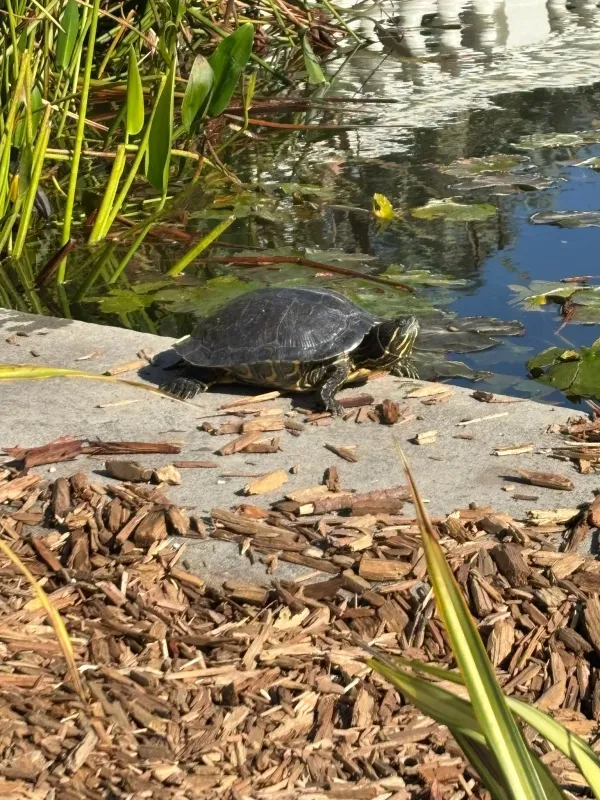
Description
How to identify
The red-eared slider (Trachemys scripta) is a member of the family Emydidae, recognized globally as a highly successful invasive species.
The name comes from the prominent red or orange streak behind each eye, which is the most reliable identifying characteristic of the turtle.
These turtles possess a hard shell and strong, serrated-edged jaws, allowing them to exploit a wide range of food sources, including aquatic vegetation.
They are cold-blooded animals that rely on environmental warmth, making them thrive in irrigation channels and fish ponds in temperate regions.
Adults exhibit significant size and strength, allowing them to disturb irrigation structures and compete with native aquatic fauna effectively.
What it damages
Red-eared sliders cause direct damage to aquatic plants grown in aquaculture, including commercial rice fields and decorative water lilies.
By consuming young plant shoots and roots, they can decimate entire crops in shallow water habitats, reducing both quality and yield.
In aquaculture environments, they often prey on small fish and fingerlings, disrupting the natural balance and food chain essential for productivity.
Their movement patterns cause mechanical damage to the substrate and root systems of submerged flora, leading to plant decay and loss.
Accumulation of waste products from turtle populations leads to water contamination, which creates unfavorable conditions for sensitive aquatic crops.
When it appears
Activity typically peaks when water temperatures rise above 15°C, usually spanning from late spring through the end of the summer season.
During the warmest months, their metabolic rate increases, leading to more frequent feeding and destructive behavior throughout the irrigation systems.
Spring serves as the breeding and dispersal period, which often leads to the colonization of new water bodies and irrigation ditches.
The damage persists until the onset of autumn cooling when the turtles begin their migration toward deeper waters for overwintering.
In warmer climates or protected greenhouse aquatic systems, the period of damage can extend throughout the entire year without interruption.
Signs of infestation
Indications of presence include chewed foliage, fragmented stems, and missing aquatic vegetation that is otherwise not affected by traditional pests.
A noticeable decline in fish larvae or tadpole populations within a monitored water system often suggests predation by sliders.
Visual confirmation involves sighting turtles basking on logs or shorelines, a behavior common for this species during sunny intervals.
Evidence of disturbed mud, uprooted plants, and murky water patches in shallow areas are standard indicators of turtle feeding activities.
Presence of turtle waste and floating vegetation debris can frequently be spotted near high-traffic areas where they gather for basking.
Control measures
Manual trapping using specialized mesh traps or floating capture devices is the most efficient method for population control in ponds.
Exclusion fencing installed around the perimeter of agricultural water basins acts as a physical barrier against movement and colonization.
Environmental management, including the removal of basking platforms like floating logs, can make a site less attractive for turtle habitation.
- Regular site monitoring and assessment.
- Safe capture and relocation or disposal.
- Preventing release of pets into agricultural waterways.
Since chemical control methods are dangerous to aquatic crops and fish, physical management and barrier maintenance are the primary strategies.
Taxonomy
- Latin name
- Trachemys scripta
- Family
- Emydidae
- EPPO code
- TRKMSC
Discussion
No discussions yet — be the first.