
Eastern box turtle
Terrapene carolina
Description
How to identify
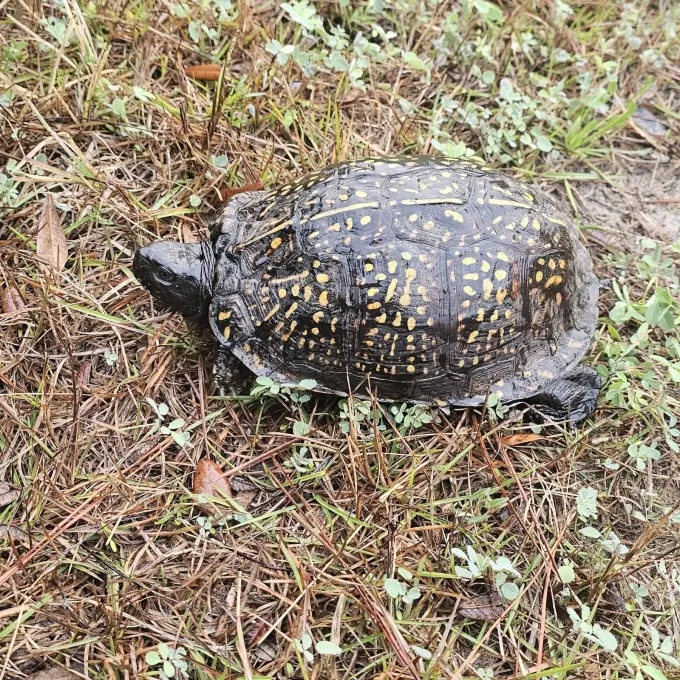
The Eastern box turtle (Terrapene carolina) is a terrestrial reptile belonging to the American box turtle family. It is characterized by its high-domed, sturdy shell, which typically ranges from 4 to 8 inches in length.
The shell coloration is highly variable, typically featuring dark brown or black base tones with intricate patterns of yellow, orange, or red markings. A key identifying feature is the hinged plastron, which allows the turtle to close its shell tightly.
These turtles possess strong, clawed limbs adapted for digging in soil and navigating diverse landscapes. They are largely solitary animals that prefer moist woodlands but frequently migrate into gardens in search of food.
Despite their slow movement, box turtles are persistent and can establish territories within home gardens where resources like food and shade are readily available.
They are long-lived animals, and their presence can be seasonal, correlating with warmer temperatures and available moisture in the environment.
What it damages
While often seen as beneficial due to their consumption of insects and slugs, Eastern box turtles can become significant pests when they turn their attention to ripe fruits and vegetable crops.
They frequently feed on low-hanging or ground-level produce, including tomatoes, strawberries, melons, and cucumbers, often causing substantial losses in a short period.
Turtles use their powerful jaws to bite large, irregular chunks out of vegetables, which damages the produce and invites secondary bacterial and fungal infections.
Beyond direct damage to fruits, their movement patterns across garden beds can lead to the crushing of seedlings and the compaction of sensitive root zones, especially in newly planted areas.
Continuous feeding by a turtle can render an entire patch of crops unsuitable for harvest, forcing gardeners to find ways to exclude them from the most vulnerable zones.
When it appears
The activity of Eastern box turtles is highly dependent on ambient temperature and soil moisture levels, with the peak season occurring from late spring through summer.
They are most active during the morning and late afternoon hours, especially following rainfall when humidity levels are high and ground conditions are optimal for movement.
During the intense heat of mid-summer, they tend to seek out cool, damp areas in the garden, such as dense vegetable foliage, which puts them in direct contact with your crops.
As autumn approaches and temperatures begin to drop, their activity levels decline as they search for suitable locations to burrow and hibernate for the winter.
Their appearance in the garden is often cyclical; once a turtle discovers a consistent food source, it is likely to revisit that location repeatedly throughout the growing season.
Signs of infestation
The most distinct sign of box turtle damage is the presence of deep, jagged bite marks on the surface of ripening fruits, often leaving large cavities.
Ground-level tracking provides further evidence, as their claws and the bottom of their shell leave recognizable furrows and depressions in loose or moist soil.
Droppings containing undigested seeds and fiber from garden vegetables are a definitive indicator that turtles are feeding on your plants.
Damaged plants often show signs of mechanical stress, such as broken stems or flattened foliage, caused by the turtle moving through the garden bed.
If fruits are disappearing from the garden or being found half-eaten in the immediate vicinity, it is a strong indicator of a turtle's presence.
Control measures
The most effective strategy for managing box turtles is the installation of physical barriers, such as a wire mesh fence at least 12–15 inches high, sunk slightly into the ground.
Maintaining a tidy garden by removing tall grass, weeds, and heavy debris helps to eliminate hiding spots, making the garden less attractive to the reptiles.
If a turtle is found damaging crops, the most humane and effective control measure is manual removal and relocation to a suitable habitat away from the garden.
Mulching garden beds with abrasive materials like large wood chips can create a surface that is difficult and unpleasant for turtles to traverse, potentially deterring them.
Regular monitoring of your garden during the growing season allows for early intervention, ensuring that you can protect your harvest before significant damage occurs.
Taxonomy
- Latin name
- Terrapene carolina
- Family
- Emydidae
- EPPO code
- TRRPCA
Discussion
No discussions yet — be the first.