
Red-eared slider
Trachemys
Description
How to identify
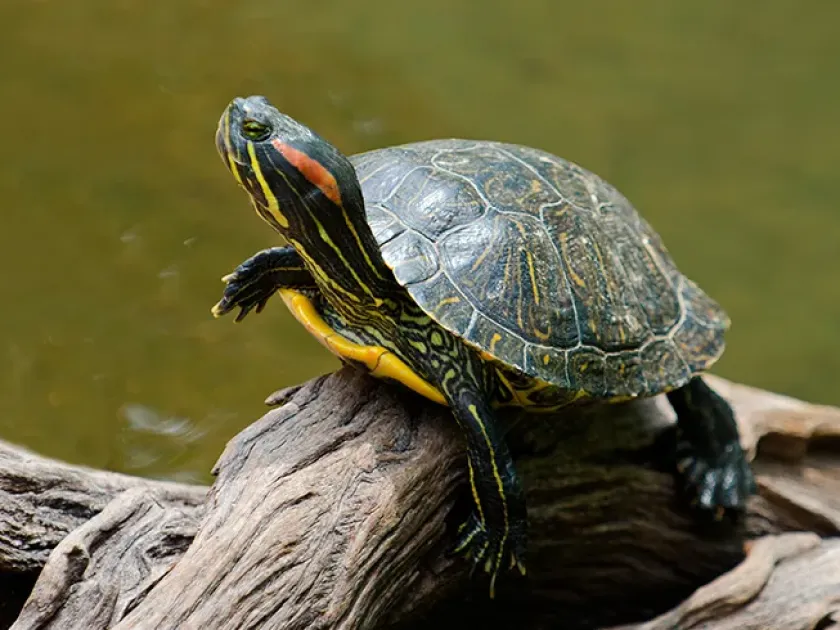
The red-eared slider (Trachemys scripta) is a semi-aquatic turtle belonging to the family Emydidae. It is easily identified by the prominent red or yellow patch behind each eye.
Adults typically reach a carapace length of 25–30 cm. The shell is usually olive-green with dark markings, while the skin has characteristic yellowish stripes.
This species is highly adaptable to various environments, including ponds, irrigation canals, and agricultural wetlands, making it a globally successful invasive organism.
Due to its high reproductive rate and competitive nature, it often outcompetes native aquatic species for food and basking sites.
It is classified among the world's 100 worst invasive alien species, as its introduction to new areas creates significant ecological and economic imbalances.
What it damages
Red-eared sliders cause extensive damage in rice paddies by consuming young rice shoots and seedlings during the early growth stages of the crop.
In aquaculture, they are considered significant pests, preying on fish fry, tadpoles, and fish eggs, which leads to substantial losses for fish farming businesses.
Their burrowing behavior damages irrigation infrastructures, including earthen dams and bank reinforcements, often leading to leakage and soil erosion.
They contribute to the eutrophication of water bodies through excessive waste, which can degrade water quality required for irrigation of agricultural crops.
By consuming native aquatic vegetation, they strip habitats of essential plants that serve as natural filters and nurseries for many other species.
When it appears
The activity of red-eared sliders is heavily dependent on temperature, usually starting when water temperatures rise above 15–18 degrees Celsius in spring.
Their peak feeding activity occurs during the summer months when high temperatures facilitate rapid digestion and overall metabolic activity.
Nesting season typically happens from late spring to mid-summer, when females emerge from the water to lay eggs, causing physical disturbance to banks and fields.
During the autumn, their activity levels gradually decrease as ambient temperatures drop, though they remain active longer than many other reptiles.
Winter is spent in a state of brumation, usually buried in the mud at the bottom of ponds, where they wait for temperatures to rise again.
Signs of infestation
The most common sign of infestation is observing groups of turtles basking in the sun on logs, rocks, or banks throughout the day.
In rice fields, the presence of damaged or "sheared" rice stems at the base of the plant is a classic indicator of turtle foraging activity.
A sudden decline in the density of fish fry in ponds, without evidence of common fish pathogens, often points to predatory pressure from turtles.
Visible damage to the edges of ponds or irrigation ditches, including deep holes and collapsed soil banks, confirms the presence of a burrowing population.
Finding shell fragments or remnants of turtle eggs in the sandy soil near the water's edge provides evidence of successful breeding and population establishment.
Control measures
The primary control method involves physical removal using specialized trapping equipment like hoop nets or basking traps placed in infested areas.
Installing fine-mesh fences along the perimeter of agricultural areas or irrigation channels serves as an effective physical barrier against turtle migration.
Draining ponds and irrigation canals during the off-season can effectively destroy hibernation sites and disrupt the nesting cycle of the population.
Regular maintenance of dams and embankments, including the infilling of discovered burrows, is necessary to mitigate structural damage caused by turtles.
Public education and the regulation of pet trade releases are essential long-term strategies to prevent new introductions into local water systems.
Taxonomy
- Latin name
- Trachemys
- Family
- Emydidae
- EPPO code
- TRKMSP
Discussion
No discussions yet — be the first.