
Pine felt scale
Toumeyella pinicola
Description
How to identify
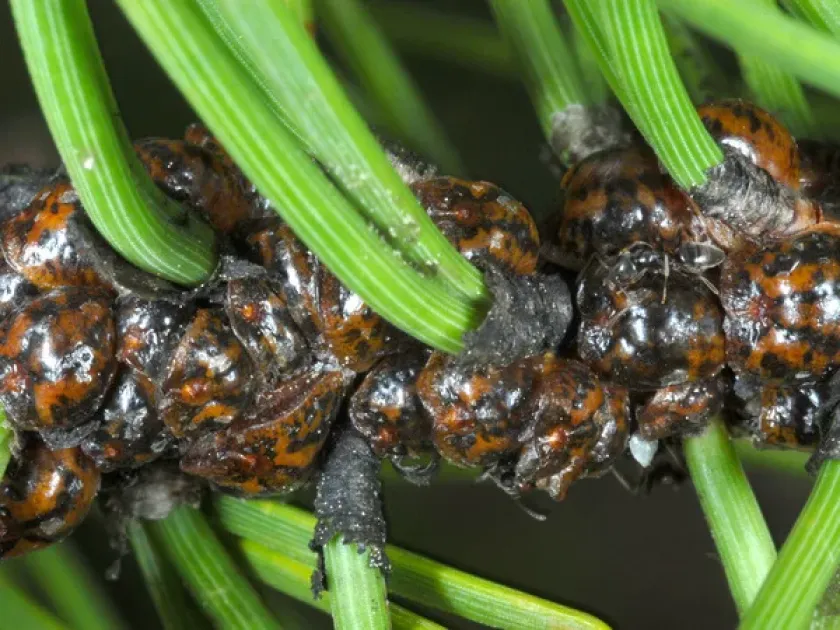
The Pine felt scale (Toumeyella pinicola), often referred to as a species of soft scale, is a member of the Coccidae family. The adult female is characterized by a rounded, convex body that is reddish-brown, often blending perfectly with pine bark.
These insects are protected by a thick, waxy, or leathery cuticle that serves as an effective barrier against predators and many environmental stressors. Adults typically measure about 3–5 mm in diameter, making them easy to overlook for the untrained eye.
Male Pine felt scales are rare and typically short-lived, as they have wings and do not feed. The population is dominated by females, which can produce offspring parthenogenetically, ensuring the species can colonize new areas efficiently.
The juvenile stage, known as the "crawler," is the only mobile phase of the life cycle. These tiny, yellowish creatures move across the branches to find suitable feeding sites, where they eventually settle down and anchor themselves to the plant tissue.
Overwintering occurs primarily as fertilized females attached to the underside of twigs. They remain in a dormant state until the arrival of spring temperatures, when they resume feeding and egg production.
What it damages
Pine felt scales primarily infest various species of the Pinus genus. They feed by inserting their piercing-sucking mouthparts into the phloem of needles and young stems to extract essential plant fluids.
This persistent sap-sucking leads to significant nutrient loss, which causes the tree to exhibit stunted growth and loss of vigor. Needles on infested branches often turn yellow, curl, and eventually drop prematurely.
A major indirect source of damage is the production of honeydew, a sticky waste product excreted by the scales. This substance serves as a substrate for sooty mold, a fungus that covers needles in a black coating, severely inhibiting photosynthesis.
Severe infestations can lead to dieback of entire branches, particularly in younger trees or stressed specimens. Weakened trees often become susceptible to secondary infestations by bark beetles, which can ultimately kill the host tree.
The spread of this pest can be rapid in dense stands or landscape plantings, as crawlers can be easily transported by wind, birds, or human activity. Regular inspections are vital to prevent large-scale outbreaks.
When it appears
In early spring, overwintering females become active and begin feeding. They enlarge rapidly as they develop eggs, and by late spring, they become highly visible on the twigs.
Crawler emergence typically occurs in early summer, coinciding with the tree's most vigorous growth period. This is the peak time for pest dispersal throughout the canopy.
During mid-to-late summer, the crawlers settle into permanent feeding sites. They gradually secrete the protective wax cover that characterizes the adult stage, making them less vulnerable to contact pesticides.
By autumn, the population stabilizes as the insects prepare for winter. The life cycle is largely governed by local climate conditions, with warmer regions potentially allowing for more rapid population expansion.
Understanding these seasonal milestones is key to timing treatments. Applying control measures during the crawler phase is significantly more effective than attempting to treat the hard-shelled adult stage.
Signs of infestation
- Presence of brown, bumpy scales on pine twigs and needles.
- Sticky honeydew residue on the needles and surrounding foliage.
- Black sooty mold growth on needles, giving them a dark appearance.
- Premature yellowing and shedding of pine needles.
- Noticeable lack of new shoot growth and general branch dieback.
Control measures
Effective management begins with dormant oil sprays in early spring. These oils coat the bark and suffocate overwintering females before they have the chance to reproduce.
For active infestations during the summer, systemic insecticides are the most effective approach. Since these chemicals are taken up by the plant, they provide internal protection that is highly lethal to the sap-feeding nymphs.
Pruning out and disposing of heavily infested branches is a practical non-chemical control measure. This physically removes a large portion of the population and reduces the risk of further spread.
Promoting overall tree health through proper fertilization and adequate irrigation helps trees withstand scale attacks. A well-nourished tree can better tolerate moderate infestations without significant long-term damage.
Biological control, including the encouragement of lady beetles and parasitic wasps, can help keep populations in check. Avoiding the use of broad-spectrum insecticides helps preserve these beneficial predator populations.
Taxonomy
- Latin name
- Toumeyella pinicola
- Order
- Hemiptera (bugs, aphids, leafhoppers)
- Family
- Coccidae
- EPPO code
- TOUMPI
Discussion
No discussions yet — be the first.