
Tulip tree scale
Toumeyella liriodendri
Description
How to identify
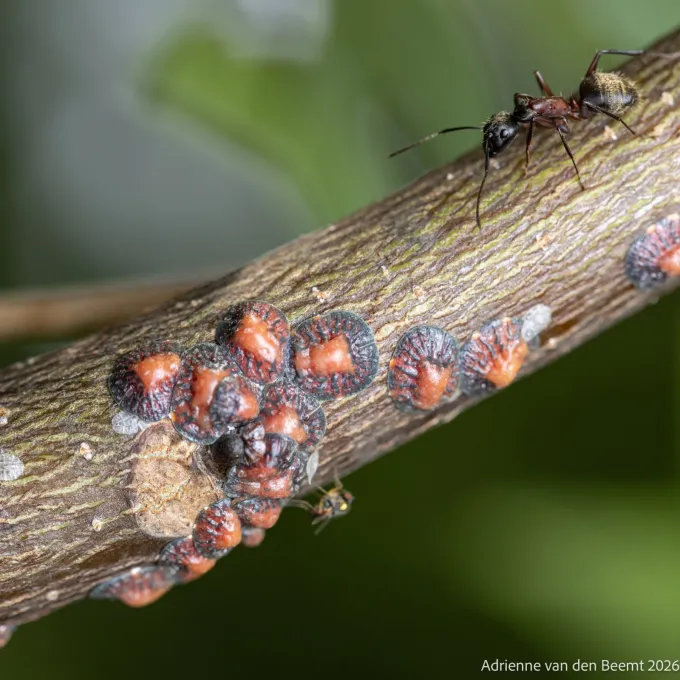
The Tulip Tree Scale Toumeyella liriodendri belongs to the Coccidae family. The adult female is characterized by a convex, almost hemispherical shape, often resembling a small brown knot or burl on the bark. As the insect matures, its body hardens and darkens, providing significant protection against environmental factors.
Males are rarely seen and possess wings, while the females remain stationary for most of their lives. The first instar nymphs, known as crawlers, are light-colored, oval-shaped, and highly mobile, which is the primary phase for the dispersal of the pest across the host tree.
The insects often congregate in large numbers on the undersides of branches and twigs. Their waxy secretions and darkened appearance make them blend in with the natural texture of the bark, which is a common reason why infestations go unnoticed until they become severe.
Morphological variations occur throughout their life cycle, with the size and color changing as the scale matures. Understanding these stages is critical for determining the timing of control efforts, as the susceptibility to insecticides varies significantly depending on the age of the insect.
Accurate identification usually requires close inspection of the twigs during late spring or early summer. Using a hand lens to examine the bark for these characteristic raised bumps can confirm the presence of the scale and help prevent potential damage to the host plant.
What it damages
The primary host for this scale is the tulip tree (Liriodendron tulipifera), although it also frequently attacks magnolias, lindens, and poplars. By feeding on the plant's sap, the scales sap the energy of the host, leading to weakened immune systems and structural decline.
As they feed, they excrete large amounts of honeydew, a sticky substance that coats the leaves and bark. This honeydew serves as a medium for the growth of sooty mold, a fungus that covers the foliage in a dark film and inhibits the plant's ability to perform photosynthesis.
Severe infestations can lead to premature leaf drop, stunted shoot growth, and branch dieback. For young or stressed trees, the presence of these scales can even be fatal if left untreated, especially when combined with other environmental stresses like drought.
The accumulation of honeydew attracts various ants, bees, and wasps, creating an unpleasant environment for gardeners and potentially drawing other pests to the tree. Furthermore, the feeding sites on the bark can develop into necrotic lesions that provide entry points for secondary pathogens.
Overall vitality is significantly reduced in infested trees, affecting their growth rate and aesthetic appeal. This is particularly problematic in landscape settings where the health and visual quality of ornamental trees are of primary concern to property owners.
When it appears
The Tulip Tree Scale overwinter as second-instar nymphs, typically tucked into the crevices of the tree bark. As temperatures rise in early spring and the tree resumes sap flow, these nymphs begin feeding actively and growing rapidly toward maturity.
Adult females are most visible from late spring to early summer as they enlarge and prepare to lay eggs. During this time, they are fixed in place on the twigs and can be easily identified by their substantial, rounded bodies and dark brown color.
Crawler emergence typically occurs in mid-to-late summer. This is the most critical window for management, as the newly hatched nymphs are vulnerable to contact insecticides while they wander in search of a suitable location to settle and feed.
In most regions, this insect completes one generation per year. However, in warmer climates, development can be accelerated, potentially leading to more complex infestations that require monitoring throughout the entire growing season.
Autumn is an excellent time for follow-up inspections or dormant treatments. By reducing the population of overwintering nymphs, gardeners can significantly decrease the intensity of the infestation in the following spring, breaking the cycle of damage.
Signs of infestation
The most immediate sign of an infestation is the presence of sticky honeydew on the leaves and nearby surfaces. If you notice a shiny, wet-looking film on the foliage, look upward to check the branches for the source of the dripping substance.
The growth of black sooty mold is another major indicator. If the bark or leaves appear to be coated in a dark, dusty soot, it is almost certainly a sign that the scale insects are actively feeding and excreting honeydew above that section of the tree.
Checking the undersides of twigs for small, dark, rounded bumps is a reliable way to confirm the presence of scale. If these bumps can be easily flicked off or crushed to reveal a moist interior, they are active scale insects.
Excessive ant activity on the tree trunk is often a secondary sign of infestation. Ants feed on the honeydew produced by the scales and will often protect the scale colony from predators, effectively acting as an indicator of the pest's presence.
Leaf yellowing, thinning of the crown, and the loss of natural luster are signs of prolonged feeding. A tree that appears unhealthy or sparse in comparison to its neighbors should always be investigated for potential scale insect colonization.
Control measures
Management of the Tulip Tree Scale involves both chemical and cultural practices. Because the hard shell of the scale protects it from many sprays, systemic insecticides are often the most effective way to reach the insect through the plant's vascular system.
- Use systemic insecticides (neonicotinoids) during the active growing season.
- Apply horticultural oils in early spring while the tree is dormant to suffocate overwintering nymphs.
- Physically remove small, localized infestations by pruning away and destroying affected branches.
- Encourage beneficial predatory insects like lady beetles which feed on scale nymphs.
- Ensure proper irrigation and fertilization to keep the tree vigorous and better able to resist pests.
Timing is everything when using contact insecticides; applications must coincide with the peak crawler emergence to be effective. Rotating different classes of insecticides is recommended to help prevent the development of pesticide resistance.
Integrating biological control by maintaining a healthy garden ecosystem can provide long-term stability. By fostering an environment that supports natural predators, you can significantly reduce the need for intensive chemical interventions over time.
Taxonomy
- Latin name
- Toumeyella liriodendri
- Order
- Hemiptera (bugs, aphids, leafhoppers)
- Family
- Coccidae
- EPPO code
- TOUMLI
Discussion
No discussions yet — be the first.