
Hawthorn scale
Toumeyella crataegi
Description
How to identify
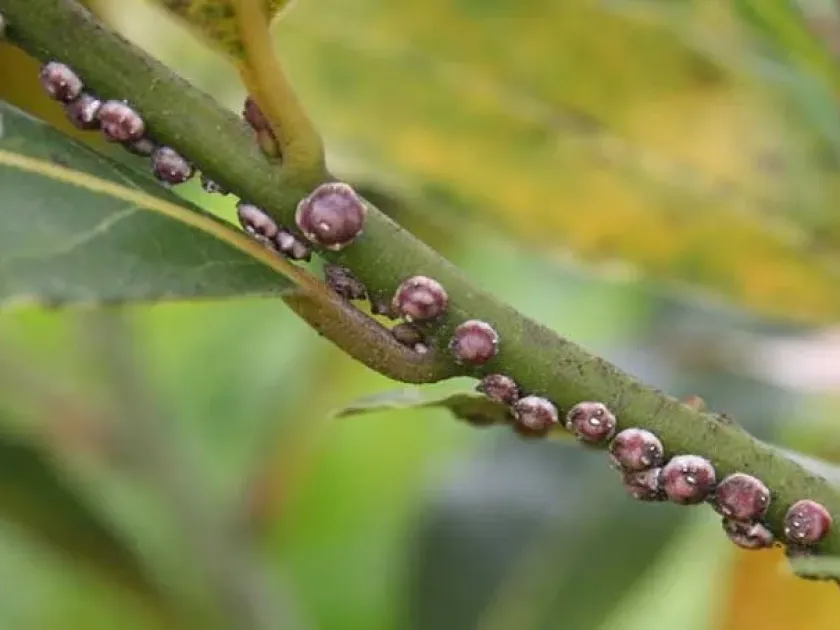
The Hawthorn scale (Toumeyella crataegi) belongs to the family Coccidae within the order Hemiptera. Adult females appear as convex, hemispherical, brown bumps on tree bark.
Unlike armored scales, the Hawthorn scale lacks a separate shell. The protective covering is formed by the insect's own hardened, sclerotized skin.
The crawlers (first-instar nymphs) are microscopic, mobile, and yellowish-brown. This is the primary stage in which the pest disperses throughout the tree canopy.
Males are extremely rare and differ significantly from females in structure, possessing wings to facilitate movement and mating.
Due to their camouflage ability, identifying these insects requires close inspection of the bark and branches, often with the aid of a hand lens.
What it damages
This pest primarily attacks members of the Rosaceae family, including hawthorn, apple, pear, plum, cherry, and various ornamental shrubs.
The scale feeds by inserting its mouthparts into plant tissue and sucking cell sap, which severely weakens the plant and stunts its vegetative growth.
Heavy infestations result in deformed twigs, premature leaf drop, and overall physiological stress, significantly reducing the tree's fruit-bearing capacity.
The insects excrete a sticky substance known as honeydew, which promotes the growth of sooty mold that covers leaves and blocks sunlight.
Sooty mold accumulation interferes with photosynthesis, which can eventually cause limb dieback or the death of the entire tree if the infestation is not addressed.
When it appears
The species generally has a one-year life cycle. Second-instar nymphs spend the winter sheltered in bark crevices or on the undersides of branches.
As temperatures rise in the spring, the nymphs resume feeding and eventually develop into mature adult females.
Egg-laying typically occurs in early summer, with the female body acting as a protective chamber for the eggs until they hatch into crawlers.
The crawler stage usually occurs in mid-summer, representing the most vulnerable period for the pest and the best time for chemical application.
By autumn, the young nymphs seek out protected sites on the branches to settle for overwintering, concluding the annual biological cycle.
Signs of infestation
The presence of stationary, brown, dome-shaped bumps on the twigs that cannot be easily removed is the primary indicator of an infestation.
Sticky residue on branches and foliage, accompanied by increased ant activity, is a common symptom of the honeydew excreted by the scales.
A black, soot-like fungal growth on leaves is a definitive sign of an advanced infestation requiring immediate management.
Reduced vigor of the tree, visible through chlorotic leaves and stunted shoot development, indicates that the population has reached damaging levels.
- Stationary brown hemispherical bumps on the bark.
- Sticky honeydew buildup on leaves and branches.
- Black sooty mold growth on foliage.
- Significant ant activity on the tree trunk and limbs.
- Twig dieback and premature leaf abscission.
Control measures
Integrated management begins with cultural practices such as pruning and removing heavily infested branches to improve air circulation within the canopy.
Manual scrubbing of the bark during the dormant season can effectively reduce the population density of overwintering nymphs.
Systemic insecticides are most effective when applied during the peak crawler emergence phase, as this is when they are most susceptible to chemical treatment.
Dormant oil or horticultural oil sprays in the spring can help smother adult females, significantly curbing the population before the egg-laying season.
Encouraging natural predators, such as lady beetles and parasitic wasps, can provide long-term biological control in orchard settings.
Taxonomy
- Latin name
- Toumeyella crataegi
- Order
- Hemiptera (bugs, aphids, leafhoppers)
- Family
- Coccidae
- EPPO code
- TOUMCR
Discussion
No discussions yet — be the first.