
Apple leafminer
Tischeria malifoliella
Description
How to identify
The apple leafminer (Tischeria malifoliella) belongs to the order Lepidoptera and the family Tischeriidae. The adult moth is a tiny insect with a wingspan of approximately 7-9 mm.
The forewings are dark-colored, typically brownish with a distinct metallic or golden sheen, allowing them to blend into the tree bark during the day.
The larva is a small, flattened caterpillar measuring 6-8 mm, characterized by a yellowish-green body and a darker head capsule suited for burrowing.
Pupation occurs within the mine created by the larva, which serves as a protective chamber throughout the development of the next adult generation.
Being a specialist species, it has evolved to feed specifically on the leaf tissue of apple trees and, occasionally, other members of the Rosaceae family.
What it damages
The primary host for this pest is the apple tree. The damage is exclusively caused by larvae that feed on the leaf parenchyma, creating distinct tunnels or mines.
This feeding activity significantly reduces the tree's photosynthetic capacity, which directly affects the accumulation of nutrients and overall vigor.
In cases of severe infestation, the tree suffers from premature leaf drop, which weakens the plant and reduces its ability to survive harsh winter conditions.
Fruit quality and yield are compromised as trees lack the necessary energy to support fruit development and vegetative growth simultaneously.
Young orchards and nurseries are particularly vulnerable, as repeated defoliation can stunt tree growth and lead to long-term productivity losses.
When it appears
The life cycle typically involves two generations per year. Adults emerge in spring, often coinciding with the bloom period of apple trees.
Eggs are deposited individually on the upper surface of leaves. Upon hatching, the larva bores into the leaf epidermis to begin its mining activity.
The second generation, occurring in mid-to-late summer, is usually more numerous and causes the most visible damage to the orchard canopy.
The pest overwinters as a mature larva inside the mined leaves that have fallen to the ground or are still attached to the branches by silk.
Temperature and environmental humidity are the primary drivers of the emergence times and the speed of development for both spring and summer generations.
Signs of infestation
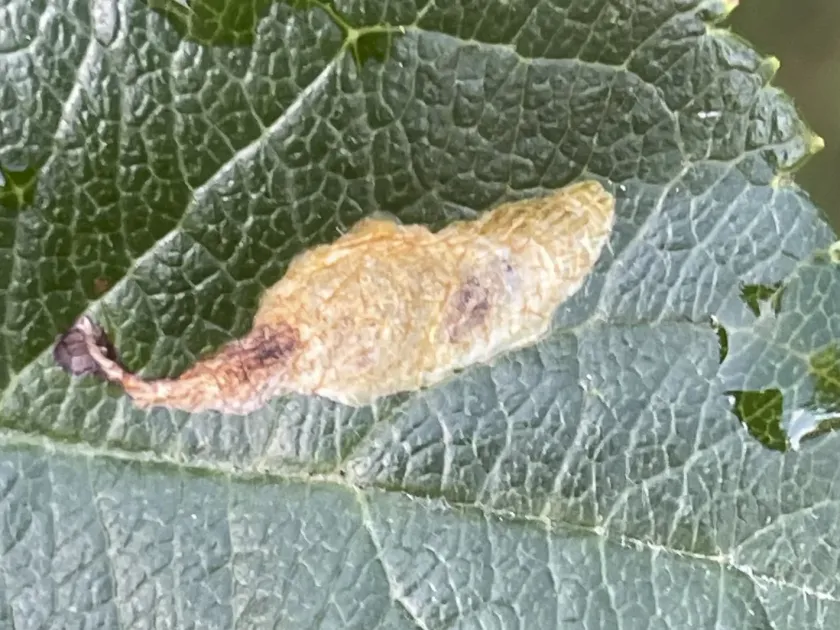
The most recognizable symptom is the appearance of blotch mines on the upper leaf surface, which start as light patches and expand over time.
Unlike serpentine mines made by other species, these mines are oval or rounded, often displaying concentric ridges similar to the shell of a tiny snail.
If you hold an infected leaf up to the light, you can usually see a dark center within the mine, which consists of concentrated larval frass.
Leaves affected by high densities of these mines become discolored, brittle, and often curl along the margins, giving the tree a sickly appearance.
Eventually, the damaged tissue dies, leading to browning and premature leaf senescence throughout the affected parts of the canopy.
Control measures
Sanitation is the most critical control method; raking and destroying fallen leaves during autumn effectively eliminates the primary overwintering sites.
Chemical control should be timed to coincide with the peak of egg-hatching, using systemic or translaminar insecticides to reach the larvae within the leaves.
Biological control agents, such as parasitoid wasps, play a significant role in naturally suppressing leafminer populations in managed orchards.
Maintaining tree health through proper irrigation and balanced fertilization helps trees recover from leaf loss and mitigates secondary pest attacks.
- Sanitary removal of leaf litter
- Monitoring with pheromone traps
- Strategic use of insect growth regulators
- Encouraging predatory wasps in the orchard
Taxonomy
- Latin name
- Tischeria malifoliella
- Order
- Lepidoptera (butterflies)
- Family
- Tischeriidae
- EPPO code
- TISCMA
Discussion
No discussions yet — be the first.