
Oak leaf miner
Tischeria dodonaea
Description
How to identify
The oak leaf miner (Tischeria dodonaea) is a small moth belonging to the Tischeriidae family within the order Lepidoptera.
The adult moth is very small, usually having a wingspan of approximately 7 to 9 millimeters, with narrow, pointed wings.
Their body and wings are generally brownish, providing effective camouflage against the bark and stems of oak trees during the day.
Larvae are small and pale, living entirely within the leaf tissue, which protects them from many external environmental stressors.
Because of their secretive lifestyle, identifying the species often relies more on the damage patterns left behind than on sightings of the adult moth.
What it damages
The primary hosts for this pest are various oak species, which suffer due to the larval feeding habits of the moth.
Larvae create blotch-like mines within the leaves, consuming the green photosynthetic tissue that the tree needs for growth.
This localized destruction of leaf tissue reduces the tree's overall ability to produce energy, potentially weakening its immune system.
Heavy infestation can lead to premature leaf drop, causing physiological stress to the tree, especially during hot and dry summer months.
Chronic annual attacks may stunt the growth of young trees and degrade the health of older, mature oaks in urban settings.
When it appears
The lifecycle of the moth is timed to coincide with the growing season of the host oak, starting in late spring.
Adult moths emerge to mate and lay eggs on the undersides of young leaves, beginning the cycle for the new generation.
Larvae develop throughout the summer, gradually enlarging their mines as they feed and grow within the protective leaf layer.
The insect typically overwinters in the pupal stage, often remaining within the fallen leaves or bark crevices until the following year.
Typically, the species completes one full generation per year, though weather conditions can slightly influence the timing of emergence.
Signs of infestation
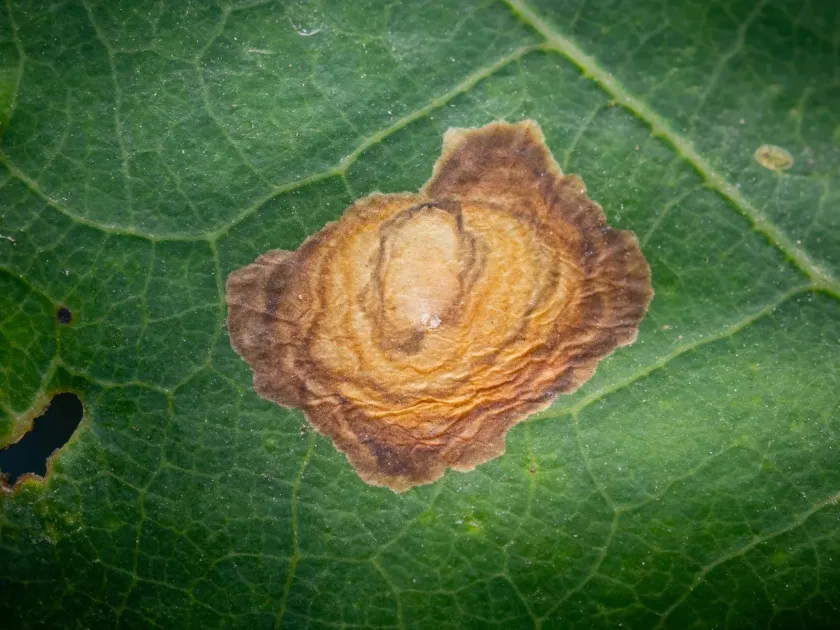
Signs of infestation become obvious when the mines turn brown and visible on the upper surface of the oak leaves.
The mines are usually irregularly shaped and bounded by leaf veins, creating a distinctive mosaic pattern on the foliage.
When looking closely, one might see small dark specks inside the mine, which are the larval droppings (frass).
- Brown, irregular patches on oak leaves during summer.
- Premature yellowing and leaf shedding on affected branches.
- Visible tracks inside the tissue when leaves are held against the light.
In severe cases, the canopy of the tree might appear discolored or sparse, signaling significant damage to the photosynthetic capacity.
Control measures
The most effective cultural practice is the sanitation of the area, specifically the collection and disposal of infested fallen leaves.
Biological control methods include encouraging natural predators and parasitoids that help keep the moth population in check.
Chemical control with systemic insecticides may be necessary in nurseries or high-value landscape trees to prevent significant aesthetic damage.
Monitoring using pheromone traps can help arborists determine the exact timing for insecticide applications to target the hatching larvae.
Maintaining tree vigor through proper watering and soil management is crucial for helping trees withstand the pressure of leaf miner attacks.
Taxonomy
- Latin name
- Tischeria dodonaea
- Order
- Lepidoptera (butterflies)
- Family
- Tischeriidae
- EPPO code
- TISCDO
Discussion
No discussions yet — be the first.