
Oak trumpet skeletonizer
Tischeria complanella
Description
How to identify
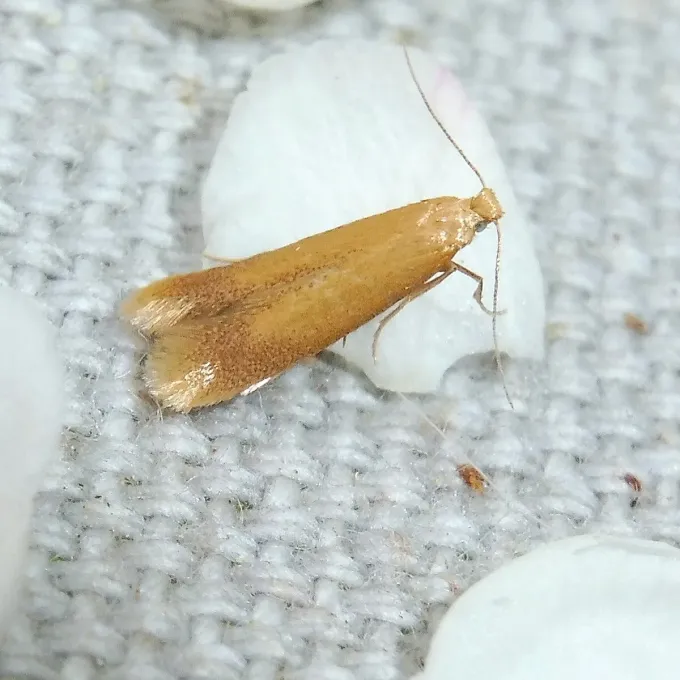
The oak trumpet skeletonizer (Tischeria complanella) is a small moth belonging to the family Tischeriidae. These moths have a wingspan of only 7 to 9 mm, making them difficult to spot in nature.
The adult moth features narrow, pointed forewings of a shiny, ocher-yellow or brown color. The hindwings are paler, often greyish, and fringed with fine hairs.
The larvae are specialized leaf miners. They possess a flattened body shape that allows them to live and feed within the mesophyll layer of the oak leaf.
The larva typically has a pale, yellowish-white body with a distinctively brown head capsule. It constructs its pupal chamber within the leaf mine itself.
Classification places this moth within the order Lepidoptera. It is a highly specialized species primarily associated with Quercus (oak) tree species.
What it damages
The primary damage is caused by the larvae feeding on the inner tissues of the oak leaves. They consume the parenchyma while leaving the epidermis intact.
This feeding activity creates characteristic blotch-shaped mines. Initially, the mine is small, but it grows larger as the larva matures, creating a visible patch on the leaf.
Severe infestations can lead to massive defoliation. This reduces the tree's photosynthetic capacity, which directly stresses the oak tree's health.
Leaves that are heavily mined tend to wither, turn brown, and drop prematurely, often leaving the tree canopy looking scorched by late summer.
Continued heavy infestations over several consecutive seasons can cause branch dieback and significantly reduce the overall vigor of mature trees.
When it appears
The life cycle of the moth typically involves two generations per year. The first generation of adults usually emerges in late spring, between May and June.
The second generation emerges in late summer, usually during August and September. These moths lay eggs that result in overwintering larvae.
The insect spends the winter in the larval stage, protected within the fallen leaf litter where it eventually pupates in early spring.
Environmental factors, particularly temperature, determine the exact timing of the emergence and the subsequent rate of larval development.
Monitoring for adult flight using pheromone traps is recommended to identify the optimal window for applying control measures before the larvae establish their mines.
Signs of infestation
The most reliable sign of an infestation is the presence of brown, blotchy mines on the surface of oak leaves.
- Distinctive patches of dead, brown tissue on the leaf surface.
- The presence of dark larval frass within the mined area, which is a key diagnostic feature.
- Visible wrinkles on the leaf epidermis caused by the internal feeding of the larvae.
- Premature yellowing and shedding of leaves during the summer months.
- Appearance of small circular emergence holes on the leaves once the moths have exited.
These signs become most apparent in the mid-to-late summer when the mines have expanded to their maximum size.
Control measures
Sanitation is a primary control method. Raking and destroying or composting leaf litter in autumn significantly reduces the overwintering population.
In cases of severe infestation, systemic insecticides are effective because they are absorbed into the leaf tissue, targeting the larvae directly.
Biological control agents, such as formulations of Bacillus thuringiensis, are effective and environmentally friendly options for managing moth larvae.
Encouraging natural predators, such as parasitic wasps that hunt the larvae, can help stabilize the moth population at manageable levels.
Chemical applications should be timed precisely with the larval hatch phase, ensuring the insecticide reaches the pests before they create protected mines.
Taxonomy
- Latin name
- Tischeria complanella
- Order
- Lepidoptera (butterflies)
- Family
- Tischeriidae
- EPPO code
- TISCCO
Discussion
No discussions yet — be the first.