
Webbing clothes moth
Tineola bisselliella
Description
How to identify
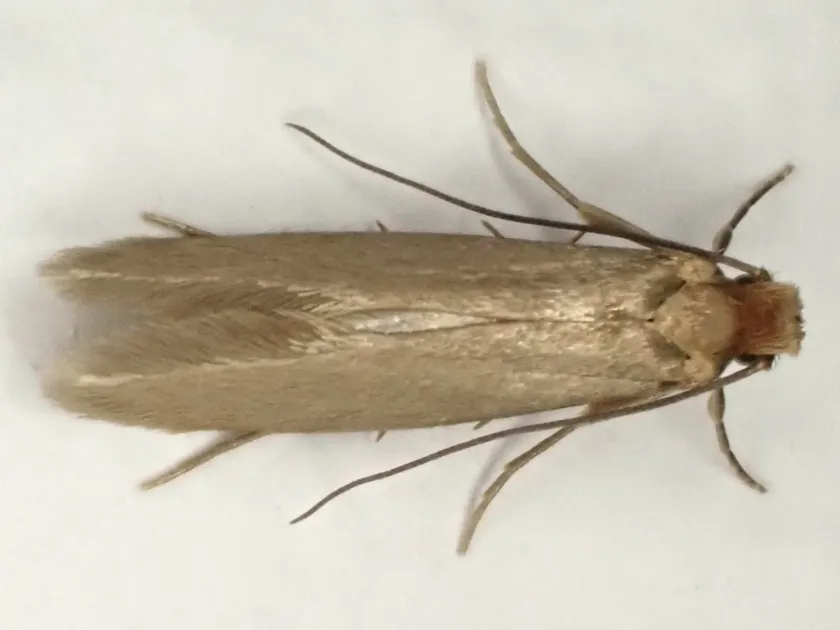
The webbing clothes moth (Tineola bisselliella) is a small moth belonging to the Tineidae family. The adult moth has a wingspan of approximately 12–15 mm and features a pale, golden-buff coloration, lacking any prominent markings on its wings.
Unlike many other insects, these moths avoid light and prefer dark, undisturbed areas such as closets, chests, and warehouses. Adult moths do not feed, as they lack functional mouthparts, and their primary focus is reproduction.
The damaging stage is the larval phase. The larvae are small, cream-colored caterpillars with a dark head. They are responsible for all the structural damage to fabrics and animal-based materials.
The life cycle of the webbing clothes moth is highly dependent on ambient conditions. In warm, indoor environments, they can complete their life cycle in as little as two months, facilitating rapid population growth throughout the year.
Females lay hundreds of eggs during their short lifespan, typically depositing them in crevices or directly on the surface of fibers, which ensures the emerging larvae have an immediate food source.
What it damages
Larvae feed exclusively on materials containing keratin, a structural protein found in wool, hair, fur, feathers, and silk. They are capable of breaking down these complex proteins, which most other household insects cannot digest.
They create characteristic irregular holes in textiles, often following the weave of the fabric. In addition to consuming the fibers, they spin silk webbing across the surface, which ruins the appearance and integrity of the item.
When food sources are scarce, larvae may infest blended fabrics. While they cannot digest synthetic fibers, they will eat through them to access natural fibers or to consume food stains, perspiration, and skin cells trapped in the weave.
This pest is a significant threat in textile manufacturing plants, clothing stores, and museums, where historical wool or silk artifacts are at high risk of total destruction if left unchecked.
Damage is often cumulative, starting with minor frayed patches and progressing to extensive loss of surface pile or complete structural collapse of garments and rugs.
Signs of infestation
The presence of adult moths fluttering near closets is the most common indicator of an active infestation. These moths typically run or hop rather than fly when disturbed.
Damage signs include small, clean holes in clothing, often located in hidden areas such as armpits, collars, or under cuffs. You may also see patches of thinned or missing fur on leather and fur garments.
Webbing and silken tunnels are hallmark signs of a webbing clothes moth infestation. These structures are often mixed with small amounts of fecal pellets, which look like tiny grains of sand.
Empty pupal cases or discarded larval skins on the surface of fabrics are clear evidence that a new generation of moths has successfully completed development.
A musty odor in a storage area is another common warning sign, often suggesting that an infestation has been present for a significant period of time.
Control measures
The first step in controlling an infestation is deep cleaning. Vacuuming floors, baseboards, and shelves removes eggs and larvae, while washing clothes at high temperatures kills all life stages.
Extreme temperatures are highly effective. Placing infested items in a freezer at -10°C for at least 48 hours is a safe and chemical-free method to eradicate the moths without damaging delicate textiles.
Chemical control involving residual insecticides may be necessary for large-scale infestations in closets or storage rooms. Always ensure that products are safe for the specific type of fabric being treated.
- Use airtight containers for long-term storage of wool and fur;
- Deploy pheromone traps to monitor adult male activity and suppress mating;
- Regularly brush and sun-dry stored items to discourage oviposition;
- Incorporate natural repellents like cedar or lavender;
- Ensure all items are thoroughly cleaned before being put away for the season.
Professional pest control may be required for severe infestations, especially when valuable collections or large quantities of inventory are affected, to ensure complete elimination of the pest.
Taxonomy
- Latin name
- Tineola bisselliella
- Order
- Lepidoptera (butterflies)
- Family
- Tineidae
- EPPO code
- TINOBI
Discussion
No discussions yet — be the first.