
Case-bearing clothes moth
Tinea pellionella
Description
How to identify
The case-bearing clothes moth (Tinea pellionella) is a small moth belonging to the Tineidae family. Adult moths have a wingspan of approximately 10–15 mm and possess grayish-yellow forewings with indistinct dark spots, allowing them to blend into fabric surfaces.
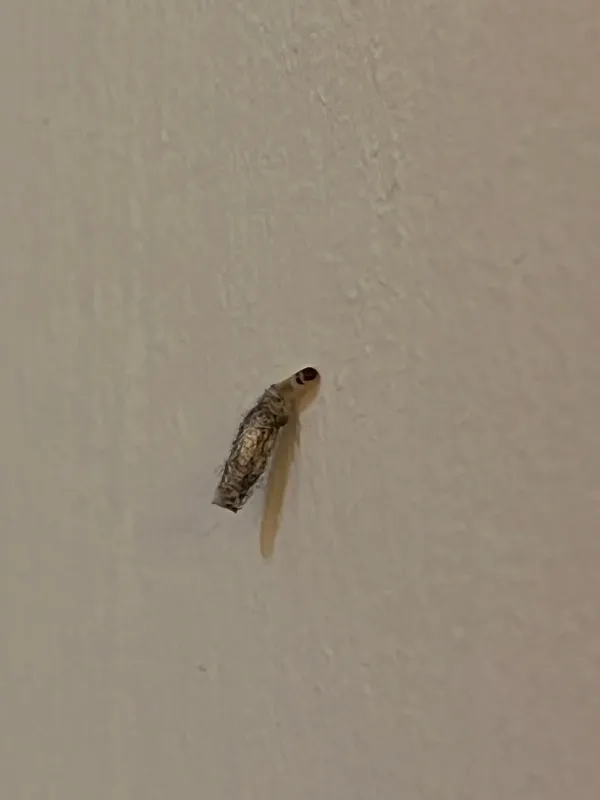
The larvae are whitish caterpillars with dark brown heads. A key identification feature is the portable case they build from silk and fiber fragments, which the larva carries around throughout its entire development period.
These moths are highly adapted to indoor environments. They are nocturnal and photophobic, meaning they prefer dark, undisturbed areas such as closets, chests, or storage boxes where they can remain concealed.
The life cycle involves complete metamorphosis, consisting of egg, larva, pupa, and adult stages. The larval stage is the most significant phase, as it is solely responsible for the feeding damage that destroys household textiles.
While originally associated with bird nests in nature, they have become a major indoor pest, thriving year-round in controlled indoor temperatures where food sources remain readily available.
What it damages
Unlike agricultural pests, the case-bearing clothes moth is strictly a domestic pest. It does not damage plants, but instead focuses exclusively on keratin-rich materials derived from animals.
The primary diet of the larvae includes natural fur, wool fabrics, felt, feathers, and hair. Larvae produce enzymes capable of breaking down keratin, allowing them to digest materials that are generally resistant to other pests.
Feeding damage presents as irregular holes and patches where the nap of the fabric or fur has been consumed. Such damage is often irreversible and ruins the aesthetic and functional value of luxury garments or upholstery.
Beyond actual consumption, larvae contaminate textiles with feces and the accumulation of their discarded cases. This organic debris can attract other secondary pests and support the growth of mold in humid conditions.
The economic impact is particularly high for museums and private collections, where historical costumes, taxidermy, and wool-based artifacts require constant monitoring to prevent total destruction by moth infestations.
When it appears
In temperature-controlled buildings, the development of the case-bearing clothes moth is continuous, with generations overlapping throughout the year. The rate of development is directly proportional to the ambient temperature.
Adult moth activity typically peaks during warmer months when indoor conditions facilitate faster pupal development and emergence. However, central heating allows the pest to remain active throughout the winter in most residential settings.
High humidity combined with moderate heat creates the most favorable environment for population growth. Conversely, low humidity and regular airflow significantly reduce the survival rate of newly hatched larvae.
During colder months, metabolic processes may slow down, leading to a state of diapause, but the population rarely dies off entirely unless extreme conditions are applied to the storage environment.
The presence of flying adults is an immediate indicator of a localized infestation. Seeing moths indicates that larvae are actively feeding nearby, necessitating a thorough inspection of stored natural fiber items.
Signs of infestation
The most common sign of an infestation is observing adult moths fluttering in dark areas. They are weak fliers and typically attempt to scuttle away into shadows when disturbed.
Small, mobile cases found on fabrics are the most reliable indicator of larvae. These cases are often colored to match the host fabric, making them difficult to spot without careful, close-up inspection.
Damage appears as bare spots or holes in the textile. These are most frequently found in hidden areas such as under collars, inside pockets, or along the folds of garments where the moth feels secure.
Thin, silken webbing often marks the paths taken by larvae across the surface of a garment. This web is sticky and collects debris, which is another telltale sign of moth presence.
Accumulated frass (larval excrement) resembling small, dark sand granules is often found underneath damaged items, indicating an active feeding colony is present in the immediate vicinity.
Control measures
Effective control of the case-bearing clothes moth requires an integrated approach that focuses on prevention, physical removal, and judicious use of insecticides.
- Routine shaking, brushing, and sun-drying of wool and fur items to physically remove larvae and eggs.
- Thorough vacuuming of closet floors, shelves, and baseboards to eliminate fiber buildup and pest colonies.
- Use of natural repellents like cedar or lavender sachets to discourage adult moths from laying eggs in storage areas.
- Application of approved insecticide sprays or vapor strips in enclosed storage spaces according to label instructions.
- Thermal treatments, such as freezing items for 72 hours or heating them to 60°C, to ensure the total eradication of all insect life stages.
Taxonomy
- Latin name
- Tinea pellionella
- Order
- Lepidoptera (butterflies)
- Family
- Tineidae
- EPPO code
- TINEPE
Discussion
No discussions yet — be the first.